

- Different Methodologies in Project Management
- Difference between Soap and Rest | Know more about it
- What is Python array? Learn with examples
- Best Career options after Engineering | Everything You Need to Know [OverView]
- What is list in Python ? All you need to know [ OverView ]
- What is Data Modelling? : All you need to know [ OverView ]
- What are Microservices? : A Complete Guide For Beginners with Best Practices
- What is Python Programming | A Definitive Guide with Best Practices
- All You Need To Know About Python List | A Complete Guide For Beginners with Best Practices
- What Is a Software Developer | Software Developer job description and duties | Everything You Need to Know
- What is Artificial Intelligence Chatbot?
- Kotlin vs Java | Know Their Differences and Which Should You Learn?
- What is Abstraction in Java | Implementations of Abstraction in Java | A Definitive Guide with Best Practices
- What are the Important Data Structures and Algorithms in Python?
- Go vs Python | Know Their Differences and Which Should You Learn?
- Best Python IDEs and Code Editors | Expert’s Top Picks | Everything You Need to Know
- Go Programming Language | Expert’s Top Picks | A Definitive Guide [ OverView ]
- Python Scopes and Their Built-in Functions | Everything You Need to Know | Expert’s Top Picks
- Python String Formatting | A Complete Guide For Beginners [ OverView ]
- Python Serialization | A Complete Guide For Beginners | Learning Guide
- What is .Net FrameWork? Uses and its Benefits | Everything You Need to Know
- What is Quality Assurance ? : A Definitive Guide | Everything You Need to Know [ OverView ]
- What is Spike Testing ? : A Definitive Guide | Expert’s Top Picks | Free Guide Tutorial
- Average Full Stack Developer Salary in India [ For Freshers and Experience ]
- What is WSDL in Web Services ? Expert’s Top Picks | Free Guide Tutorial
- Virtual Instrumentation using Labview | Comprehensive Guide [ Explained ]
- Gradle vs Maven | Know Their Differences and Which Should You Learn?
- Python Sleep Method | Free Guide Tutorial & REAL-TIME Examples
- Kotlin vs Python | A Complete Guide with Best Practices
- Spring Boot vs Spring MVC | Differences and Which Should You Learn?
- IT Engineer Salary in India – How much does one earn?
- What is pip ? and Getting Started with Python pip | All you need to know [ OverView ]
- Node.js Installation on Windows and Ubuntu | Free Guide Tutorial
- Skills Needed for Full Stack Developers | All you need to know [ OverView ]
- What is Axios in React? and Its Uses [ OverView ]
- What is MEAN Stack? All you need to know [ OverView ]
- How to Install Node.JS on Ubuntu | Everything You Need to Know
- Average Annual Salary of a Python Certified Professional – Career Path
- What is Scala Programming? A Complete Guide with Best Practices
- What Is User Input in Python? Expert’s Top Picks
- Interface vs Abstract Class | Difference You Should Know
- Final Year Computer Science Project Ideas | All you need to know [ OverView ]
- Technical Architect | Free Guide Tutorial & REAL-TIME Examples
- Logical Programs in Java | Step-By-Step Process
- C++ vs Java | Difference You Should Know
- What is C Programming? Comprehensive Guide
- What Is a Quality Engineer? ( Everything You Need to Know )
- Python Project Ideas for Beginners | All you need to know
- How to Run Python Scripts? Comprehensive Guide
- Python Operators
- How To Install NumPy in Python?
- Top Software Courses to Get High Paying Jobs
- Loops In Python
- Tips to Avoid Application Rejection
- Top Young App Developers Who Became Millionaires
- Top Technical Courses After Graduation
- Node JS Architecture
- What is PyCharm?
- Resources To Help You Learn Java Programming
- How to Become a Software Engineer?
- Best Programming Languages to Learn in 2020
- Scala vs Python
- How to Become a Full Stack Developer?
- The Most Popular Java Applications Used World-wide
- What is Java String?
- Full Stack Developer vs Front End Developer vs Back End Developer
- Python Collections
- Identifiers in Python
- Dynamic Method Dispatch in Java
- Hadoop Ecosystem
- Method Overloading in Python
- Convert Decimal To Binary In Python
- How To Make A Chatbot In Python?
- How to Input a List in Python?
- Hash Tables and Hashmaps in Python
- Top Python Framework’s
- Python Split Method with Example
- Python Enumerate
- Inheritance in Java
- Init in Python
- Goto Statement in Python
- Literals in Java
- Polymorphism in Oops
- Socket Programming in Python
- Object Class in Java
- Break, Continue, and Pass Statements in Python
- Exception Handling in Java
- Java BASIC Programs
- Different Methodologies in Project Management
- Difference between Soap and Rest | Know more about it
- What is Python array? Learn with examples
- Best Career options after Engineering | Everything You Need to Know [OverView]
- What is list in Python ? All you need to know [ OverView ]
- What is Data Modelling? : All you need to know [ OverView ]
- What are Microservices? : A Complete Guide For Beginners with Best Practices
- What is Python Programming | A Definitive Guide with Best Practices
- All You Need To Know About Python List | A Complete Guide For Beginners with Best Practices
- What Is a Software Developer | Software Developer job description and duties | Everything You Need to Know
- What is Artificial Intelligence Chatbot?
- Kotlin vs Java | Know Their Differences and Which Should You Learn?
- What is Abstraction in Java | Implementations of Abstraction in Java | A Definitive Guide with Best Practices
- What are the Important Data Structures and Algorithms in Python?
- Go vs Python | Know Their Differences and Which Should You Learn?
- Best Python IDEs and Code Editors | Expert’s Top Picks | Everything You Need to Know
- Go Programming Language | Expert’s Top Picks | A Definitive Guide [ OverView ]
- Python Scopes and Their Built-in Functions | Everything You Need to Know | Expert’s Top Picks
- Python String Formatting | A Complete Guide For Beginners [ OverView ]
- Python Serialization | A Complete Guide For Beginners | Learning Guide
- What is .Net FrameWork? Uses and its Benefits | Everything You Need to Know
- What is Quality Assurance ? : A Definitive Guide | Everything You Need to Know [ OverView ]
- What is Spike Testing ? : A Definitive Guide | Expert’s Top Picks | Free Guide Tutorial
- Average Full Stack Developer Salary in India [ For Freshers and Experience ]
- What is WSDL in Web Services ? Expert’s Top Picks | Free Guide Tutorial
- Virtual Instrumentation using Labview | Comprehensive Guide [ Explained ]
- Gradle vs Maven | Know Their Differences and Which Should You Learn?
- Python Sleep Method | Free Guide Tutorial & REAL-TIME Examples
- Kotlin vs Python | A Complete Guide with Best Practices
- Spring Boot vs Spring MVC | Differences and Which Should You Learn?
- IT Engineer Salary in India – How much does one earn?
- What is pip ? and Getting Started with Python pip | All you need to know [ OverView ]
- Node.js Installation on Windows and Ubuntu | Free Guide Tutorial
- Skills Needed for Full Stack Developers | All you need to know [ OverView ]
- What is Axios in React? and Its Uses [ OverView ]
- What is MEAN Stack? All you need to know [ OverView ]
- How to Install Node.JS on Ubuntu | Everything You Need to Know
- Average Annual Salary of a Python Certified Professional – Career Path
- What is Scala Programming? A Complete Guide with Best Practices
- What Is User Input in Python? Expert’s Top Picks
- Interface vs Abstract Class | Difference You Should Know
- Final Year Computer Science Project Ideas | All you need to know [ OverView ]
- Technical Architect | Free Guide Tutorial & REAL-TIME Examples
- Logical Programs in Java | Step-By-Step Process
- C++ vs Java | Difference You Should Know
- What is C Programming? Comprehensive Guide
- What Is a Quality Engineer? ( Everything You Need to Know )
- Python Project Ideas for Beginners | All you need to know
- How to Run Python Scripts? Comprehensive Guide
- Python Operators
- How To Install NumPy in Python?
- Top Software Courses to Get High Paying Jobs
- Loops In Python
- Tips to Avoid Application Rejection
- Top Young App Developers Who Became Millionaires
- Top Technical Courses After Graduation
- Node JS Architecture
- What is PyCharm?
- Resources To Help You Learn Java Programming
- How to Become a Software Engineer?
- Best Programming Languages to Learn in 2020
- Scala vs Python
- How to Become a Full Stack Developer?
- The Most Popular Java Applications Used World-wide
- What is Java String?
- Full Stack Developer vs Front End Developer vs Back End Developer
- Python Collections
- Identifiers in Python
- Dynamic Method Dispatch in Java
- Hadoop Ecosystem
- Method Overloading in Python
- Convert Decimal To Binary In Python
- How To Make A Chatbot In Python?
- How to Input a List in Python?
- Hash Tables and Hashmaps in Python
- Top Python Framework’s
- Python Split Method with Example
- Python Enumerate
- Inheritance in Java
- Init in Python
- Goto Statement in Python
- Literals in Java
- Polymorphism in Oops
- Socket Programming in Python
- Object Class in Java
- Break, Continue, and Pass Statements in Python
- Exception Handling in Java
- Java BASIC Programs

Identifiers in Python
Last updated on 25th Sep 2020, Artciles, Blog, Software Engineering
 (5.0) | 16387 Ratings 2198
 Today we will learn about Python keywords and identifiers. Earlier we learned how to install python and get started with it in a python articlesl for beginners
Python Keywords
Well simply, python keywords are the words that are reserved. That means you can’t use them as names of any entities like variables, classes and functions.
So you might be thinking what are these keywords for. They are for defining the syntax and structures of Python language.
You should know there are 33 keywords in Python programming language as of writing this tutorial. Although the number can vary in course of time. Also keywords in Python are case sensitive. So they are to be written as it is. Here is a list of all keywords in python programming.
Subscribe For Free Demo
Error: Contact form not found.
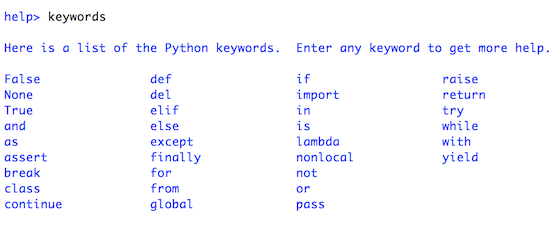
If you look at all the keywords and try to figure out all at once, you will be overwhelmed. So for now just know these are the keywords. We will learn their uses respectively. You can get the list of python keywords through python shell help.
>>> help() Welcome to Python 3.6’s help utility! help> keywords Here is a list of the Python keywords. Enter any keyword to get more help. False def if raise None del import return True elif in try and else is while as except lambda with assert finally nonlocal yield break for not class from or continue global pass help>
Below is a simple example showing usage of if-else in python programs.
- var = 1; if(var==1): print(“odd”) else: print(“even”)
When we run the above program, python understands the if-else block because of fixed keywords and syntax and then does the further processing.
Python Identifiers
Python Identifier is the name we give to identify a variable, function, class, module or other object. That means whenever we want to give an entity a name, that’s called identifier.
Sometimes variables and identifiers are often misunderstood as the same but they are not. Well for clarity, let’s see what is a variable?
Variable in Python
A variable, as the name indicates, is something whose value is changeable over time. In fact a variable is a memory location where a value can be stored. Later we can retrieve the value to use. But for doing it we need to give a nickname to that memory location so that we can refer to it. That’s the identifier, the nickname.
Rules for writing Identifiers
There are some rules for writing Identifiers. But first you must know Python is case sensitive. That means Name and name are two different identifiers in Python. Here are some rules for writing Identifiers in python.
- 1. Identifiers can be a combination of uppercase and lowercase letters, digits or an underscore(_). So myVariable, variable_1, variable_for_print all are valid python identifiers.
- 2. An Identifier can not start with a digit. So while variable1 is valid, 1variable is not valid.
- 3. We can’t use special symbols like !,#,@,%,$ etc in our Identifier.
- 4. Identifiers can be of any length.
Though these are hard rules for writing identifiers, also there are some naming conventions which are not mandatory but rather good practices to follow.
- 1. Class names start with an uppercase letter. All other identifiers start with a lowercase letter.
- 2. Starting an identifier with a single leading underscore indicates the identifier is private.
- 3. If the identifier starts and ends with two underscores, then means the identifier is a language-defined special name.
- 4. While c = 10 is valid, writing count = 10 would make more sense and it would be easier to figure out what it does even when you look at your code after a long time.
- 5. Multiple words can be separated using an underscore, for example this_is_a_variable.
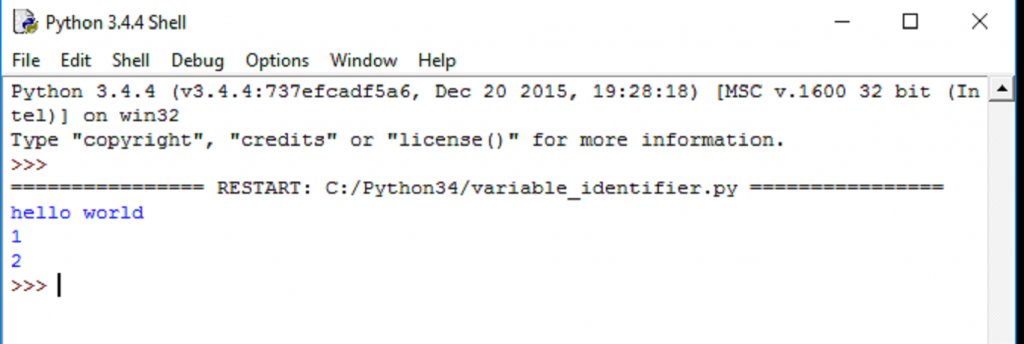
Here’s a sample program for python variables.
- myVariable=”hello world” print(myVariable) var1=1 print(var1) var2=2 print(var2)
If you run the program, the output will be like the image below.
Python Keywords
Keywords are the reserved words in Python.
We cannot use a keyword as a variable name, function name or any other identifier. They are used to define the syntax and structure of the Python language.
In Python, keywords are case sensitive.
There are 33 keywords in Python 3.7. This number can vary slightly over the course of time.
All the keywords except True, False and None are in lowercase and they must be written as they are. The list of all the keywords is given below.
| False | await | else | import | pass |
| None | break | except | in | raise |
| True | class | finally | is | return |
| and | continue | for | lambda | try |
| as | def | from | nonlocal | while |
| assert | del | global | not | with |
| async | elif | if | or | yield |
Looking at all the keywords at once and trying to figure out what they mean might be overwhelming.
If you want to have an overview, here is the complete list of all the keywords with examples.
Python Identifiers
An identifier is a name given to entities like class, functions, variables, etc. It helps to differentiate one entity from another.
Rules for writing identifiers
- 1. Identifiers can be a combination of letters in lowercase (a to z) or uppercase (A to Z) or digits (0 to
Pega Sample Resumes! Download & Edit, Get Noticed by Top Employers!Download
- 9) or an underscore _. Names like myClass, var_1 and print_this_to_screen, all are valid examples.
- 2. An identifier cannot start with a digit. 1variable is invalid, but variable1 is a valid name.
Keywords cannot be used as identifiers.
global = 1
Output
File “<interactive input>”, line 1
global = 1
^
- SyntaxError: invalid syntax
We cannot use special symbols like !, @, #, $, % etc. in our identifier.
a@ = 0
Output
File “<interactive input>”, line 1
a@ = 0
^
- SyntaxError: invalid syntax
- An identifier can be of any length.
Things to Remember
Python is a case-sensitive language. This means, Variable and variable are not the same.
Always give the identifiers a name that makes sense. While c = 10 is a valid name, writing count = 10 would make more sense, and it would be easier to figure out what it represents when you look at your code after a long gap.
Multiple words can be separated using an underscore, like this_is_a_long_variable.

