Home » Others Courses » Other Courses Online » Full Stack Developer Training in Trivandrum

Full Stack Developer Training in Trivandrum

(4.6) 18452 Ratings
  • Join Full Stack Developer Course in Trivandrum to master front-end and back-end development with web technologies.
  • Learn essential stacks including databases, APIs, server-side scripting, and responsive UI frameworks.
  • Gain hands-on exposure through real-time projects, coding labs, testing, and live deployment tasks.
  • Ideal for Full Stack Developers, Programmers, Graduates, and IT Professionals building web application careers.
  • Choose from flexible batch timings: Weekday, Weekend, or Fast-Track learning schedules.
  • Benefit from placement assistance, interview preparation, and certification guidance.

Course Duration

45+ Hrs

Live Project

3 Project

Certification Pass

Guaranteed

Training Format

Live Online (Expert Trainers)
Quality Training With Affordable Fee

⭐ Fees Starts From

INR 38,000
INR 18,500

11065+

Professionals Trained

9+

Batches every month

2658+

Placed Students

198+

Corporate Served

What You'll Learn

Full Stack Developer training in Trivandrum delivers deep practical understanding of how modern web applications are designed, built, secured, and scaled across real production environments.

Build strong foundations by learning the Full Stack Developer Course in Trivandrum fundamentals, covering front-end architecture, server logic, databases, and real-time application workflows.

Strengthen problem-solving ability by developing complete web solutions, integrating APIs, optimizing performance, and applying secure coding strategies in live scenarios.

Gain immersive hands-on experience through Full Stack Developer training in Trivandrum with guided labs, collaborative coding exercises, and industry-style project development.

Explore advanced course areas such as microservices design, cloud deployment pipelines, containerized applications, and automation-driven development workflows.

Earn career-focused expertise that prepares you for high-demand developer roles, helping you confidently transition into professional full stack engineering environments.

An Comprehensive Overview of Full Stack Developer Course

The Full Stack Developer Course in Trivandrum is designed to give learners complete, practical mastery over modern web development, covering front-end engineering, backend systems, and scalable application architecture. Through Full Stack Developer training in Trivandrum, students work on live coding projects, guided exercises, and mentor-led development sessions that mirror real company workflows. This Full Stack Developer training course supports flexible learning formats including classroom, live online, and fast-track options to match different schedules. Enrolling in the Full Stack Developer Certification Course in Trivandrum strengthens technical confidence, improves employability, and prepares learners for advanced roles in professional software development environments.

Additional Info

Future Trends for Full Stack Developer Training

  • AI-Assisted Development Workflows: Future Full Stack Developer training will deeply integrate AI-assisted coding tools into daily development practice. Learners will not just use AI to generate code, but to review architecture, predict bugs, and suggest optimizations. Training will emphasize how to collaborate with intelligent tools without losing core engineering judgment. Developers must learn when to trust automation and when to override it. This balance creates faster workflows while preserving code quality. AI becomes a productivity partner rather than a shortcut. Developers trained this way will adapt faster to evolving toolchains.
  • Serverless Application Architecture: Serverless computing is reshaping how modern applications are deployed and scaled. Full stack training will increasingly focus on event-driven architectures and managed cloud services. Learners will build applications that scale automatically without managing infrastructure. This changes how performance and cost efficiency are designed from the beginning. Developers must understand distributed behavior, not just code logic. Serverless thinking encourages lightweight, modular systems. Training will prepare engineers to build systems that grow without friction.
  • API-First Ecosystem Design: Future applications will be built around APIs as primary building blocks. Full stack programs will teach developers to design reusable, secure interfaces before writing front-end code. API-first thinking improves collaboration across teams and platforms. Training will highlight versioning strategies and long-term maintainability. Developers will learn to treat APIs as products, not internal utilities. This mindset increases application longevity. Strong API skills will define adaptable engineers.
  • Microservices and Modular Systems: Large monolithic systems are giving way to modular microservice ecosystems. Full stack training will emphasize designing independent services that communicate reliably. Developers must learn orchestration, fault tolerance, and service isolation. This architecture improves scalability and resilience. Training environments will simulate real distributed systems. Students will experience debugging across service boundaries. These skills reflect how modern enterprises build software.
  • Cloud-Native Development Culture: Cloud-native thinking will become a foundation of Full Stack Developer education. Training will focus on containerization, orchestration, and automated deployment pipelines. Developers will design applications that assume cloud environments from day one. This shifts responsibility from hardware to architecture. Learners will understand how infrastructure decisions affect code behavior. Cloud-native skills increase deployment confidence. Engineers trained this way will operate comfortably at scale.
  • Security-Integrated Development: Security will no longer be a final testing step but a constant development layer. Full stack training will embed secure coding habits into every module. Developers will learn to anticipate vulnerabilities during design. This reduces the cost of fixing issues later. Training will simulate real exploitation scenarios to reinforce awareness. Security becomes a development instinct rather than an afterthought. Engineers who code defensively protect users and organizations alike.
  • Real-Time Application Engineering: User expectations now demand instant feedback and live updates. Full stack education will expand into real-time architecture and streaming data systems. Developers will build applications that react dynamically instead of refreshing pages. Training will explore performance tuning for persistent connections. These systems require careful resource management. Real-time engineering changes how front-end and backend communicate. Mastery here enables richer digital experiences.
  • Cross-Platform Experience Design: Future developers must design for multiple devices simultaneously. Full stack training will emphasize shared logic across web, mobile, and desktop platforms. Learners will practice building unified user experiences. This reduces duplication and improves maintainability. Developers will understand responsive behavior at architectural levels. Cross-platform thinking expands career versatility. Engineers capable of multi-device delivery become highly valuable.
  • Automated Testing Ecosystems: Testing will evolve from isolated scripts into continuous ecosystems. Full stack programs will teach integrated testing pipelines that run alongside development. Developers will treat testing as part of design, not cleanup. Automated validation increases release confidence. Training will include failure simulation and resilience checks. This builds discipline around reliability. Strong testing culture produces durable software.
  • Human-Centered Performance Optimization: Performance will be measured by user perception, not just server metrics. Full stack training will teach developers to interpret real usage behavior. Optimization will focus on responsiveness and accessibility. Engineers will learn to balance speed with maintainability. Training will connect technical metrics to human experience. This approach prioritizes meaningful efficiency. Developers who understand performance emotionally build software people trust.

Tools and Technologies for Full Stack Developer Training

  • Visual Studio Code: Visual Studio Code is a central workspace in Full Stack Developer training because it supports rapid coding across multiple languages in one environment. Learners customize extensions to match real professional workflows. The editor teaches discipline in debugging and version tracking. Its integrated terminal encourages command-line familiarity. Students gradually build efficient development habits. VS Code becomes a daily engineering companion rather than just a text editor.
  • Git and GitHub: Git and GitHub form the backbone of collaborative software development. Training emphasizes version control as a thinking process, not just a tool. Learners practice tracking changes, resolving conflicts, and managing code history. This builds accountability in shared projects. Git workflows teach structured teamwork. Developers trained here understand how real teams ship software safely.
  • Node.js: Node.js introduces server-side JavaScript that powers modern web backends. Full stack learners use it to build scalable, event-driven applications. Training explores asynchronous programming and performance behavior. Students understand how backend logic interacts with front-end systems. Node encourages modular architecture. This foundation supports building high-traffic applications.
  • React: React is essential for building interactive user interfaces. Training focuses on component-driven design and state management. Learners create dynamic applications that respond instantly to user input. React teaches clean separation of logic and presentation. Students gain confidence building reusable UI structures. This improves both speed and maintainability.
  • MongoDB: MongoDB exposes learners to document-based data storage models. Training highlights flexible schema design and scalable database thinking. Students understand how modern apps manage unstructured data. MongoDB encourages rapid prototyping. Developers learn to design data around real usage patterns. This prepares them for cloud-scale systems.
  • Docker: Docker transforms how applications are packaged and deployed. Full stack training teaches containerization for consistent environments. Learners eliminate the classic “works on my machine” problem. Docker introduces infrastructure awareness without complexity. Students build portable development workflows. This bridges development and deployment skills.
  • Express.js: Express.js simplifies backend API creation in Node environments. Training emphasizes lightweight server architecture. Learners design RESTful services that scale cleanly. Express encourages organized routing and middleware usage. Students build maintainable server logic. This tool anchors backend development confidence.
  • PostgreSQL: PostgreSQL introduces structured relational database management. Training covers advanced querying and data integrity principles. Learners understand transaction behavior and indexing. PostgreSQL reinforces disciplined schema planning. Students gain respect for data consistency. This knowledge strengthens enterprise application design.
  • Webpack: Webpack teaches learners how modern applications bundle and optimize assets. Training explores performance tuning and build pipelines. Students see how raw code becomes production-ready output. Webpack introduces automation thinking. Developers understand dependency management deeply. This improves deployment reliability.
  • Kubernetes: Kubernetes exposes learners to orchestration at scale. Full stack training uses it to demonstrate distributed deployment management. Students learn how applications survive failures and scale dynamically. Kubernetes connects development with real infrastructure realities. It teaches resilience planning. Developers trained in orchestration think beyond single servers.

Roles and Responsibilities for Full Stack Developer Training

  • Full Stack Developer Engineer: A Full Stack Developer Engineer is responsible for building complete applications from user interface to backend logic. Training prepares learners to connect databases, APIs, and front-end frameworks into one seamless system. Engineers must understand how each layer affects performance and usability. They debug across the entire stack rather than in isolated sections. This role demands structured thinking and clean coding habits. A strong engineer turns complex requirements into reliable software.
  • Application Development Analyst: An Application Development Analyst studies system requirements and translates them into workable code solutions. Training sharpens the ability to evaluate architecture choices before implementation. Analysts focus on efficiency, maintainability, and long-term scalability. They collaborate with teams to refine technical direction. Their responsibility includes identifying risks early in development. This role bridges planning and execution.
  • Software Integration Consultant: A Software Integration Consultant ensures different services communicate correctly within an application ecosystem. Training teaches learners to handle APIs, middleware, and data synchronization. Consultants diagnose compatibility issues between platforms. Their work prevents system fragmentation. They design smooth data flow between components. This role is critical in multi-service environments.
  • Web Systems Architect: A Web Systems Architect designs the structural blueprint of full stack applications. Training emphasizes architecture patterns and system reliability. Architects evaluate scalability before development begins. They guide teams toward stable technical foundations. Their responsibility includes preventing design bottlenecks. Strong architecture reduces future technical debt.
  • Backend Development Specialist: A Backend Development Specialist focuses on server logic and data processing. Training builds expertise in handling authentication, performance, and storage. Specialists optimize how applications handle large workloads. They protect system integrity under stress. Their role ensures reliable data flow. Backend stability defines user trust.
  • Frontend Experience Developer: A Frontend Experience Developer crafts responsive and intuitive interfaces. Training strengthens understanding of usability and interaction design. Developers transform complex functionality into simple user journeys. They ensure consistency across devices. Their responsibility includes performance optimization on the client side. Good frontend work shapes user perception.
  • DevOps Collaboration Engineer: A DevOps Collaboration Engineer connects development with deployment environments. Training introduces automation pipelines and container workflows. Engineers ensure applications move smoothly from code to production. They reduce deployment friction and downtime. Their work improves release confidence. This role aligns technical teams.
  • Quality Assurance Developer: A Quality Assurance Developer embeds testing into the development lifecycle. Training teaches automated validation and failure detection. Developers simulate edge cases before users encounter them. Their responsibility is protecting software reliability. They reduce post-release defects. Quality assurance strengthens reputation.
  • Cloud Application Developer: A Cloud Application Developer builds systems designed for distributed infrastructure. Training emphasizes scalable deployment strategies. Developers understand how code behaves in cloud environments. They design for resilience and elasticity. Their work supports global accessibility. Cloud fluency expands engineering reach.
  • Technical Project Developer: A Technical Project Developer coordinates implementation while staying hands-on with code. Training prepares learners to balance deadlines with technical accuracy. Developers translate business goals into structured milestones. They maintain communication across teams. Their responsibility includes guiding execution quality. This role blends leadership with engineering discipline.

Companies Hiring Full Stack Developer Professionals

  • Google: Google continuously seeks Full Stack Developer professionals who can build scalable products used by millions of people daily. Engineers work across distributed systems, user-facing platforms, and cloud-native applications. The company values developers who understand both performance and usability. Full stack talent contributes to rapid product experimentation and global deployment. Developers here are expected to learn fast and adapt to evolving frameworks. The environment rewards innovation grounded in strong engineering fundamentals.
  • Amazon: Amazon hires full stack developers to support high-traffic e-commerce and cloud platforms. Engineers design services that must operate reliably under massive load. The role demands clean architecture and automation awareness. Developers collaborate across global teams to deliver customer-focused features. Security and performance are treated as core responsibilities. This workplace exposes professionals to real-world scale challenges.
  • Microsoft: Microsoft invests heavily in full stack engineering for enterprise and consumer software. Developers build integrated solutions spanning web, cloud, and desktop ecosystems. The company emphasizes maintainable architecture and cross-platform compatibility. Full stack professionals work on products used by businesses worldwide. Collaboration between engineering teams is central to development culture. This environment strengthens long-term technical depth.
  • Infosys: Infosys recruits full stack developers for digital transformation projects across industries. Engineers modernize legacy systems and build new cloud-ready platforms. The company values structured coding discipline and enterprise reliability. Developers gain exposure to large organizational ecosystems. Projects often involve international clients. This provides broad professional experience early in a career.
  • Tata Consultancy Services (TCS): TCS employs full stack professionals to deliver end-to-end software solutions for global enterprises. Developers handle both client-facing interfaces and backend integration. The work environment emphasizes process-driven development. Engineers learn to build scalable applications for diverse industries. TCS encourages continuous skill development. This creates steady career progression.
  • Accenture: Accenture seeks full stack developers who can combine technical skill with consulting awareness. Engineers work on digital platforms that support business innovation. The role requires adaptability across industries and technologies. Developers participate in large modernization initiatives. Collaboration with cross-functional teams is constant. This builds both technical and communication strength.
  • Wipro: Wipro hires full stack developers to support enterprise application ecosystems. Engineers contribute to modernization of IT infrastructure. The company emphasizes secure and efficient coding. Developers work closely with cloud and DevOps teams. Projects often involve mission-critical systems. This environment strengthens engineering discipline.
  • IBM: IBM values full stack developers who understand enterprise architecture and cloud integration. Engineers design systems that support large organizations. The company blends research-driven innovation with practical delivery. Developers participate in advanced technology initiatives. Collaboration spans global technical communities. This fosters continuous learning.
  • Capgemini: Capgemini recruits full stack professionals for digital engineering services worldwide. Developers build applications that integrate modern frameworks with enterprise platforms. The company emphasizes reliability and maintainability. Engineers gain exposure to multinational project environments. Structured teamwork defines daily operations. This helps developers mature quickly.
  • Cognizant: Cognizant hires full stack developers to accelerate product and platform development. Engineers work in agile environments focused on rapid delivery. The company values practical problem-solving and clean code design. Developers collaborate with clients to refine technical solutions. Exposure to varied industries broadens expertise. This creates strong real-world adaptability.
View more

Full Stack Developer Course Objectives

A basic comfort with computers, internet usage, and logical thinking is usually enough to begin Full Stack Developer training. Familiarity with any programming language is helpful but not mandatory. Learners who understand how websites function at a surface level tend to adapt faster. The course is structured to guide beginners step by step into real coding environments.
This course transforms you from a passive technology user into someone who can build complete web applications independently. You gain the ability to design interfaces, write server logic, and manage data systems confidently. The training strengthens problem-solving and structured thinking. It also improves your ability to work in collaborative software teams. Most learners leave with a portfolio that demonstrates real capability. These benefits directly increase employability in modern tech roles.
Full stack development is one of the most valued skills because companies prefer professionals who understand entire systems instead of isolated parts. Businesses want developers who can move between front-end and backend tasks without friction. This versatility reduces hiring complexity and accelerates product delivery. As organizations digitize services, demand continues to rise. Full stack developers are often central to product teams. Their adaptability makes them critical assets in fast-changing markets.
Yes, practical projects are a core element of the training experience. Students build applications that simulate real client requirements. These projects involve planning, coding, testing, and deployment. Working on realistic scenarios builds confidence and workflow discipline. Learners experience how professional development cycles operate. This exposure prepares them for industry expectations.
  • Continuous global demand for web application engineers
  • Growth of remote software development opportunities
  • Expansion of cloud-based application platforms
  • Startup ecosystem reliance on full stack talent
  • Front-end development fundamentals
  • Backend server programming
  • Database design and management
  • API creation and integration
  • Responsive user interface design
  • Software and IT services
  • E-commerce platforms
  • Financial technology companies
  • Healthcare technology providers
  • Education technology firms
Full Stack Developer Course provides strong practical skills dramatically improve your chances. Employers hire developers who can demonstrate working applications. This course equips you with a portfolio that proves ability. Job success depends on continued learning and active job search effort. The training opens doors, but persistence walks you through them. Consistent practice remains the deciding factor.
  • Ability to build complete web applications
  • Strong understanding of modern software workflows
  • Increased job opportunities in tech roles
  • Portfolio showcasing practical projects
Participants gain hands-on experience with essential development tools such as Visual Studio Code, Git, GitHub, Node.js, React, database systems, Docker, and modern debugging utilities. The training focuses on how these tools work together in real production workflows rather than isolated practice. Learners understand when and why each tool is used. This integrated exposure builds professional readiness. Tool familiarity becomes second nature through repeated application.
view More view Less

Full Stack Developer Course Benefits

The Full Stack Developer course in Trivandrum places learners inside real coding environments where they practice deployment workflows, automation, and modern build pipelines. Students gain industry-style exposure through a guided Full Stack Developer internship that sharpens problem-solving in live project settings. Training covers container-based development, cloud-ready architecture, and continuous delivery under expert mentorship. Graduates move forward through a Full Stack Developer course with placement pathway that connects practical skills directly to hiring opportunities in growing tech companies.

  • Designation
  • Annual Salary
    Hiring Companies
  • 4.64L
    Min
  • 8.59L
    Average
  • 14.25L
    Max
  • 4.50L
    Min
  • 9.25L
    Average
  • 16.5L
    Max
  • 4.70L
    Min
  • 9.45L
    Average
  • 13.5L
    Max
  • 4.74L
    Min
  • 8.95L
    Average
  • 12.5L
    Max

About Full Stack Developer Certification Training

The Full Stack Developer certification course in Trivandrum builds strong technical depth in designing, coding, and deploying scalable web applications across modern platforms. Learners work on guided Full Stack Developer projects that mirror real production environments, helping them understand architecture, debugging, and performance tuning. The program blends frontend creativity with backend logic so students can confidently build complete digital solutions. Dedicated career support and portfolio-driven training prepare participants to enter the job market with proven, hands-on capability.

Top Skills You Will Gain
  • Frontend Development
  • Backend Programming
  • Database Design
  • API Integration
  • Version Control
  • Cloud Deployment
  • UI Engineering
  • Server Handling

12+ Full Stack Developer Tools

Online Classroom Batches Preferred

Weekdays (Mon - Fri)
04 - May - 2026
08:00 AM (IST)
Weekdays (Mon - Fri)
06 - May - 2026
08:00 AM (IST)
Weekend (Sat)
09 - May - 2026
11:00 AM (IST)
Weekend (Sun)
10 - May - 2026
11:00 AM (IST)
Can't find a batch you were looking for?
₹38,000 ₹18,500 10% OFF Expires in

No Interest Financing start at ₹ 5000 / month

Corporate Training

  • Customized Learning
  • Enterprise Grade Learning Management System (LMS)
  • 24x7 Support
  • Enterprise Grade Reporting

Not Just Studying
We’re Doing Much More!

Empowering Learning Through Real Experiences and Innovation
Hiring
Hiring
Hiring
Hiring
Hiring
Hiring
Hiring
User
User
User
User
User
User

Full Stack Developer Course Curriculum

Trainers Profile

The Full Stack Developer course in Trivandrum is guided by senior engineers who bring deep hands-on exposure to modern web ecosystems and production-grade application building. Learners use structured Full Stack Developer training materials that simplify complex coding concepts and translate them into practical development workflows. Every session is built around real coding tasks so students steadily gain confidence in designing, integrating, and deploying full-scale applications. The training shapes job-ready developers who can independently build responsive platforms, debug live systems, and adapt to evolving tech stacks.

Syllabus for Full Stack Developer Course Download syllabus

  • HTML structure
  • CSS styling
  • Responsive layouts
  • Browser behavior
  • Developer tools
  • Accessibility basics
  • Syntax fundamentals
  • Data structures
  • Functions and scope
  • DOM interaction
  • Event handling
  • Error handling
  • ES6 features
  • Async programming
  • Promises
  • Fetch API
  • Closures
  • Modules
  • Component structure
  • Routing concepts
  • State handling
  • Hooks usage
  • UI rendering
  • Form handling
  • Server setup
  • REST architecture
  • Request handling
  • Middleware logic
  • Authentication basics
  • Server routing
  • Database models
  • CRUD operations
  • Query building
  • Schema design
  • Data validation
  • Indexing
  • API structure
  • JSON handling
  • Authentication tokens
  • Error responses
  • Testing endpoints
  • API security
  • Repository setup
  • Branch workflows
  • Commit tracking
  • Merge handling
  • Conflict resolution
  • Remote syncing
  • Deployment pipelines
  • Environment setup
  • Build automation
  • Container intro
  • Hosting platforms
  • Monitoring tools
  • Unit testing
  • Integration testing
  • Debugging tools
  • Test automation
  • Performance checks
  • Logging
(15) view More view Less
Need customized curriculum?

REAL

start
STORIES SUCCESS INSPIRATION
CAREER
UPGRADE
sowmiya

sowmiya

CAREER
UPGRADE
Rajkumar

Rajkumar

CAREER
UPGRADE
Thon

Thon

CAREER
UPGRADE
lavanya

Lavanya

Industry Projects

Project 1
E-Commerce Web Platform

Build a scalable shopping application with user login, product catalog, payment simulation, and admin dashboard. The project focuses on secure data handling to simulate a live commercial website environment.

Project 2
Real-Time Task Tracker

Develop a browser-based productivity system where users create, update, and track tasks instantly. Includes authentication, database storage, live UI updates, and notification logic that demonstrates full application lifecycle development.

Project 3
Streaming Dashboard Application

Create an interactive dashboard that fetches and displays live data streams through APIs. The project emphasizes dynamic rendering, performance optimization, and server communication for handling continuous incoming data.

Our Hiring Partner

Exam & Full Stack Developer Certification

  • Basic understanding of HTML, CSS, and JavaScript
  • Familiarity with computer fundamentals
  • Interest in web application development
  • Logical thinking and problem-solving skills
  • Willingness to practice coding regularly
A Full Stack Developer certification proves that you can handle both frontend and backend responsibilities with confidence, making you a versatile asset to employers. It builds trust in your technical ability, strengthens your resume, and helps you stand out in competitive hiring processes. Certified professionals are often considered more job-ready because they demonstrate structured learning, practical exposure, and commitment to mastering modern development tools.
When paired with strong project work and consistent practice, a Full Stack Developer certification signals to recruiters that you possess validated technical capability. Employers value candidates who can contribute quickly, and certification helps position you as a prepared and dependable hire.
  • Full Stack Developer
  • Web Application Developer
  • Frontend Developer
  • Backend Developer
  • Software Engineer
The certification accelerates career progression by expanding your technical range and opening access to broader responsibilities. Instead of being limited to a single layer of development, you gain the flexibility to work across entire systems. This adaptability increases earning potential, boosts confidence during interviews, and prepares you for leadership opportunities in future software projects.

Our learners
transformed their careers

35 Laks
Highest Salary Offered
50%
Average Salary Hike
30K+
Placed in MNC's
15+
Year's in Training
Our Alumni
Alumni

A majority of our alumni

fast-tracked into managerial careers.

Get inspired by their progress in the Career Growth Report.

Our Student Successful Story

checkimage Regular 1:1 Mentorship From Industry Experts checkimage Live Classes checkimage Career Support

How are the Full Stack Developer Course with LearnoVita Different?

Feature

LearnoVita

Other Institutes

Affordable Fees

Competitive Pricing With Flexible Payment Options.

Higher Full Stack Developer Fees With Limited Payment Options.

Live Class From ( Industry Expert)

Well Experienced Trainer From a Relevant Field With Practical Full Stack Developer Training

Theoretical Class With Limited Practical

Updated Syllabus

Updated and Industry-relevant Full Stack Developer Course Curriculum With Hands-on Learning.

Outdated Curriculum With Limited Practical Training.

Hands-on projects

Real-world Full Stack Developer Projects With Live Case Studies and Collaboration With Companies.

Basic Projects With Limited Real-world Application.

Certification

Industry-recognized Full Stack Developer Certifications With Global Validity.

Basic Full Stack Developer Certifications With Limited Recognition.

Placement Support

Strong Placement Support With Tie-ups With Top Companies and Mock Interviews.

Basic Placement Support

Industry Partnerships

Strong Ties With Top Tech Companies for Internships and Placements

No Partnerships, Limited Opportunities

Batch Size

Small Batch Sizes for Personalized Attention.

Large Batch Sizes With Limited Individual Focus.

Additional Features

Lifetime Access to Full Stack Developer Course Materials, Alumni Network, and Hackathons.

No Additional Features or Perks.

Training Support

Dedicated Mentors, 24/7 Doubt Resolution, and Personalized Guidance.

Limited Mentor Support and No After-hours Assistance.

Full Stack Developer Course FAQ's

Certainly, you are welcome to join the demo session. However, due to our commitment to maintaining high-quality standards, we limit the number of participants in live sessions. Therefore, participation in a live class without enrollment is not feasible. If you're unable to attend, you can review our pre-recorded session featuring the same trainer. This will provide you with a comprehensive understanding of our class structure, instructor quality, and level of interaction.
All of our instructors are employed professionals in the industry who work for prestigious companies and have a minimum of 9 to 12 years of significant IT field experience. A great learning experience is provided by all of these knowledgeable people at LearnoVita.
  • LearnoVita is dedicated to assisting job seekers in seeking, connecting, and achieving success, while also ensuring employers are delighted with the ideal candidates.
  • Upon successful completion of a career course with LearnoVita, you may qualify for job placement assistance. We offer 100% placement assistance and maintain strong relationships with over 650 top MNCs.
  • Our Placement Cell aids students in securing interviews with major companies such as Oracle, HP, Wipro, Accenture, Google, IBM, Tech Mahindra, Amazon, CTS, TCS, Sports One , Infosys, MindTree, and MPhasis, among others.
  • LearnoVita has a legendary reputation for placing students, as evidenced by our Placed Students' List on our website. Last year alone, over 5400 students were placed in India and globally.
  • We conduct development sessions, including mock interviews and presentation skills training, to prepare students for challenging interview situations with confidence. With an 85% placement record, our Placement Cell continues to support you until you secure a position with a better MNC.
  • Please visit your student's portal for free access to job openings, study materials, videos, recorded sections, and top MNC interview questions.
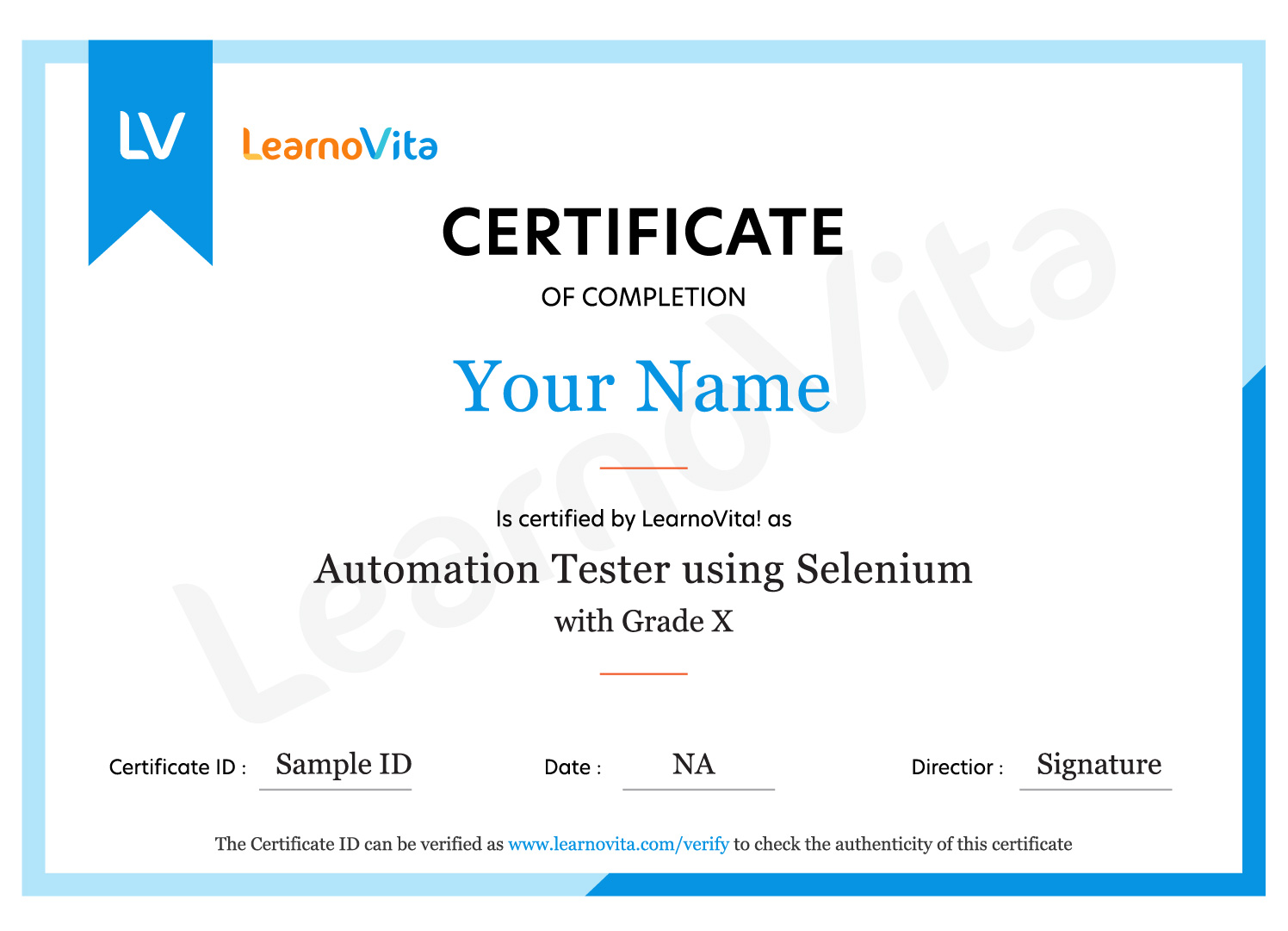
LearnoVita Certification is awarded upon course completion and is recognized by all of the world's leading global corporations. LearnoVita are the exclusive authorized Oracle, Microsoft, Pearson Vue, and Full Stack Developer I exam centers, as well as an authorized partner of Full Stack Developer . Additionally, those who want to pass the National Authorized Certificate in a specialized IT domain can get assistance from LearnoVita's technical experts.
As part of the training program, LearnoVita provides you with the most recent, pertinent, and valuable real-world projects. Every program includes several projects that rigorously assess your knowledge, abilities, and real-world experience to ensure you are fully prepared for the workforce. Your abilities will be equivalent to six months of demanding industry experience once the tasks are completed.
At LearnoVita, participants can choose from instructor-led online training, self-paced training, classroom sessions, one-to-one training, fast-track programs, customized training, and online training options. Each mode is designed to provide flexibility and convenience to learners, allowing them to select the format that best suits their needs. With a range of training options available, participants can select the mode that aligns with their learning style, schedule, and career goals to excel in Full Stack Developer .
LearnoVita guarantees that you won't miss any topics or modules. You have three options to catch up: we'll reschedule classes to suit your schedule within the course duration, provide access to online class presentations and recordings, or allow you to attend the missed session in another live batch.
Please don't hesitate to reach out to us at contact@learnovita.com if you have any questions or need further clarification.
To enroll in the Full Stack Developer at LearnoVita, you can conveniently register through our website or visit any of our branches in India for direct assistance.
Yes, after you've enrolled, you will have lifetime access to the student portal's study materials, videos, and top MNC interview questions.
At LearnoVita, we prioritize individual attention for students, ensuring they can clarify doubts on complex topics and gain a richer understanding through interactions with instructors and peers. To facilitate this, we limit the size of each Full Stack Developer Service batch to 5 or 6 members.
The average annual salary for Full Stack Developer Professionals in India is 5 LPA to 8 LPA.
view More view Less
Career Assistance
  • Build a Powerful Resume for Career Success
  • Get Trainer Tips to Clear Interviews
  • Practice with Experts: Mock Interviews for Success
  • Crack Interviews & Land Your Dream Job

Find Full Stack Developer Training in Other Cities

Acte Technologies WhatsApp