Home » Oracle » Oracle DBA Training in Visakhapatnam

Oracle DBA Training in Visakhapatnam

(4.5) 19980 Ratings
  • Enroll in the Oracle DBA Course in Visakhapatnam to master database administration and performance tuning.
  • Learn core skills including Oracle installation, user management, security configuration, and database optimization.
  • Gain hands-on experience through real-time projects, lab sessions, and live database scenarios.
  • Ideal for Oracle DBAs, System Administrators, Developers, and IT professionals seeking database expertise.
  • Choose from flexible batch timings: Weekday, Weekend, or Fast-Track learning schedules.
  • Benefit from placement support, interview coaching, and certification guidance.

Course Duration

45+ Hrs

Live Project

3 Project

Certification Pass

Guaranteed

Training Format

Live Online (Expert Trainers)
Quality Training With Affordable Fee

⭐ Fees Starts From

INR 38,000
INR 18,500

11138+

Professionals Trained

10+

Batches every month

2658+

Placed Students

198+

Corporate Served

What You'll Learn

Oracle DBA Course in Visakhapatnam delivers practical knowledge of database architecture, storage management, and high-availability environments used in modern enterprises.

Understand essential Oracle administration concepts such as installation, instance configuration, user control, and secure data handling through structured learning.

Build real-world expertise by working on backup strategies, disaster recovery planning, and performance tuning in simulated production environments.

Gain career-focused skills through Oracle DBA training in Visakhapatnam, designed to prepare learners for enterprise database roles and certification readiness.

Practice advanced administration tasks including RMAN recovery, patch management, and system monitoring to maintain stable database operations.

Strengthen professional confidence with hands-on labs and scenario-based exercises that mirror real IT infrastructure challenges faced by database teams.

An Comprehensive Overview of Oracle DBA Course

The Oracle DBA Course in Visakhapatnam is designed to give learners deep practical understanding of enterprise database administration, focusing on installation, configuration, security management, and performance tuning. Through Oracle DBA training in Visakhapatnam, students work on live database environments, guided labs, and real-time troubleshooting scenarios led by experienced instructors. This Oracle DBA training course supports flexible learning formats, including classroom, online, and fast-track options to suit working professionals and fresh graduates. The Oracle DBA Certification Course in Visakhapatnam strengthens technical confidence, improves job readiness, and prepares candidates for industry-recognized credentials.

Additional Info

Future Trends for Oracle DBA Training

  • AI-Assisted Database Automation: Future Oracle DBA training will increasingly focus on working alongside AI-driven automation tools that handle routine maintenance and predictive diagnostics. Instead of replacing DBAs, automation is reshaping their responsibilities toward strategic oversight and optimization. Learners will be trained to interpret AI-generated insights, fine-tune automated scripts, and prevent performance bottlenecks before they occur. Training programs will emphasize decision-making skills that combine human judgment with machine efficiency. This shift prepares professionals to manage intelligent infrastructures where uptime and speed are business-critical. Understanding how automation behaves in real production systems will become a core competency. Oracle DBAs who adapt early will remain highly relevant in data-centric organizations.
  • Cloud-Native Database Administration: As enterprises move aggressively toward hybrid and multi-cloud ecosystems, Oracle DBA training is evolving to prioritize cloud-native architecture. Modern DBAs must understand provisioning, scaling, and securing Oracle databases across distributed environments. Training will simulate real-world deployments on Oracle Cloud Infrastructure and integrated platforms. Learners will gain experience in cost optimization, workload balancing, and cross-region disaster recovery. The emphasis will move beyond on-premise management to elastic infrastructure thinking. Cloud-native skills will define the next generation of database administrators. Organizations increasingly value professionals who can bridge legacy systems with scalable cloud ecosystems.
  • Zero-Trust Security Frameworks: Cybersecurity threats are reshaping how databases are protected, pushing Oracle DBA education toward zero-trust models. Future training will highlight identity verification, privilege minimization, and continuous monitoring. DBAs will learn to treat every access request as a potential vulnerability. Courses will integrate practical labs on encryption, auditing, and anomaly detection. Security will no longer be an isolated function but embedded into daily database operations. Learners will be trained to think like both administrators and defenders. This mindset ensures stronger resilience against sophisticated cyber threats.
  • Real-Time Performance Engineering: Traditional performance tuning is evolving into real-time performance engineering driven by live analytics. Oracle DBA training will increasingly focus on proactive monitoring rather than reactive troubleshooting. Students will learn to interpret telemetry data and performance metrics as they occur. Training environments will simulate high-traffic enterprise systems to build practical intuition. The goal is to maintain optimal performance without downtime interruptions. This approach aligns with modern expectations of uninterrupted digital services. DBAs will be positioned as performance strategists rather than emergency responders.
  • Data Compliance and Governance Expertise: Regulatory pressure around data privacy is shaping the responsibilities of Oracle DBAs. Future training will incorporate global compliance frameworks and governance models. Learners will understand how to enforce retention policies and audit trails within Oracle ecosystems. Courses will emphasize ethical data handling alongside technical skills. Organizations require administrators who can align infrastructure with legal standards. This expands the DBA role into risk management and accountability. Compliance knowledge will become as important as technical mastery.
  • Automation Through Scripting and DevOps Integration: Oracle DBA training is merging with DevOps culture, encouraging automation through scripting and pipeline integration. DBAs will learn to collaborate closely with development teams. Training will include infrastructure-as-code practices and CI/CD workflows. This creates faster deployment cycles and more stable releases. Professionals will be expected to automate repetitive tasks using advanced scripting techniques. The boundary between operations and development will continue to blur. DBAs who understand DevOps principles will drive operational efficiency.
  • High-Availability and Disaster Recovery Architecture: Business continuity planning is becoming a central pillar of database training. Oracle DBA programs will deepen focus on fault tolerance and recovery engineering. Learners will design systems that remain operational during unexpected failures. Training will simulate disaster scenarios to test resilience strategies. Understanding redundancy architecture will be critical for enterprise readiness. DBAs will be evaluated on how well they minimize downtime. Reliability will define professional credibility in high-stakes environments.
  • Intelligent Monitoring and Observability: Modern infrastructures demand deeper visibility into database behavior. Future Oracle DBA training will highlight observability platforms and intelligent monitoring tools. Students will learn to correlate logs, metrics, and traces for holistic insights. This allows faster diagnosis of hidden issues. Training will emphasize predictive alerts rather than reactive fixes. DBAs will evolve into data interpreters who understand system patterns. Observability skills will drive smarter operational decisions.
  • Cross-Platform Database Interoperability: Enterprises increasingly operate mixed database ecosystems, requiring DBAs to manage interoperability. Training will include integration strategies between Oracle and other database technologies. Learners will understand data migration, synchronization, and compatibility challenges. This prepares professionals for hybrid IT environments. DBAs will act as connectors between diverse systems. Flexibility across platforms will enhance career adaptability. Organizations value professionals who can unify fragmented infrastructures.
  • Strategic Database Leadership Skills: The future DBA is not only technical but strategic. Training programs will include leadership, planning, and communication skills. DBAs will influence infrastructure decisions at organizational levels. Learners will be trained to align database strategies with business goals. This elevates the role from maintenance to innovation leadership. Strong communication bridges technical and executive teams. Oracle DBAs will increasingly shape long-term digital strategies.

Tools and Technologies for Oracle DBA Training

  • Oracle Enterprise Manager: Oracle Enterprise Manager is a central tool taught in Oracle DBA training because it provides a unified console for monitoring and managing complex database environments. Learners use it to track performance metrics, configure alerts, and automate administrative tasks without relying only on command-line operations. The tool helps future DBAs understand how enterprise systems are supervised in real organizations. Training focuses on interpreting dashboards and responding to early warning indicators before failures occur. Mastering Enterprise Manager builds confidence in handling production-scale infrastructure.
  • SQL*Plus: SQL*Plus remains a foundational utility in Oracle DBA training because it teaches administrators how to interact directly with the database engine. It allows learners to execute commands, manage schemas, and test queries in a lightweight environment. Through this tool, students develop a strong command over Oracle syntax and troubleshooting practices. Training emphasizes precision and discipline when working in text-based administrative interfaces. This experience strengthens a DBA’s technical depth and problem-solving mindset.
  • Oracle Recovery Manager (RMAN): RMAN is introduced as a mission-critical technology for backup and recovery strategies. Oracle DBA training uses RMAN labs to simulate real failure scenarios and recovery workflows. Students learn how to protect enterprise data using structured backup policies and restoration planning. The tool reinforces the importance of resilience and preparation in database operations. By practicing RMAN regularly, learners gain the confidence to manage high-risk recovery tasks in live environments.
  • Oracle Data Guard: Oracle Data Guard is a key technology for high-availability architecture and disaster recovery. Training programs demonstrate how standby databases protect organizations from unexpected outages. Learners configure failover systems and test data synchronization under controlled conditions. This tool teaches DBAs how to design systems that remain operational during disruptions. Understanding Data Guard prepares professionals to support mission-critical infrastructures where downtime is unacceptable.
  • Oracle Automatic Storage Management (ASM): ASM is taught as a specialized storage framework that simplifies database file management. Oracle DBA training shows how ASM distributes data intelligently across storage resources. Learners understand how performance improves when storage is optimized at the architectural level. The technology introduces DBAs to the relationship between hardware efficiency and database stability. Mastering ASM enables professionals to design scalable and balanced storage systems.
  • Oracle SQL Developer: Oracle SQL Developer provides a graphical environment that enhances productivity and visualization. In training, students use it to manage objects, run queries, and review database structures efficiently. The tool bridges the gap between beginner-friendly interfaces and advanced administration. Learners benefit from seeing how visual tools complement command-line expertise. This combination strengthens adaptability in diverse workplace environments.
  • Oracle Grid Infrastructure: Grid Infrastructure introduces students to clustered database environments and shared resource management. Oracle DBA training explains how distributed systems improve performance and availability. Learners explore node coordination and workload balancing in simulated enterprise clusters. The technology highlights how modern databases operate beyond single-machine limitations. Understanding grid architecture prepares DBAs for large-scale corporate ecosystems.
  • Oracle Cloud Infrastructure (OCI) Tools: OCI tools represent the shift toward cloud-based database management. Training programs integrate cloud deployment exercises to reflect modern enterprise practices. Learners experience provisioning, scaling, and monitoring Oracle databases in virtual infrastructure. This exposure ensures DBAs remain relevant in cloud-driven IT landscapes. OCI knowledge expands career opportunities beyond traditional on-premise roles.
  • Oracle Performance Tuning Tools: Performance tuning utilities are central to maintaining responsive systems. Oracle DBA training introduces diagnostic reports, wait analysis, and workload evaluation methods. Students learn how to detect inefficiencies and apply optimization strategies. These tools transform raw performance data into actionable insights. Mastery of tuning practices helps DBAs sustain smooth and predictable operations.
  • Oracle Security and Auditing Tools: Security and auditing technologies teach DBAs how to protect sensitive enterprise data. Training emphasizes access control, encryption management, and activity tracking. Learners understand how to enforce accountability within database environments. These tools reinforce the DBA’s responsibility in safeguarding digital assets. Security expertise ensures organizations maintain trust and compliance in data handling.

Roles and Responsibilities for Oracle DBA Training

  • Oracle Database Administrator: An Oracle Database Administrator is responsible for installing, configuring, and maintaining enterprise databases to ensure stable daily operations. During Oracle DBA certification training, learners understand how to manage storage, users, and performance tuning tasks in real production scenarios. The role demands continuous monitoring to prevent failures and maintain data integrity. DBAs also design backup and recovery strategies that protect business-critical information. Strong troubleshooting ability is essential when resolving unexpected system issues. This position forms the backbone of any organization that depends heavily on structured data systems.
  • Database Support Analyst: A Database Support Analyst focuses on diagnosing operational problems and assisting teams that rely on database services. Oracle DBA training prepares professionals to investigate errors, analyze logs, and restore service quickly during disruptions. This role requires attention to detail and strong analytical thinking. Support analysts act as the first line of defense when systems behave unpredictably. They collaborate closely with developers and administrators to implement fixes. Their responsibility ensures that business applications remain responsive and dependable.
  • Oracle Performance Engineer: An Oracle Performance Engineer specializes in optimizing database speed and efficiency. Certification training teaches how to interpret workload reports and eliminate performance bottlenecks. This role involves studying system behavior under heavy demand. Engineers redesign queries and storage structures to improve responsiveness. Their work directly impacts user experience and operational productivity. Organizations depend on performance experts to maintain smooth digital services.
  • Database Security Specialist: A Database Security Specialist protects sensitive information from unauthorized access. Oracle DBA certification training emphasizes encryption, auditing, and access control strategies. This role involves constant vigilance against evolving cyber threats. Specialists enforce strict policies that safeguard confidential enterprise data. They also conduct regular security reviews to identify vulnerabilities. Their responsibility is critical for maintaining regulatory compliance and organizational trust.
  • Backup and Recovery Manager: A Backup and Recovery Manager ensures that data can be restored after failures or disasters. Oracle DBA training teaches structured recovery planning and simulation exercises. This role demands precision because mistakes can result in permanent data loss. Managers develop automated backup policies and test restoration procedures. They prepare organizations for worst-case scenarios before they occur. Their planning protects operational continuity.
  • Database Infrastructure Engineer: A Database Infrastructure Engineer designs the environment that supports large-scale database operations. Training introduces concepts such as clustering, storage architecture, and high availability. Engineers build systems capable of handling heavy workloads without interruption. Their responsibility extends to capacity planning and scalability. They ensure that infrastructure grows alongside business needs. This role blends database expertise with architectural vision.
  • Oracle Cloud Database Administrator: An Oracle Cloud Database Administrator manages databases deployed in cloud ecosystems. Certification training includes provisioning, scaling, and monitoring in virtual infrastructure. This role requires understanding cost efficiency alongside technical reliability. Cloud DBAs secure distributed environments and maintain uptime across regions. They adapt traditional DBA practices to modern cloud platforms. Their expertise supports digital transformation initiatives.
  • Database Migration Consultant: A Database Migration Consultant oversees transitions between systems or versions. Oracle DBA training teaches safe data transfer methods and compatibility planning. Consultants minimize downtime during migrations. Their work demands careful validation and testing. They ensure data consistency throughout the process. Organizations rely on them during critical modernization projects.
  • Data Reliability Engineer: A Data Reliability Engineer focuses on maintaining uninterrupted database availability. Training prepares professionals to design fault-tolerant systems. This role emphasizes proactive monitoring and rapid recovery. Engineers anticipate risks before they impact operations. Their strategies reduce downtime and service disruption. Reliability specialists protect business continuity.
  • Oracle Database Manager: An Oracle Database Manager leads teams responsible for enterprise database environments. Certification training strengthens both technical and leadership skills. Managers coordinate maintenance schedules and long-term strategy. They align database operations with business goals. Their decisions influence performance, security, and scalability. This role requires both managerial judgment and deep technical understanding.

Companies Hiring Oracle DBA Professionals

  • Tata Consultancy Services (TCS): Tata Consultancy Services regularly hires Oracle DBA professionals to manage large-scale enterprise database environments for global clients. Their projects demand administrators who can maintain uptime, optimize performance, and secure mission-critical systems. Professionals trained in Oracle DBA practices are valued for their ability to support high-transaction applications. TCS environments expose DBAs to complex, real-world infrastructure challenges. Working here builds strong enterprise experience and long-term career stability.
  • Infosys: Infosys recruits Oracle DBA specialists to support digital transformation initiatives across banking, retail, and telecom sectors. The company relies on skilled database professionals to maintain reliability across distributed systems. Oracle-trained DBAs contribute to automation, performance tuning, and cloud database migration. The work culture emphasizes structured processes and technical excellence. This creates opportunities to grow into senior infrastructure roles.
  • Wipro: Wipro seeks Oracle DBA professionals who can manage enterprise data platforms with precision and security awareness. Their global delivery model requires administrators capable of supporting 24/7 operations. Trained DBAs help maintain service continuity and regulatory compliance. Exposure to diverse international clients enhances technical adaptability. Wipro environments are ideal for professionals who want hands-on infrastructure experience.
  • HCLTech: HCLTech employs Oracle DBAs to maintain resilient IT ecosystems for large enterprises. The company values professionals who understand automation, recovery strategies, and system optimization. DBAs play a direct role in ensuring uninterrupted service delivery. Training in Oracle technologies aligns closely with HCL’s infrastructure-focused projects. Employees gain exposure to cutting-edge enterprise environments.
  • Accenture: Accenture hires Oracle DBA professionals to support consulting-driven database transformation projects. Their work involves performance engineering and modernization of legacy systems. Oracle-trained DBAs contribute to strategic infrastructure upgrades. The role blends technical depth with business alignment. Accenture provides global project exposure that strengthens professional credibility.
  • Capgemini: Capgemini values Oracle DBA experts who can manage data reliability across multinational client platforms. Professionals are expected to maintain scalability and operational efficiency. The company invests heavily in infrastructure modernization initiatives. DBAs contribute to secure and optimized database ecosystems. Working at Capgemini encourages continuous technical learning.
  • IBM: IBM recruits Oracle database professionals to support enterprise-grade computing environments. DBAs here manage mission-critical workloads that demand precision and discipline. Their responsibilities extend to performance monitoring and secure architecture design. Oracle-trained professionals fit naturally into IBM’s structured infrastructure culture. The experience gained supports long-term career advancement.
  • Cognizant: Cognizant hires Oracle DBA specialists to maintain stable backend systems across healthcare, finance, and retail industries. The company depends on administrators who understand real-time performance demands. Trained DBAs strengthen operational resilience and service quality. The role involves collaboration with development and cloud teams. This environment encourages practical skill development.
  • Tech Mahindra: Tech Mahindra seeks Oracle database professionals to support telecom and enterprise IT operations. DBAs help maintain data consistency in high-volume transaction systems. Their expertise supports modernization and migration initiatives. The company values professionals who combine technical accuracy with problem-solving ability. Exposure to telecom infrastructure adds specialized experience.
  • Oracle Corporation: Oracle Corporation itself hires trained Oracle DBA professionals to support its global product ecosystem. Employees work closely with the technologies they specialize in. DBAs contribute to innovation, customer support, and advanced infrastructure projects. This environment demands deep technical mastery. Working with Oracle provides unmatched exposure to enterprise database evolution.
View more

Oracle DBA Course Objectives

A basic understanding of computers, operating systems, and simple database concepts is helpful before starting Oracle DBA training. Learners who are familiar with SQL fundamentals or have exposure to IT environments tend to progress faster. However, the course is structured to support beginners as well, starting from core concepts and gradually moving toward advanced administration. Curiosity about how data systems function and a willingness to practice regularly matter more than prior expertise. Consistent hands-on learning is the real prerequisite for success.
Oracle DBA training builds strong technical confidence in managing enterprise databases, which are central to modern business operations. Participants learn how to maintain performance, protect data, and recover systems during failures. These skills translate directly into employability because organizations rely on stable database infrastructure. The training also sharpens problem-solving ability and operational discipline. Over time, professionals gain credibility as trusted custodians of critical information systems.
Oracle DBA expertise remains highly relevant because nearly every large organization depends on structured databases to operate. Finance, healthcare, telecom, and e-commerce sectors require professionals who can ensure uptime and data safety. As digital services expand, the cost of database failure grows, making skilled administrators indispensable. Employers value DBAs who can combine reliability with efficiency. This role continues to be a backbone position in IT infrastructure teams.
Yes, practical exposure is a central part of Oracle DBA training. Students work in simulated production environments that mirror real enterprise systems. These projects include recovery drills, performance optimization, and live monitoring tasks. The goal is to move beyond theory and build operational confidence. By the end of training, learners are comfortable handling real infrastructure challenges.
  • Growing demand for cloud database administrators
  • Expansion of data-driven enterprise operations
  • Integration with AI-assisted automation systems
  • Rising need for cybersecurity-focused DBAs
  • Opportunities in hybrid and multi-cloud infrastructure
  • Increased reliance on high-availability architecture
  • Long-term relevance in digital transformation projects
  • Oracle installation and configuration
  • Database architecture fundamentals
  • User and security management
  • Backup and recovery strategies
  • Performance tuning techniques
  • Storage and memory optimization
  • Monitoring and troubleshooting
  • High-availability solutions
  • Banking and financial services
  • Healthcare and pharmaceuticals
  • Telecommunications
  • E-commerce and retail
  • Government and public sector
  • IT services and consulting
  • Manufacturing and logistics
No training program can promise employment, but Oracle DBA training significantly improves job readiness. It equips learners with skills that employers actively seek in infrastructure roles. Success ultimately depends on individual effort, practice, and interview performance. Certification and hands-on experience increase credibility. Many graduates find opportunities because they can demonstrate real competence.
  • Strong foundation in enterprise database management
  • Higher employability in infrastructure roles
  • Practical experience with real database systems
  • Improved troubleshooting confidence
  • Recognition through professional certification
  • Career growth in data-driven industries
Participants gain experience with essential Oracle administration tools such as Oracle Enterprise Manager, SQL*Plus, RMAN, Data Guard, and performance monitoring utilities. Training environments allow learners to practice installation, backup, tuning, and recovery workflows using industry-standard software. These tools reflect what professionals use daily in enterprise settings. Familiarity with them ensures smoother transition into real job roles. Mastery of tools is treated as practical skill, not just theoretical knowledge.
view More view Less

Oracle DBA Course Benefits

The Oracle DBA course in Visakhapatnam delivers strong practical training through live database environments, guided labs, and real operational scenarios used in enterprise systems. Learners strengthen their experience through structured Oracle DBA internship exposure, allowing them to apply administration, backup, and tuning skills in workplace-style projects. The curriculum focuses on modern database workflows, automation practices, and real production challenges under the mentorship of working professionals. Graduates benefit from career-focused guidance through an Oracle DBA course with placement, helping them transition confidently into roles demanded by growing IT organizations.

  • Designation
  • Annual Salary
    Hiring Companies
  • 3.24L
    Min
  • 6.5L
    Average
  • 13.5L
    Max
  • 4.50L
    Min
  • 8.5L
    Average
  • 16.5L
    Max
  • 4.0L
    Min
  • 6.5L
    Average
  • 13.5L
    Max
  • 3.24L
    Min
  • 6.5L
    Average
  • 12.5L
    Max

About Oracle DBA Certification Training

The Oracle DBA certification course in Visakhapatnam builds deep expertise in database design, administration, and enterprise-level performance management used by modern organizations. Learners work on intensive Oracle DBA projects that simulate real production systems, helping them understand backup planning, security control, and recovery execution. Hands-on sessions focus on live server environments, monitoring tools, and troubleshooting workflows guided by experienced database professionals. Strong industry partnerships and dedicated placement guidance improve career visibility and connect graduates with companies actively hiring database specialists.

Top Skills You Will Gain
  • Database Installation
  • SQL Optimization
  • Backup Recovery
  • Performance Tuning
  • Storage Configuration
  • User Security
  • Query Troubleshooting
  • System Monitoring

12+ Oracle DBA Tools

Online Classroom Batches Preferred

Weekdays (Mon - Fri)
27 - Apr - 2026
08:00 AM (IST)
Weekdays (Mon - Fri)
29 - Apr - 2026
08:00 AM (IST)
Weekend (Sat)
2 - May - 2026
11:00 AM (IST)
Weekend (Sun)
3 - May - 2026
11:00 AM (IST)
Can't find a batch you were looking for?
₹38,000 ₹18,500 10% OFF Expires in

No Interest Financing start at ₹ 5000 / month

Corporate Training

  • Customized Learning
  • Enterprise Grade Learning Management System (LMS)
  • 24x7 Support
  • Enterprise Grade Reporting

Not Just Studying
We’re Doing Much More!

Empowering Learning Through Real Experiences and Innovation
Hiring
Hiring
Hiring
Hiring
Hiring
Hiring
Hiring
User
User
User
User
User
User

Oracle DBA Course Curriculum

Trainers Profile

The Oracle DBA course in Visakhapatnam is guided by working database professionals who bring years of enterprise infrastructure experience into the classroom. Trainers focus on practical exposure, demonstrating how real production databases are installed, monitored, and recovered in high-pressure environments. Learners receive structured Oracle DBA training materials that support step-by-step practice and reinforce technical clarity. The teaching approach is hands-on and career-focused, helping students build confidence to handle live database responsibilities.

Syllabus for Oracle DBA Course Download syllabus

  • Introduction to Oracle architecture
  • Database components overview
  • Instance and memory structure
  • Physical storage concepts
  • Data files and control files
  • Oracle software installation
  • Database creation process
  • Environment setup
  • Configuration parameters
  • Listener setup
  • Initial connectivity testing
  • Logical storage structure
  • Tablespaces and segments
  • Data blocks and extents
  • Redo log structure
  • Undo management
  • Creating user accounts
  • Role assignment
  • Privilege control
  • Password policies
  • Profile configuration
  • Tables and indexes
  • Views and synonyms
  • Constraints handling
  • Sequence creation
  • Data dictionary usage
  • Backup types overview
  • Cold backup process
  • Hot backup methods
  • Archive log mode
  • Backup scheduling
  • Recovery planning
  • RMAN configuration
  • Backup execution
  • Restore commands
  • Recovery procedures
  • Catalog usage
  • Instance monitoring
  • Memory tuning basics
  • Wait event analysis
  • AWR report reading
  • Session tracking
  • ASM introduction
  • Disk group setup
  • File allocation
  • Storage balancing
  • Capacity monitoring
  • Oracle Net services
  • Listener configuration
  • Client connectivity
  • Service naming
  • Troubleshooting connections
(15) view More view Less
Need customized curriculum?

REAL

start
STORIES SUCCESS INSPIRATION
CAREER
UPGRADE
sowmiya

sowmiya

CAREER
UPGRADE
Rajkumar

Rajkumar

CAREER
UPGRADE
Thon

Thon

CAREER
UPGRADE
lavanya

Lavanya

Industry Projects

Project 1
Enterprise Backup Recovery Simulation

Design a full Oracle backup and restore environment that mimics a live production server. The project involves configuring RMAN policies, scheduling automated backups, and performing timed recovery drills after simulated crashes to prove data integrity and service continuity under pressure.

Project 2
High Availability Database Setup

Build a primary and standby Oracle database using Data Guard to maintain uninterrupted service. The project tests failover readiness, log synchronization, and disaster response planning, helping learners understand how enterprises protect critical databases from sudden outages.

Project 3
Performance Tuning Live Database

Analyze a slow-running Oracle database and improve its response time through indexing, memory tuning, and workload balancing. The project requires reading performance reports and applying fixes that demonstrate measurable speed improvement in a stressed environment.

Our Hiring Partner

Exam & Oracle DBA Certification

  • Basic understanding of SQL and databases
  • Familiarity with operating systems
  • Exposure to database concepts
  • Hands-on practice with Oracle tools
  • Interest in infrastructure technologies
Oracle DBA certification validates real technical ability and signals to employers that the holder understands enterprise database operations. It strengthens professional credibility, improves interview confidence, and increases visibility in competitive hiring markets. Certified professionals are often trusted with higher responsibility roles. The credential also reflects commitment to continuous learning, which employers value when selecting candidates for infrastructure teams.
Certification alone cannot promise employment, but it significantly improves employability when combined with practice and project experience. Employers look for proof of skill, and certification acts as structured evidence of knowledge. Success still depends on interviews and practical ability. It opens doors, but effort determines the outcome.
  • Oracle Database Administrator
  • Database Support Engineer
  • Performance Tuning Specialist
  • Backup Recovery Engineer
  • Cloud Database Administrator
  • Infrastructure Database Analyst
Oracle DBA certification positions professionals as trusted database specialists capable of handling enterprise workloads. It creates pathways into higher-paying infrastructure roles and strengthens long-term job stability. Certified individuals often receive faster career progression because organizations rely on proven expertise. The credential builds authority, confidence, and technical recognition that supports sustained growth in IT careers.

Our learners
transformed their careers

35 Laks
Highest Salary Offered
50%
Average Salary Hike
30K+
Placed in MNC's
15+
Year's in Training
Our Alumni
Alumni

A majority of our alumni

fast-tracked into managerial careers.

Get inspired by their progress in the Career Growth Report.

Our Student Successful Story

checkimage Regular 1:1 Mentorship From Industry Experts checkimage Live Classes checkimage Career Support

How are the Oracle DBA Course with LearnoVita Different?

Feature

LearnoVita

Other Institutes

Affordable Fees

Competitive Pricing With Flexible Payment Options.

Higher Oracle DBA Fees With Limited Payment Options.

Live Class From ( Industry Expert)

Well Experienced Trainer From a Relevant Field With Practical Oracle DBA Training

Theoretical Class With Limited Practical

Updated Syllabus

Updated and Industry-relevant Oracle DBA Course Curriculum With Hands-on Learning.

Outdated Curriculum With Limited Practical Training.

Hands-on projects

Real-world Oracle DBA Project With Live Case Studies and Collaboration With Companies.

Basic Projects With Limited Real-world Application.

Certification

Industry-recognized Oracle DBA Certifications With Global Validity.

Basic Oracle DBA Certifications With Limited Recognition.

Placement Support

Strong Placement Support With Tie-ups With Top Companies and Mock Interviews.

Basic Placement Support

Industry Partnerships

Strong Ties With Top Tech Companies for Internships and Placements

No Partnerships, Limited Opportunities

Batch Size

Small Batch Sizes for Personalized Attention.

Large Batch Sizes With Limited Individual Focus.

Additional Features

Lifetime Access to Oracle DBA Course Materials, Alumni Network, and Hackathons.

No Additional Features or Perks.

Training Support

Dedicated Mentors, 24/7 Doubt Resolution, and Personalized Guidance.

Limited Mentor Support and No After-hours Assistance.

Oracle DBA Course FAQ's

Certainly, you are welcome to join the demo session. However, due to our commitment to maintaining high-quality standards, we limit the number of participants in live sessions. Therefore, participation in a live class without enrollment is not feasible. If you're unable to attend, you can review our pre-recorded session featuring the same trainer. This will provide you with a comprehensive understanding of our class structure, instructor quality, and level of interaction.
All of our instructors are employed professionals in the industry who work for prestigious companies and have a minimum of 9 to 12 years of significant IT field experience. A great learning experience is provided by all of these knowledgeable people at LearnoVita.
  • LearnoVita is dedicated to assisting job seekers in seeking, connecting, and achieving success, while also ensuring employers are delighted with the ideal candidates.
  • Upon successful completion of a career course with LearnoVita, you may qualify for job placement assistance. We offer 100% placement assistance and maintain strong relationships with over 650 top MNCs.
  • Our Placement Cell aids students in securing interviews with major companies such as Oracle, HP, Wipro, Accenture, Google, IBM, Tech Mahindra, Amazon, CTS, TCS, HCL, Infosys, MindTree, and MPhasis, among others.
  • LearnoVita has a legendary reputation for placing students, as evidenced by our Placed Students' List on our website. Last year alone, over 5400 students were placed in India and globally.
  • We conduct development sessions, including mock interviews and presentation skills training, to prepare students for challenging interview situations with confidence. With an 85% placement record, our Placement Cell continues to support you until you secure a position with a better MNC.
  • Please visit your student's portal for free access to job openings, study materials, videos, recorded sections, and top MNC interview questions.
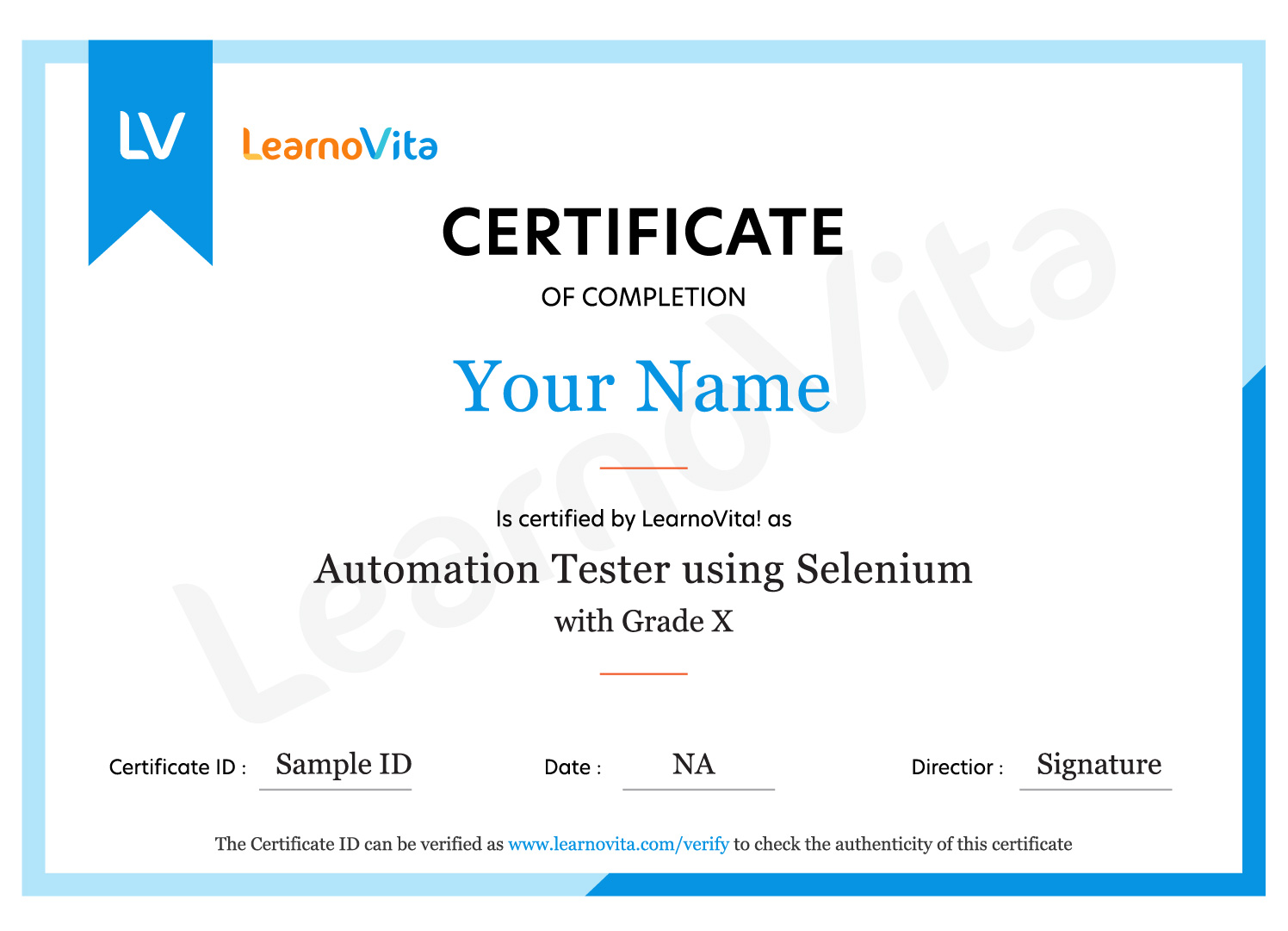
LearnoVita awards certifications upon course completion, recognized by leading global corporations. As an exclusive authorized exam center for Oracle, Microsoft, Pearson Vue, and PSI, and an authorized SAP CRM partner, LearnoVita provides a credible certification pathway. Additionally, LearnoVita’s technical experts assist individuals aiming for National Authorized Certificates in specialized IT domains.
As part of the training program, LearnoVita provides you with the most recent, pertinent, and valuable real-world projects. Every program includes several projects that rigorously assess your knowledge, abilities, and real-world experience to ensure you are fully prepared for the workforce. Your abilities will be equivalent to six months of demanding industry experience once the tasks are completed.
At LearnoVita, participants can choose from instructor-led online training, self-paced training, classroom sessions, one-to-one training, fast-track programs, customized training, and online training options. Each mode is designed to provide flexibility and convenience to learners, allowing them to select the format that best suits their needs. With a range of training options available, participants can select the mode that aligns with their learning style, schedule, and career goals to excel in Oracle DBA.
LearnoVita guarantees that you won't miss any topics or modules. You have three options to catch up: we'll reschedule classes to suit your schedule within the course duration, provide access to online class presentations and recordings, or allow you to attend the missed session in another live batch.
Please don't hesitate to reach out to us at contact@learnovita.com if you have any questions or need further clarification.
To enroll in the Oracle DBA Course at LearnoVita, you can conveniently register through our website or visit any of our branches in India for direct assistance.
Yes, after you've enrolled, you will have lifetime access to the student portal's study materials, videos, and top MNC interview questions.
At LearnoVita, we prioritize individual attention for students, ensuring they can clarify doubts on complex topics and gain a richer understanding through interactions with instructors and peers. To facilitate this, we limit the size of each Oracle DBA batch to 5 or 6 members.
The average annual salary for Oracle DBA Professionals in India is 5 LPA to 8 LPA.
view More view Less
Career Assistance
  • Build a Powerful Resume for Career Success
  • Get Trainer Tips to Clear Interviews
  • Practice with Experts: Mock Interviews for Success
  • Crack Interviews & Land Your Dream Job

Find Oracle DBA Training in Other Cities

Acte Technologies WhatsApp