Home » Others Courses » AI and Machine Learning Course

AI and Machine Learning Course

(4.8) 18475 Ratings
  • Enroll in the AI and Machine Learning Training to master AI concepts and ML algorithms for real-world applications.
  • Learn key components such as Supervised & Unsupervised Learning, Neural Networks, and Deep Learning models.
  • Gain hands-on experience through real-time projects, model building, training, and deployment activities.
  • Ideal for Data Analysts, Developers, AI Enthusiasts, and IT Professionals.
  • Choose from flexible batch timings: Weekday, Weekend, or Fast-Track sessions.
  • Benefit from placement support, interview prep, and certification guidance.

Course Duration

55+ Hrs

Live Project

3 Project

Certification Pass

Guaranteed

Training Format

Live Online (Expert Trainers)
Quality Training With Affordable Fee

⭐ Fees Starts From

INR 38,000
INR 18,500

12057+

Professionals Trained

10+

Batches every month

3075+

Placed Students

265+

Corporate Served

What You'll Learn

Join the AI and Machine Learning Course to learn key concepts of artificial intelligence and practical machine learning techniques.

Understand the basics, including data cleaning, feature engineering and selecting the right models for predictions.

Create smart solutions using data insights to optimize business operations and support better decisions.

Get hands-on experience developing, testing and implementing machine learning models in real-world scenarios.

Dive into advanced topics like neural networks, deep learning and natural language processing applications.

Receive a recognized certification in AI and Machine Learning Training to strengthen your career prospects in data science and AI fields.

An Complete Overview of AI and Machine Learning Training

The AI and Machine Learning Course is designed to provide learners with in-depth knowledge of AI concepts and machine learning techniques, covering topics like supervised and unsupervised learning, neural networks and predictive modeling. Through industry case studies, real-world datasets and expert-led instruction, participants in the AI and Machine Learning Online Course get practical experience. A range of educational approaches can be supported by the AI and Machine Learning Certification Course provides flexible learning choices such as instructor-led and self-paced sessions. The AI and Machine Learning training course guarantees practical exposure to real-time projects, helping you to confidently take on complicated challenges. Enrolling in this course also improves your abilities making you highly employable in data-driven professions. Completing the program and earning a recognized AI and Machine Learning certification opens doors to high-demand roles in AI, data science and analytics-driven industries.

Additional Info

Future Trends for AI and Machine Learning Training

  • Automated Machine Learning (AutoML): Automated Machine Learning is transforming how models are developed by reducing manual coding and experimentation. It makes it possible for non-experts to create reliable models quickly. AutoML automatically manages data preprocessing, chooses the optimal methods and optimizes hyperparameters. Without extensive knowledge, this trend aids businesses in accelerating the use of AI. By simplifying the model development lifecycle, it increases efficiency and reduces expenses. AutoML modules are becoming more and more common in AI training programs to get students ready for contemporary workflows. Students that have practical experience using AutoML tools are better prepared to tackle real-world issues more quickly.
  • Explainable AI (XAI): The goal of explainable AI is to create machine learning models transparent and understandable. Decisions made by AI must be trusted by stakeholders, particularly in the legal, medical and financial fields. XAI methods assist in determining the reasons behind a model's predictions. Students that receive XAI training learn how to analyze models without sacrificing efficiency. An important component of this tendency is comprehending bias and fairness. XAI experts are in great demand for the use of ethical AI. It guarantees that AI solutions in crucial applications are reliable, understandable and accountable.
  • Edge AI and On-Device Processing: Edge AI involves running machine learning models directly on devices rather than centralized servers. This reduces latency and improves real-time decision-making. These days, edge deployment approaches are emphasized in AI and machine learning training. Model optimization for low-power and resource-constrained contexts is taught to students. By processing sensitive data locally, this trend makes privacy-preserving solutions possible. Mastery of Edge AI prepares learners for cutting-edge, decentralized AI applications.
  • AI-Powered Natural Language Processing (NLP): With sophisticated models like transformers, BERT, and GPT, NLP is still developing. Language translation, chatbots, and sentiment analysis are the main topics of AI training programs. Students gain knowledge of methods for question-answering systems, summarization and text classification. Business workflows that use natural language processing improve customer service and facilitate more intelligent decision-making. Students who work on real-time NLP projects are better able to handle unstructured text data. For contemporary data professionals, knowing contextual word embeddings is essential.
  • Reinforcement Learning and Autonomous Systems: Agents are trained to make sequential judgments in dynamic contexts through reinforcement learning. Autonomous systems, game AI, and robots are all powered by this trend. Policy optimization, environment modeling and reward function design are all part of training. By creating AI agents in controlled simulations, students get practical experience. Reinforcement learning emphasizes experimentation and iterative improvement. Learners develop skills to create systems that adapt and optimize over time. Knowledge in this area is vital for careers in robotics, smart systems and autonomous solutions.
  • AI in Predictive Analytics: Predictive analytics uses AI to forecast trends, customer behavior and operational outcomes. Training programs focus on time-series modeling, regression techniques and anomaly detection. Students learn how to leverage historical data for strategic business insights. Predictive models support risk management, sales forecasting and maintenance planning. AI-based analytics helps organizations make informed, proactive decisions. Learners' ability to apply theory to actual datasets is ensured by practical tasks. Gaining expertise in predictive analytics increases job prospects in operations, healthcare, and finance.
  • Multi-Modal AI Integration: Text, image, voice, and sensor data are all combined by multi-modal AI to provide more thorough insights. Applications including autonomous vehicles, virtual assistants and medical diagnostics are improved by this trend. Techniques for successfully integrating various data kinds are introduced in training programs. Students gain knowledge of joint representation learning, feature extraction, and model fusion. Multi-modal learning uses a variety of information sources to enhance accuracy and decision-making. Learners can apply multi-modal AI systems in the actual world with the aid of practical projects. Professionals with this kind of expertise are at the forefront of AI advancement.
  • Generative AI and Creative Applications: Deep learning models are used by generative AI to create new content, such as writing, music and images. Large-scale language models, GANs, and VAEs are used in training. Learners use AI-generated content to experiment with creative problem-solving. The design, marketing, and entertainment sectors are being completely transformed by this movement. AI programs improve practical understanding by simulating real-world creativity issues. Understanding the ethical use of generative models is emphasized in training. Mastery of generative AI opens careers in digital content, innovation and research.
  • AI Model Optimization and Efficiency: Optimizing AI models for speed, accuracy and resource efficiency is a growing trend. Training programs teach pruning, quantization and knowledge distillation techniques. Students learn to deploy models on diverse platforms with minimal performance trade-offs. Efficient AI reduces costs and energy consumption in large-scale applications. Hands-on labs allow learners to experiment with different optimization strategies. For AI solutions to be scalable and suitable for production, model efficiency is essential. In industry projects, experts with model optimization skills are highly prized.
  • Ethical AI and Responsible Deployment: Ethical AI ensures fairness, transparency and accountability in machine learning solutions. Governance policies, fairness metrics and bias detection are all included in training. Students can evaluate how AI systems will impact society prior to their implementation. Responsible use of AI prevents discrimination and unintended consequences. Ethics-integrated AI training creates knowledgeable, moral employees. Students use real-world case studies to understand how to apply ethical ideas. Ethical AI understanding is essential for dependable, long-lasting AI jobs across industries.

Key Tools and Technologies in AI and Machine Learning Training

  • TensorFlow: TensorFlow is a well-known open-source toolkit for building and using machine learning models. It supports deep learning frameworks and makes it possible for developers to create neural networks quickly. Students can learn how to implement real-world models using TensorFlow. The software also provides visualization capabilities for monitoring model performance. Through practical experience learners get an intuitive knowledge of complex AI processes.
  • PyTorch: PyTorch is a flexible deep learning library known for dynamic computation and ease of experimentation. Learners use PyTorch to build neural networks for image recognition, NLP and predictive analytics. PyTorch is taught for hands-on model creation and debugging. Its simplicity makes it ideal for research and prototyping. Training projects ensure students can implement scalable AI solutions effectively.
  • Scikit-learn: A Python package called Scikit-learn focuses on traditional machine learning methods including regression, clustering, and classification. It can be used by students for pipeline development, model evaluation, and data preprocessing. Learning complicated algorithms is made easier by the library's extensive documentation. Through practical exercises, students learn how to apply models to real datasets. Scikit-learn ensures a strong basis in conventional machine learning techniques.
  • Keras: A sophisticated neural network API called Keras that simplifies deep learning model design. Keras is used for rapid model construction, training, and validation. The smooth deployment of production-ready solutions is made possible by its connection with TensorFlow. For challenges including images, text, and audio, students learn how to create multi-layer neural networks. Keras's modular components and user-friendly interfaces speed up learning.
  • Jupyter Notebook: The Jupyter Notebook is an interactive coding, visualization and documentation environment. It enables students to blend the execution of code with instructional material. Students are able to maintain repeatable workflows, visualize data, and experiment with models. It is adaptable for AI projects due to its support for numerous languages and libraries. Jupyter's actual coding and data analysis exercises improve hands-on skills.
  • Google Colab: For AI studies, Google Colab is a cloud-based platform that provides free GPU support. It is used by students in the AI and Machine Learning Certification Course to effectively run deep learning and intensive machine learning models. It makes real-time notebook sharing and collaboration possible. Colab eliminates setup issues, allowing students to focus on model design. Training projects in Colab enhance practical understanding of scalable AI workflows.
  • Apache Spark: An effective engine for processing massive amounts of data is Apache Spark. In AI and Machine Learning , Spark is used to handle big datasets and perform distributed machine learning. Students learn to integrate Spark with MLlib for scalable predictive modeling. It ensures faster computation on large volumes of data compared to traditional tools. Mastery of Spark prepares learners for enterprise-level AI projects.
  • H2O.ai: H2O.ai is an open-source AI platform designed for automatic machine learning and predictive modeling. Learners in AI and Machine Learning use it to build models without extensive coding. Its AutoML features make choosing algorithms and adjusting hyperparameters easier. Students get hands-on experience modeling and deploying data in real-time. The gap between AI research and solutions that are ready for production is filled by H2O.ai.
  • RapidMiner: RapidMiner is a visual data science platform that allows learners to build AI workflows through drag-and-drop functionality. It helps students prototype models quickly. The platform supports data preparation, modeling and evaluation in one environment. Hands-on projects ensure learners can translate theoretical knowledge into practical AI applications. RapidMiner reduces the learning curve for complex AI tasks.
  • Microsoft Azure Machine Learning: Azure Machine Learning provides cloud-based tools for model building, training and deployment. Students can learn to deploy scalable AI solutions in a secure environment. The platform supports automated ML, data preprocessing and monitoring of deployed models. Real-world exercises prepare learners for enterprise AI projects. Azure ML bridges practical experience with industry-grade deployment skills.

Roles and Responsibilities in AI and Machine Learning Training

  • AI/ML Analyst: Large datasets are examined by an AI/ML specialist to identify patterns and revelations that could guide business decisions. In order to guarantee high-quality inputs for AI models, they preprocess and clean data. In order to properly implement models, analysts work closely with data engineers. They monitor the model's performance and offer suggestions for improvements based on the results. Their expertise helps companies streamline processes and create predictive plans. They are essential for establishing a connection between data and useful AI solutions.
  • Machine Learning Engineer: Machine Learning Engineers design, build and deploy AI models for production systems. They focus on algorithm selection, model optimization and integration into software applications. Engineers also ensure that models scale efficiently in cloud or on-premise environments. They collaborate with data scientists to implement real-time solutions. Model validation and testing are essential tasks to guarantee accuracy. Through their efforts, businesses may successfully use AI at scale.
  • AI Consultant: Strategic advice on integrating AI technologies into company operations is given by AI consultants. They evaluate existing processes and pinpoint places where AI can boost productivity. Consultants design implementation roadmaps for AI based on the requirements of the enterprise. They advise groups on the best ways to choose and implement models. They are also responsible for assessing ROI and educating stakeholders about AI technologies. For AI adoption to be effective consultants connect technical expertise with business strategy.
  • Data Scientist: Data Scientists explore, analyze and interpret complex datasets to build predictive and prescriptive models. They apply statistical techniques, machine learning algorithms and deep learning methods. Data Scientists collaborate with business teams to translate insights into actionable strategies. They also ensure the quality and integrity of data for reliable model outputs. Their work is critical for developing AI solutions that drive decision-making. They constantly refine models to improve accuracy and efficiency.
  • AI Project Manager: The task of planning, executing and completing AI initiatives falls to AI project managers. To ensure that projects are finished on time, they help technical teams and stakeholders communicate. Managers monitor resource allocation, budget and project risks. They define project goals, timelines and success metrics for AI deployments. One of their responsibilities is to ensure adherence to legal and ethical requirements. Their leadership ensures AI projects achieve intended business objectives.
  • Robotics and Automation Engineer: Robotics and Automation Engineers design and implement AI-driven automation systems. They program robots, drones or autonomous vehicles to perform specific tasks. Engineers integrate machine learning models to enhance operational efficiency. For optimum performance, they test, diagnose, and maintain automated systems. Working together with AI developers guarantees the ability to make decisions in real time. Through their efforts, manual procedures are converted into automated, intelligent ones.
  • AI Trainer/Instructor: Learners can better grasp AI principles, methods, and applications with the help of AI trainers. For experiential learning, they develop real-time projects and useful exercises. In order to impart pertinent knowledge, trainers stay informed with the most recent advancements in AI technology. They provide employees or students with mentorship to develop useful AI abilities. One of their most important responsibilities is to keep an eye on developments and provide input. In AI learning environments, they connect theoretical understanding with real-world application.
  • Deep Learning Specialist: Experts in deep learning concentrate on creating neural network structures for challenging issues like natural language processing or picture recognition. To train, improve and optimize models, they work with enormous datasets. Experts use sophisticated metrics and methods to assess model performance. To incorporate models into applications, they work in tandem with data scientists. Innovations in fields needing high computational intelligence are fueled by their experience. The secret to mastering deep learning solutions is constant testing and study.
  • AI Research Scientist: AI Research Scientists conduct experimental research to advance AI technologies and methodologies. They test new architectures, create original algorithms, and publish their results. In order to address practical AI issues, research scientists investigate theoretical frameworks. Research is guaranteed to be practically applicable through collaboration with academic and industry partners. Their work often influences the next generation of AI tools and models. They combine creativity with technical rigor to push AI boundaries.
  • Data Engineer for AI: Data engineers create, construct and manage the data pipelines that supply machine learning and artificial intelligence models. They ensure data is clean, structured and accessible for analysis. Engineers optimize storage solutions for high-speed data retrieval and processing. They collaborate with data scientists to integrate pipelines with AI models effectively. Maintaining data security, scalability and compliance is a core responsibility. Their work forms the backbone of successful AI implementations by ensuring reliable data infrastructure.

Companies Seeking AI and Machine Learning Professionals

  • Google: Google constantly seeks AI and Machine Learning experts to enhance its search algorithms, cloud AI services and autonomous technologies. Professionals contribute to projects in natural language processing, computer vision and predictive analytics.Google offers a cooperative setting for using state-of-the-art AI algorithms. Professionals with AI training are essential to improving data-driven solutions and user experiences. The business promotes ongoing education and creativity in cutting-edge AI technologies.
  • Microsoft: Microsoft hires AI and Machine Learning specialists to develop intelligent solutions for cloud computing, productivity tools and AI-driven applications. Professionals work on Azure AI services, speech recognition and enterprise AI solutions. They help design and deploy scalable machine learning models for global clients. AI experts also contribute to research in deep learning and computer vision. The company offers growth opportunities in AI consulting, model deployment and product development.
  • Amazon: Amazon looks for AI and Machine Learning professionals to improve recommendation engines, logistics optimization and Alexa voice services. Employees focus on predictive analytics, personalization and real-time decision-making models. AI-trained talent supports large-scale e-commerce and cloud operations. Machine learning projects drive efficiency across supply chain and retail platforms. The company values innovation and hands-on experience in real-world AI applications.
  • IBM: IBM hires AI and Machine Learning professionals to work on Watson AI solutions, cognitive computing and enterprise AI platforms. Professionals design models for business intelligence, automation and natural language understanding. Training experience helps in deploying practical AI solutions for global clients. They collaborate on AI research, predictive analytics and data-driven strategy development. IBM fosters professional growth through exposure to diverse AI projects and consulting roles.
  • Facebook (Meta): Meta uses experts in AI and machine learning to improve virtual reality apps, ad targeting, and social media algorithms. Natural language processing, recommendation systems, and computer vision are the areas of expertise for AI specialists. Their work improves user experience and platform engagement through predictive modeling. Professionals also contribute to ethical AI and bias reduction initiatives. Training in AI equips them to work on large-scale, high-impact social media solutions.
  • NVIDIA: NVIDIA hires AI and Machine Learning specialists to work on GPU-accelerated AI platforms, deep learning frameworks and autonomous systems. Professionals focus on training neural networks for applications like robotics, gaming and AI research. AI-trained talent contributes to cutting-edge innovations in high-performance computing. Their work enables scalable, real-time AI solutions for diverse industries. NVIDIA emphasizes hands-on AI experience and deep technical expertise.
  • Intel: Intel seeks AI and Machine Learning professionals to enhance chip design, AI inference and data center solutions. Professionals optimize AI models for hardware acceleration and real-time performance. Training experience helps in deploying AI across cloud, edge and IoT platforms. Employees collaborate with research teams to improve algorithms and computational efficiency. Intel encourages innovation, experimentation and leadership in AI-driven projects.
  • Accenture: Accenture hires AI and Machine Learning experts to implement AI-driven solutions for consulting clients across industries. Professionals work on predictive analytics, automation and AI strategy development. They deploy machine learning models to improve business processes and decision-making. Training experience prepares them for real-world enterprise AI challenges. Accenture provides opportunities to work on global projects and client-facing AI solutions.
  • Salesforce: Salesforce employs AI and Machine Learning professionals to enhance CRM platforms with predictive analytics, automation and recommendation engines. Professionals design models that improve sales, marketing and customer engagement processes. AI training ensures accurate, data-driven decision-making for clients. They work on integrating AI into cloud services and customer solutions. Salesforce emphasizes hands-on experience and innovation in AI-powered business applications.
  • Infosys: Infosys seeks AI and Machine Learning professionals to develop enterprise solutions, automation tools and analytics platforms. Professionals implement AI models for client projects across finance, healthcare and retail sectors. Training experience prepares them to handle real-world data challenges and business scenarios. They contribute to process optimization, predictive modeling and intelligent automation. Infosys fosters learning and innovation in AI technologies for global clients.
View more

AI and Machine Learning Training Objectives

To enroll in the AI and Machine Learning training, participants should have a basic understanding of programming concepts, preferably in Python and familiarity with statistics and mathematics. Knowledge of data structures, algorithms and database fundamentals is helpful. A keen interest in data analysis, AI applications and problem-solving is essential. No advanced AI knowledge is required, as the course covers foundational to advanced topics step by step.
Students who complete this class will have the practical abilities necessary to create intelligent solutions, neural networks, and predictive models. By gaining practical experience with real world datasets, participants improve their analytical and problem-solving skills. Taking the course improves your chances of landing a job in analytics, data science, or artificial intelligence. Learners also receive guidance on certification preparation and interview readiness, improving employability. Overall, the program bridges theoretical knowledge with industry-ready AI applications.
In today's competitive labor market, where organizations increasingly rely on data-driven decision-making, expertise in AI and machine learning is highly sought for. Organizations across industries are implementing AI solutions for efficiency, automation and insights, making trained professionals critical. Proficiency in AI and Machine Learning enhances career prospects and positions candidates for high-paying, specialized roles.
Yes, learners engage in real-world projects that simulate practical AI challenges. They build predictive models, deploy machine learning solutions and analyze real datasets. This hands-on experience ensures participants can apply theoretical concepts effectively. Projects also enhance problem-solving skills and boost confidence for industry readiness.
  • High demand in data-driven industries for predictive analytics and automation.
  • Opportunities in healthcare, finance, retail and autonomous systems.
  • Positions in neural networks, visual intelligence and language understanding.
  • Expanding research and development in AI technologies.
  • Career paths in AI consultancy, research and enterprise solutions.
  • Introduction to Artificial Intelligence and Machine Learning concepts
  • Python programming and libraries for AI
  • Data preprocessing and visualization
  • Supervised and unsupervised learning algorithms
  • IT and software development
  • Healthcare and medical research
  • Finance and banking
  • E-commerce and retail analytics
  • Automotive and autonomous systems
Although the program offers practical experience and industry-relevant skills, a job guarantee is contingent on interview performance, portfolio growth, and individual effort. Completing the course significantly improves employability by preparing learners for AI roles and certification exams. Guidance and placement support are provided to help students land jobs in cutthroat industries.
  • Develop your knowledge of AI and machine learning algorithms.
  • Practical exposure to real-world datasets
  • Capacity to create clever and predictive models
  • Increased employment prospects in data-driven sectors
  • Exam and interview preparation for AI certification
Participants will gain practical experience in Python, TensorFlow, Keras, PyTorch, Scikit-learn, Jupyter Notebook, Google Colab and cloud-based AI platforms. These tools enable learners to implement machine learning models, analyze data and deploy AI solutions effectively in real-world applications.
view More view Less

AI and Machine Learning Course Benefits

The AI and Machine Learning Certification Course offers participants practical experience in designing and deploying intelligent models, covering key concepts like predictive analytics, neural networks and deep learning. Learners engage in hands-on labs and real-time AI and Machine Learning internships to apply theoretical knowledge to real-world scenarios. The program equips students with skills in data preprocessing, model evaluation and AI solution deployment under expert guidance. Completing this AI and Machine Learning course with placement support enhances career prospects and prepares candidates for high-demand roles in top IT companies and innovative startups.

  • Designation
  • Annual Salary
    Hiring Companies
  • 3.24L
    Min
  • 6.5L
    Average
  • 13.5L
    Max
  • 4.50L
    Min
  • 8.5L
    Average
  • 16.5L
    Max
  • 4.0L
    Min
  • 6.5L
    Average
  • 13.5L
    Max
  • 3.24L
    Min
  • 6.5L
    Average
  • 12.5L
    Max

About AI and Machine Learning Certification Training

Our AI and Machine Learning Course provides in-depth knowledge for building intelligent solutions and understanding core AI concepts. Learners have practical experience in predictive modeling, neural networks, and real-world data analysis through interactive AI and machine learning projects. Because of the course’s emphasis on applied learning, students can use AI solutions and improve their problem-solving abilities. Participants receive 100% placement assistance and training that is relevant to the business, preparing them for high-demand positions in data-driven and artificial intelligence.

Top Skills You Will Gain
  • Data Analysis
  • Neural Networks
  • Predictive Modeling
  • Deep Learning
  • Algorithm Design
  • Data Preprocessing
  • Computer Vision
  • Natural Language

12+ AI and Machine Learning Tools

Online Classroom Batches Preferred

Weekdays (Mon - Fri)
01 - Jun - 2026
08:00 AM (IST)
Weekdays (Mon - Fri)
03 - Jun - 2026
08:00 AM (IST)
Weekend (Sat)
06 - Jun - 2026
11:00 AM (IST)
Weekend (Sun)
07 - Jun - 2026
11:00 AM (IST)
Can't find a batch you were looking for?
₹38,000 ₹18,500 10% OFF Expires in

No Interest Financing start at ₹ 5000 / month

Corporate Training

  • Customized Learning
  • Enterprise Grade Learning Management System (LMS)
  • 24x7 Support
  • Enterprise Grade Reporting

Not Just Studying
We’re Doing Much More!

Empowering Learning Through Real Experiences and Innovation
Hiring
Hiring
Hiring
Hiring
Hiring
Hiring
Hiring
User
User
User
User
User
User

AI and Machine Learning Course Curriculam

Trainers Profile

Industry professionals with extensive knowledge of AI algorithms, data analysis, and model deployment lead our AI and machine learning course. By focusing on real-world applications, the program helps students grasp fundamental AI ideas while working with authentic datasets. To facilitate learning at every level, we offer thorough AI and machine learning training Materials for learning. By adopting these technologies, people can improve their practical skills, generate creative ideas, and succeed in positions driven by AI.

Syllabus for AI and Machine Learning Training Download syllabus

  • History of AI
  • Types of AI: Narrow, General and Super AI
  • Machine Learning vs Traditional Programming
  • Applications of AI in Industries
  • Overview of AI and ML workflow
  • Python fundamentals
  • Data types and structures
  • Functions and loops
  • File handling
  • Libraries for AI: NumPy, Pandas
  • Data collection techniques
  • Handling missing values
  • Data normalization and scaling
  • Encoding categorical data
  • Feature selection methods
  • Data visualization techniques
  • Matplotlib and Seaborn usage
  • Correlation and covariance
  • Identifying outliers
  • Summary statistics
  • Linear regression
  • Logistic regression
  • Decision trees
  • Random forest
  • Support Vector Machines (SVM)
  • Clustering techniques: K-Means, Hierarchical
  • Dimensionality reduction
  • Principal Component Analysis (PCA)
  • Anomaly detection
  • Association rule learning
  • An overview of neural networks
  • Activation and perceptron functions
  • Backpropagation
  • CNNs, or convolutional neural networks
  • Neural networks that recur (RNN)
  • Text preprocessing
  • Tokenization and stemming
  • Sentiment analysis
  • Bag-of-Words and TF-IDF
  • Word embeddings
  • Preprocessing images
  • Detecting objects
  • Classification of images
  • Fundamentals of OpenCV
  • Convolutional processes
  • Training and testing split
  • Accuracy, precision, recall
  • Confusion matrix
  • Cross-validation
  • Hyperparameter tuning
(15) view More view Less
Need customized curriculum?

REAL

start
STORIES SUCCESS INSPIRATION
CAREER
UPGRADE
sowmiya

sowmiya

CAREER
UPGRADE
Rajkumar

Rajkumar

CAREER
UPGRADE
Thon

Thon

CAREER
UPGRADE
lavanya

Lavanya

Industry Projects

Project 1
Predictive Sales Forecasting

Build a model that evaluates past sales information to forecast demand patterns in the future, helping businesses optimize inventory and improve revenue using AI algorithms.

Project 2
Customer Sentiment Analysis

Develop an NLP-based system to analyze social media and review data, classifying customer feedback as positive, negative or neutral for actionable business insights.

Project 3
Image Recognition for Quality Inspection

Create a computer vision model to automatically detect defects in product images, enhancing quality control efficiency and reducing human error in manufacturing processes.

Our Hiring Partner

Exam & AI and Machine Learning Certification

  • Basic programming knowledge, preferably in Python
  • Understanding of statistics and mathematics
  • Familiarity with data structures and algorithms
  • Interest in data analysis and machine learning concepts
  • No prior AI experience is required
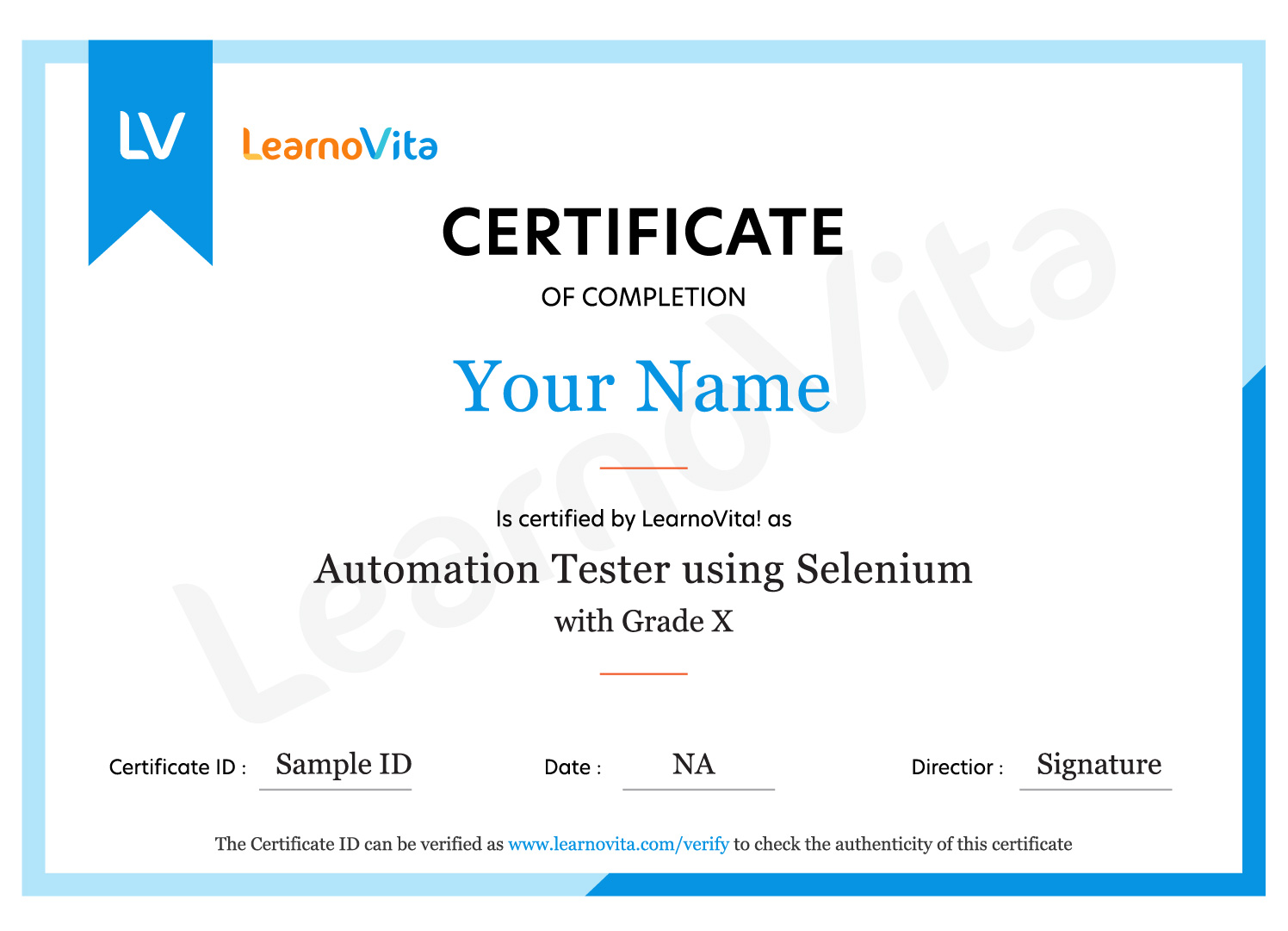
Earning an AI and Machine Learning certification validates your expertise in designing, building and deploying intelligent systems. It demonstrates your ability to work with algorithms, neural networks and predictive models. The certification enhances credibility with employers, improves career prospects and opens opportunities in data-driven industries and innovative technology roles.
While the certification significantly enhances your employability, a guaranteed job depends on your skills, portfolio and interview performance. Completing the certification equips you with practical project experience, industry-relevant expertise and direction to pursue in-demand data science and AI positions.
  • Machine Learning Engineer
  • Data Scientist
  • AI Developer
  • Data Analyst
The certification strengthens your practical and theoretical knowledge, making you proficient in building AI solutions for real-world problems. It provides exposure to advanced algorithms, modeling techniques and project implementation. This prepares you for senior roles, increases earning potential and positions you as a skilled professional in the rapidly growing AI and data-driven technology sector.

MNC Recognized course
complete certification
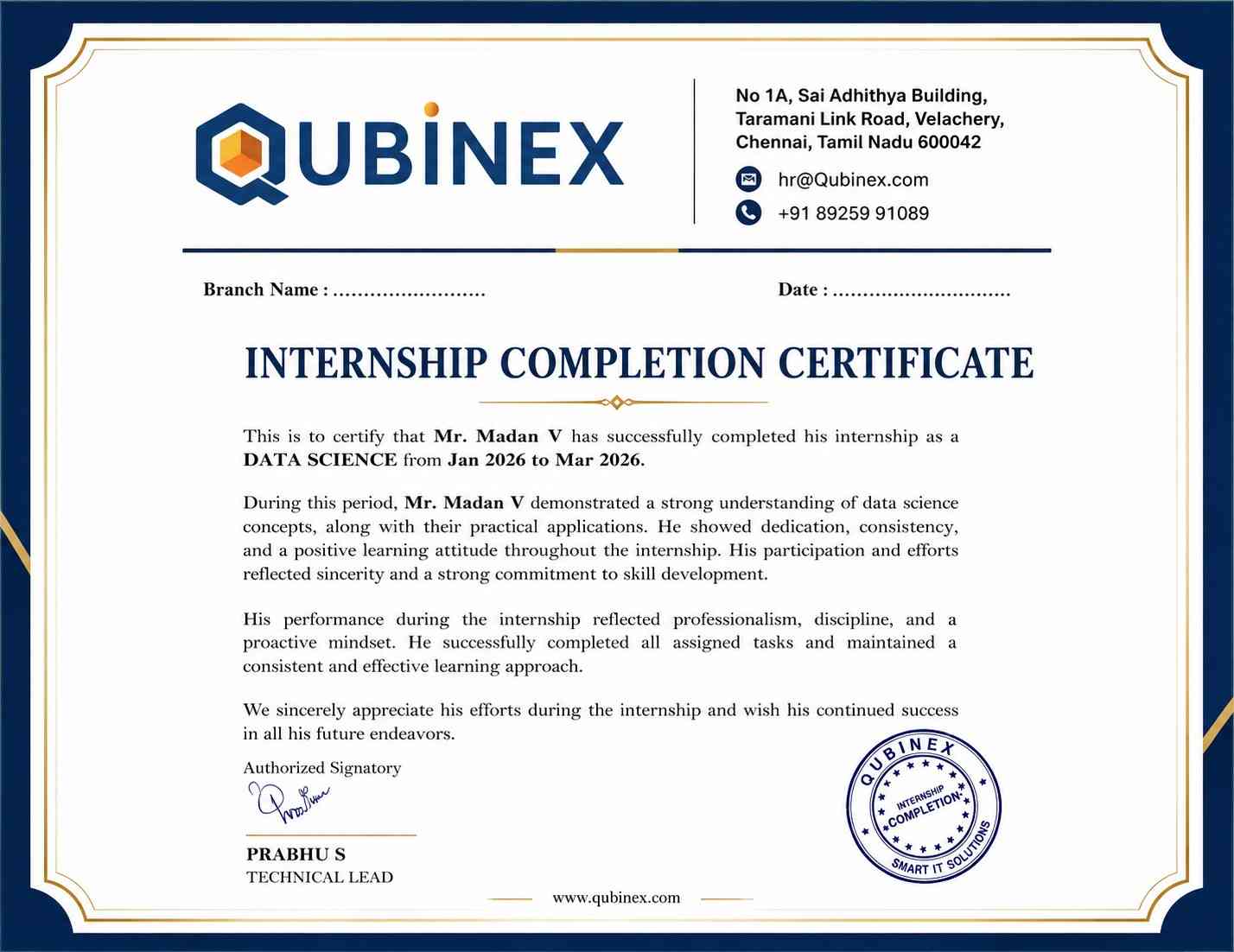
Intership
complete certification
Placement
complete certification

Our learners
transformed their careers

35 Laks
Highest Salary Offered
50%
Average Salary Hike
30K+
Placed in MNC's
15+
Year's in Training
Our Alumni
Alumni

A majority of our alumni

fast-tracked into managerial careers.

Get inspired by their progress in the Career Growth Report.

Our Student Successful Story

checkimage Regular 1:1 Mentorship From Industry Experts checkimage Live Classes checkimage Career Support

How are the AI and Machine Learning Course with LearnoVita Different?

Feature

LearnoVita

Other Institutes

Affordable Fees

Competitive Pricing With Flexible Payment Options.

Higher AI and Machine Learning Fees With Limited Payment Options.

Live Class From ( Industry Expert)

Well Experienced Trainer From a Relevant Field With Practical AI and Machine Learning Training

Theoretical Class With Limited Practical

Updated Syllabus

Updated and Industry-relevant AI and Machine Learning Course Curriculum With Hands-on Learning.

Outdated Curriculum With Limited Practical Training.

Hands-on projects

Real-world AI and Machine Learning Projects With Live Case Studies and Collaboration With Companies.

Basic Projects With Limited Real-world Application.

Certification

Industry-recognized AI and Machine Learning Certifications With Global Validity.

Basic AI and Machine Learning Certifications With Limited Recognition.

Placement Support

Strong Placement Support With Tie-ups With Top Companies and Mock Interviews.

Basic Placement Support

Industry Partnerships

Strong Ties With Top Tech Companies for Internships and Placements

No Partnerships, Limited Opportunities

Batch Size

Small Batch Sizes for Personalized Attention.

Large Batch Sizes With Limited Individual Focus.

Additional Features

Lifetime Access to AI and Machine Learning Course Materials, Alumni Network, and Hackathons.

No Additional Features or Perks.

Training Support

Dedicated Mentors, 24/7 Doubt Resolution, and Personalized Guidance.

Limited Mentor Support and No After-hours Assistance.

AI and Machine Learning Course FAQ's

Certainly, you are welcome to join the demo session. However, due to our commitment to maintaining high-quality standards, we limit the number of participants in live sessions. Therefore, participation in a live class without enrollment is not feasible. If you're unable to attend, you can review our pre-recorded session featuring the same trainer. This will provide you with a comprehensive understanding of our class structure, instructor quality, and level of interaction.
All of our instructors are employed professionals in the industry who work for prestigious companies and have a minimum of 9 to 12 years of significant IT field experience. A great learning experience is provided by all of these knowledgeable people at LearnoVita.
  • LearnoVita is dedicated to assisting job seekers in seeking, connecting, and achieving success, while also ensuring employers are delighted with the ideal candidates.
  • Upon successful completion of a career course with LearnoVita, you may qualify for job placement assistance. We offer 100% placement assistance and maintain strong relationships with over 650 top MNCs.
  • Our Placement Cell aids students in securing interviews with major companies such as Oracle, HP, Wipro, Accenture, Google, IBM, Tech Mahindra, Amazon, CTS, TCS, Sports One , Infosys, MindTree, and MPhasis, among others.
  • LearnoVita has a legendary reputation for placing students, as evidenced by our Placed Students' List on our website. Last year alone, over 5400 students were placed in India and globally.
  • We conduct development sessions, including mock interviews and presentation skills training, to prepare students for challenging interview situations with confidence. With an 85% placement record, our Placement Cell continues to support you until you secure a position with a better MNC.
  • Please visit your student's portal for free access to job openings, study materials, videos, recorded sections, and top MNC interview questions.
LearnoVita Certification is awarded upon course completion and is recognized by all of the world's leading global corporations. LearnoVita are the exclusive authorized Oracle, Microsoft, Pearson Vue, and AI and Machine Learning exam centers, as well as an authorized partner of AI and Machine Learning. Additionally, those who want to pass the National Authorized Certificate in a specialized IT domain can get assistance from LearnoVita's technical experts.
As part of the training program, LearnoVita provides you with the most recent, pertinent, and valuable real-world projects. Every program includes several projects that rigorously assess your knowledge, abilities, and real-world experience to ensure you are fully prepared for the workforce. Your abilities will be equivalent to six months of demanding industry experience once the tasks are completed.
At LearnoVita, participants can choose from instructor-led online training, self-paced training, classroom sessions, one-to-one training, fast-track programs, customized training, and online training options. Each mode is designed to provide flexibility and convenience to learners, allowing them to select the format that best suits their needs. With a range of training options available, participants can select the mode that aligns with their learning style, schedule, and career goals to excel in AI and Machine Learning.
LearnoVita guarantees that you won't miss any topics or modules. You have three options to catch up: we'll reschedule classes to suit your schedule within the course duration, provide access to online class presentations and recordings, or allow you to attend the missed session in another live batch.
Please don't hesitate to reach out to us at contact@learnovita.com if you have any questions or need further clarification.
To enroll in the AI and Machine Learning at LearnoVita, you can conveniently register through our website or visit any of our branches in India for direct assistance.
Yes, after you've enrolled, you will have lifetime access to the student portal's study materials, videos, and top MNC interview questions.
At LearnoVita, we prioritize individual attention for students, ensuring they can clarify doubts on complex topics and gain a richer understanding through interactions with instructors and peers. To facilitate this, we limit the size of each AI and Machine Learning Service batch to 5 or 6 members.
The average annual salary for AI and Machine Learning Professionals in India is 3 LPA to 8 LPA.
view More view Less
Career Assistance
  • Build a Powerful Resume for Career Success
  • Get Trainer Tips to Clear Interviews
  • Practice with Experts: Mock Interviews for Success
  • Crack Interviews & Land Your Dream Job
100% JOB GUARANTEE

Global Quality Training
At The Lowest Fees & Expert Trainer

AVAILABLE IN:
India Canada USA Singapore UAE Australia EU Germany

Need custom pricing?

4.9/5 from 50k+ students
Acte Technologies WhatsApp
Call Us! Chat With Us