Home » Others Courses » Tableau Certification Course in San Francisco

Tableau Certification Course in San Francisco

(4.7) 19452 Ratings
  • Enroll in the Tableau Course in San Francisco to master business intelligence concepts.
  • Learn key features such as dashboards, calculated fields, data blending, and interactive reporting tools.
  • Gain hands-on experience through real-time projects, data analysis, dashboard creation, and live case studies.
  • Ideal for Tableau Developers, Data Analysts, BI Professionals, and IT Experts seeking career growth.
  • Choose from flexible batch timings: Weekday, Weekend, or Fast-Track learning options.
  • Benefit from placement support, resume building, interview preparation, and certification guidance.

Course Duration

50+ Hrs

Live Project

3 Project

Certification Pass

Guaranteed

Training Format

Live Online (Expert Trainers)
Quality Training With Affordable Fee

⭐ Fees Starts From

INR 38,000
INR 18,500

11658+

Professionals Trained

10+

Batches every month

2688+

Placed Students

245+

Corporate Served

What You'll Learn

Tableau Certification Course in San Francisco delivers deep expertise in data storytelling and modern business intelligence strategies for smarter decision-making.

Build strong foundations through structured modules covering data connections, calculated fields, visual analytics, and performance optimization techniques.

Strengthen analytical capabilities by transforming raw datasets into meaningful insights that support strategic planning and operational growth.

Gain practical exposure with Tableau training in San Francisco, working on live datasets, dashboard publishing, and collaborative reporting workflows.

Explore advanced features including data blending, parameter controls, level of detail expressions, and dynamic visualization customization.

Earn industry-valued Tableau certification credentials that enhance career opportunities in analytics, reporting, and data-driven business environments.

An Overview of Tableau Training

The Tableau Course in San Francisco is thoughtfully designed to equip learners with in-depth expertise in data visualization, dashboard design, and modern business intelligence techniques. Through Tableau training in San Francisco, participants gain practical exposure by working with real-world datasets, interactive reporting scenarios, and guided hands-on sessions led by experienced analytics professionals. This Tableau Certification Course in San Francisco offers flexible learning formats, including classroom-based and instructor-led online sessions, allowing professionals and students to learn at their convenience. The structured Tableau training course strengthens analytical thinking, improves data interpretation skills, and prepares candidates to confidently handle complex business reporting requirements.

Additional Info

Future Trends for Tableau Training

  • AI-Driven Data Visualization in Tableau: The future of Tableau training is closely connected with artificial intelligence that simplifies how users explore complex datasets. Learners will increasingly study features that recommend charts, highlight anomalies, and surface insights automatically. Training programs are beginning to focus on teaching professionals how to interpret AI-generated suggestions rather than just building dashboards manually. This shift helps analysts move from basic reporting to strategic storytelling. As businesses rely more on predictive insights, courses will include real business simulations that mirror evolving industry demands. Understanding how AI enhances visualization accuracy will become a core competency for aspiring Tableau experts. Professionals who master AI-supported analytics will stand out in competitive data careers.
  • Real-Time Data Integration Skills: Modern organizations operate on live data streams, and Tableau training is adapting to this demand. Future-focused courses emphasize connecting dashboards to cloud databases, APIs, and streaming platforms. Learners are taught how to manage performance while working with continuously updating datasets. This ensures decisions are based on the most current information available. Training also covers troubleshooting latency and optimizing queries for speed. By mastering real-time data workflows, professionals gain confidence in handling high-pressure reporting environments. These skills are especially valuable in finance, healthcare, and e-commerce sectors.
  • Cloud-Based Analytics Expertise: With businesses migrating to cloud ecosystems, Tableau training now integrates cloud analytics practices. Learners explore how Tableau works seamlessly with platforms like cloud data warehouses and SaaS environments. Training includes deployment strategies, online collaboration, and secure data sharing across distributed teams. This cloud-first approach prepares professionals for hybrid and remote workplaces. Understanding permissions, governance, and scalability in cloud dashboards is becoming essential. Courses increasingly mirror enterprise-level implementations rather than standalone desktop projects. As cloud adoption rises, cloud-savvy Tableau professionals will remain in high demand.
  • Data Storytelling and Business Communication: Future Tableau training goes beyond charts and focuses on storytelling with impact. Professionals are trained to design dashboards that communicate insights clearly to non-technical stakeholders. Emphasis is placed on visual hierarchy, color psychology, and narrative flow. Learners practice presenting findings in boardroom-style scenarios. This approach transforms data analysts into business influencers. Organizations seek professionals who can translate numbers into meaningful strategies. Strong storytelling skills enhance leadership opportunities in analytics roles.
  • Industry-Specific Tableau Specializations: Training programs are increasingly tailored to industry needs such as healthcare analytics, retail intelligence, and financial reporting. Instead of generic dashboards, learners work on domain-focused case studies. This specialization improves job readiness and industry relevance. Understanding sector-specific KPIs and compliance standards adds depth to training. Professionals gain insights into how analytics drives operational decisions in particular industries. Customized learning paths are becoming more common in advanced programs. Industry-focused expertise helps candidates position themselves strategically in the job market.
  • Integration with Advanced Analytics Tools: The future of Tableau training includes integration with programming languages and statistical tools. Learners are exposed to connecting Tableau with Python, R, and machine learning models. This allows dashboards to display predictive and prescriptive analytics outputs. Training focuses on bridging the gap between data science and business intelligence teams. Understanding how to embed advanced calculations enhances dashboard sophistication. Professionals who combine analytics tools with visualization skills gain a competitive advantage. Cross-functional expertise is shaping the next generation of Tableau specialists.
  • Emphasis on Data Governance and Security: As data privacy regulations evolve, Tableau training now incorporates governance best practices. Learners study role-based access control, secure publishing, and data source certification. Organizations expect analytics professionals to protect sensitive information. Courses include practical exercises in managing user permissions and maintaining compliance. Understanding governance ensures dashboards remain trustworthy and secure. This knowledge is especially critical in regulated industries. Security-focused training enhances credibility and professional responsibility.
  • Mobile and Responsive Dashboard Design: With executives accessing reports on smartphones and tablets, Tableau training is adapting to mobile-first strategies. Learners are taught to design responsive dashboards optimized for various screen sizes. Training includes user experience principles to improve readability on compact devices. Professionals practice creating interactive views that maintain clarity without clutter. Mobile-ready analytics supports faster decision-making on the go. This trend reflects the growing need for accessibility and flexibility. Designing for mobility increases the practical value of analytics solutions.
  • Collaborative Analytics and Team Workflows: Future Tableau training emphasizes teamwork and collaborative data projects. Learners practice version control, shared dashboards, and feedback integration. Collaboration tools within Tableau are explored in depth. This prepares professionals for enterprise environments where analytics is a team effort. Communication between analysts, managers, and developers becomes smoother. Training simulates real workplace collaboration scenarios. Strong teamwork skills enhance productivity and project success.
  • Continuous Learning and Certification Evolution: The landscape of Tableau certification is evolving to match rapid technological change. Training programs now encourage ongoing skill upgrades rather than one-time certification goals. Learners are guided on preparing for updated certification standards. Continuous learning modules help professionals stay relevant in a fast-moving analytics market. Employers value candidates who demonstrate commitment to growth. Future-oriented training emphasizes adaptability and innovation. Staying updated ensures long-term career sustainability in data analytics.

Tools and Technologies for Tableau Training

  • Tableau Desktop: Tableau Desktop stands at the core of Tableau training because it is where most visualization development begins. Learners use it to connect to multiple data sources, clean datasets, and design interactive dashboards from scratch. It helps users understand the structure of data through calculated fields, filters, and parameters. During training, students practice transforming raw numbers into meaningful visual stories. Mastering Tableau Desktop builds a strong technical foundation for any aspiring data professional.
  • Tableau Server: Tableau Server is essential for understanding how dashboards are shared securely within organizations. In training programs, learners explore how to publish reports and manage user access efficiently. It introduces governance practices, permission settings, and content scheduling. Students also gain insight into maintaining performance while supporting multiple users. Knowledge of Tableau Server prepares professionals for enterprise-level analytics environments.
  • Tableau Online: Tableau Online plays a vital role in cloud-based analytics education. It allows learners to understand how dashboards can be hosted and accessed without on-premise infrastructure. Training covers collaboration features, automatic updates, and secure remote access. Participants learn how distributed teams interact with shared visual content. This tool reflects the growing importance of cloud-first data strategies.
  • Tableau Prep: Tableau Prep is a powerful data preparation tool included in many training programs. It helps learners clean, combine, and reshape data before visualization begins. Through hands-on practice, students understand how to handle missing values and inconsistencies. The tool simplifies complex data transformation tasks with a visual workflow interface. Strong data preparation skills improve dashboard accuracy and reliability.
  • SQL for Data Management: Structured Query Language, commonly known as SQL, is frequently integrated into Tableau training. It enables learners to query databases and retrieve precise datasets for analysis. Understanding SQL strengthens the ability to filter, aggregate, and join data effectively. Training sessions often combine SQL queries with Tableau visualizations for deeper insights. This technical pairing enhances analytical confidence and career versatility.
  • Microsoft Excel: Microsoft Excel remains a foundational tool within Tableau training environments. Many datasets used in learning projects originate from spreadsheets. Students explore how to structure Excel files properly before importing them into Tableau. Excel also supports quick calculations and preliminary analysis. Familiarity with spreadsheets complements visualization expertise and supports smoother data workflows.
  • Python Integration: Python integration is becoming increasingly relevant in advanced Tableau training. Learners are introduced to connecting Tableau with Python scripts for enhanced analytics. This allows predictive models and custom calculations to appear directly within dashboards. Training highlights how programming can extend visualization capabilities. Combining Python knowledge with Tableau skills broadens professional opportunities in analytics.
  • R Programming Support: R programming is another valuable technology incorporated into specialized training modules. It enables statistical modeling and advanced data analysis alongside Tableau dashboards. Students learn how to pass data between Tableau and R environments for deeper insights. This integration strengthens analytical rigor and supports research-focused projects. Exposure to R adds an extra layer of technical depth to visualization training.
  • Data Warehousing Platforms: Modern Tableau training often includes exposure to data warehousing platforms. Learners explore how Tableau connects with centralized data storage systems. This knowledge helps them understand large-scale data architecture. Training emphasizes performance tuning when working with extensive datasets. Familiarity with warehousing technology prepares professionals for enterprise analytics roles.
  • Cloud Data Connectors: Cloud data connectors are critical tools in contemporary Tableau education. They allow learners to link dashboards with online databases and SaaS applications. Training focuses on secure authentication and efficient data synchronization. Participants gain confidence in managing live connections without compromising speed. Mastering cloud connectivity ensures readiness for today’s dynamic and distributed business landscape.

Roles and Responsibilities for Tableau Training

  • Tableau Data Analyst: A Tableau Data Analyst is responsible for collecting, organizing, and interpreting complex datasets to uncover meaningful business insights. In a Tableau Certification Course training environment, this role focuses on mastering dashboard creation, data blending, and advanced calculations. Analysts ensure reports are accurate, visually clear, and aligned with organizational objectives. They translate raw data into practical recommendations that support strategic decisions. Strong analytical thinking and attention to detail define this role within modern business intelligence teams.
  • Business Intelligence Developer: A Business Intelligence Developer uses Tableau to design scalable reporting solutions for various departments. During certification training, this role emphasizes building interactive dashboards and optimizing performance for large datasets. Developers work closely with stakeholders to understand reporting requirements and technical constraints. They are responsible for maintaining data accuracy and implementing best visualization practices. Their contribution ensures that decision-makers receive timely and actionable insights.
  • Tableau Consultant: A Tableau Consultant advises organizations on implementing effective data visualization strategies. In a Tableau Certification Course training path, consultants learn to assess client requirements and recommend suitable dashboard frameworks. They guide teams in adopting analytics best practices and improving reporting workflows. Consultants also support deployment, user training, and troubleshooting. This role demands both technical expertise and strong communication skills to deliver measurable business value.
  • Data Visualization Specialist: A Data Visualization Specialist focuses on crafting compelling and user-friendly dashboards. Within Tableau training, this role involves mastering design principles, storytelling techniques, and interactive features. Specialists ensure that visual elements enhance clarity rather than overwhelm the audience. They experiment with layout structures, color schemes, and navigation flows. Their responsibility is to make complex information easy to interpret for both technical and non-technical users.
  • Analytics Manager: An Analytics Manager oversees data projects and ensures alignment with organizational goals. Through Tableau Certification Course training, this role learns how to supervise dashboard development and maintain reporting standards. Managers coordinate between analysts, IT teams, and leadership to deliver consistent insights. They evaluate data strategies and identify opportunities for process improvement. Leadership, planning, and performance monitoring are central responsibilities in this position.
  • Tableau Developer: A Tableau Developer specializes in building advanced dashboards and customized reporting solutions. Training programs prepare developers to handle calculated fields, parameters, and data source integrations efficiently. They are responsible for testing visualizations and resolving performance bottlenecks. Developers also document workflows to ensure smooth collaboration within teams. Their expertise transforms technical data requirements into practical visual analytics tools.
  • Data Engineer: A Data Engineer supports Tableau projects by preparing reliable data pipelines. In certification training, this role focuses on structuring datasets for seamless integration with visualization tools. Engineers clean, transform, and maintain large data repositories to ensure consistency. They collaborate with analysts to deliver optimized and accessible data sources. Their technical foundation strengthens the overall accuracy and performance of reporting systems.
  • Reporting Manager: A Reporting Manager ensures that organizational reports are delivered accurately and on schedule. Through Tableau training, they learn to standardize dashboards and enforce governance policies. They review analytics outputs to maintain consistency and compliance. This role involves coordinating reporting cycles and responding to executive data needs. Effective communication and quality control define their responsibilities.
  • Tableau Administrator: A Tableau Administrator manages platform access, security, and system performance. Certification training equips administrators with knowledge of user roles, permissions, and server maintenance. They are responsible for monitoring dashboard usage and optimizing resources. Administrators also troubleshoot technical issues to maintain uninterrupted reporting services. Their work ensures a secure and efficient analytics environment.
  • Business Analyst: A Business Analyst uses Tableau insights to bridge the gap between data teams and leadership. In a Tableau Certification Course training context, they learn to gather business requirements and convert them into analytical solutions. Analysts interpret trends and present findings in a strategic manner. They collaborate with cross-functional teams to support operational improvements. Their responsibility lies in turning data-driven observations into practical business actions.

Companies Hiring Tableau Professionals

  • Amazon: Amazon actively recruits Tableau-trained professionals to strengthen its data-driven culture across retail, logistics, and cloud operations. Teams rely on interactive dashboards to monitor customer behavior, supply chain efficiency, and sales performance. Tableau experts help convert massive volumes of operational data into clear business intelligence reports. Their insights support faster decisions in competitive global markets. Skilled visualization professionals play a key role in optimizing performance across Amazon’s diverse business units.
  • Google: Google values Tableau professionals who can interpret marketing metrics, product analytics, and user engagement trends. Data visualization experts assist teams in understanding advertising performance and operational benchmarks. Clear dashboards help leadership track innovation progress and customer impact. Tableau skills complement Google’s analytics ecosystem by enhancing clarity in reporting. Professionals with strong visualization abilities contribute to smarter strategic planning within the organization.
  • Microsoft: Microsoft seeks Tableau-trained candidates to support analytics across enterprise solutions and cloud services. Visualization specialists collaborate with cross-functional teams to present structured performance insights. Their dashboards help monitor adoption rates, sales targets, and operational KPIs. Clear data storytelling strengthens executive communication and reporting transparency. Tableau expertise adds value in transforming technical datasets into actionable business perspectives.
  • Deloitte: Deloitte hires Tableau professionals to deliver advanced analytics solutions to its consulting clients. Visualization experts design dashboards that simplify financial audits, risk assessments, and operational reviews. Their role often involves presenting insights directly to corporate stakeholders. Strong analytical reporting enhances client decision-making processes. Tableau-trained specialists help Deloitte maintain its reputation for data-driven advisory excellence.
  • Accenture: Accenture integrates Tableau expertise into digital transformation projects across industries. Professionals create interactive reports that guide technology upgrades and process improvements. Clear visualizations help clients understand complex performance data quickly. Tableau skills are particularly valuable in large-scale analytics implementations. Certified experts support Accenture’s mission to deliver measurable and sustainable business results.
  • Infosys: Infosys actively recruits Tableau professionals to strengthen its business intelligence service offerings. Visualization specialists assist global clients in interpreting operational and financial metrics. Their dashboards provide clarity in performance tracking and forecasting initiatives. Strong reporting capabilities enhance project delivery outcomes. Tableau-trained candidates add depth to Infosys’ analytics and consulting solutions.
  • Tata Consultancy Services: Tata Consultancy Services values Tableau-certified professionals for enterprise analytics deployments. Experts design dashboards that support banking, healthcare, and retail clients. Clear and structured visual reports improve transparency across large organizations. Tableau skills enable efficient monitoring of KPIs and compliance metrics. Skilled analysts contribute to scalable and reliable data reporting frameworks within TCS projects.
  • IBM: IBM seeks Tableau specialists to complement its advanced analytics and AI-driven initiatives. Visualization professionals help translate complex datasets into digestible insights for business leaders. Their dashboards often support research, operations, and client advisory services. Accurate reporting enhances confidence in data-backed decisions. Tableau-trained experts strengthen IBM’s analytics-driven innovation strategy.
  • Capgemini: Capgemini employs Tableau professionals to enhance digital reporting solutions for global enterprises. Experts focus on creating structured dashboards aligned with client objectives. Their work improves transparency in financial, operational, and customer analytics. Effective visualization supports faster executive-level decision-making. Tableau certification increases opportunities within Capgemini’s expanding analytics practice.
  • Cognizant: Cognizant hires Tableau-trained analysts to deliver comprehensive business intelligence services. Visualization experts design performance dashboards tailored to industry-specific needs. Their insights assist clients in identifying trends and improving operational efficiency. Clear reporting frameworks strengthen collaboration between technical and management teams. Tableau-certified professionals contribute significantly to Cognizant’s data-driven transformation projects.
View more

Tableau Training Objectives

There are no strict eligibility requirements for joining Tableau training, but a basic understanding of data concepts and familiarity with spreadsheets can make learning smoother. Individuals who have worked with reports, metrics, or simple databases will find it easier to grasp visualization techniques. Even beginners from non-technical backgrounds can enroll if they are comfortable working with numbers and logical thinking. A curiosity to explore patterns in data and a willingness to practice regularly are often more important than prior technical expertise. With the right guidance and consistent effort, learners from diverse academic streams can succeed in mastering Tableau.
Tableau training strengthens your ability to convert raw data into meaningful visual insights that support informed decision-making. It enhances analytical thinking and improves your confidence in presenting reports to management teams. The program also builds hands-on experience in dashboard design, data blending, and performance optimization. By completing the training, you expand your career options in analytics, reporting, and business intelligence roles. Most importantly, you gain a practical skill set that is highly valued across multiple industries.
  • Growing demand for data visualization experts across industries
  • Increasing integration with cloud and advanced analytics platforms
  • Expansion of self-service business intelligence solutions
  • Rising need for real-time and interactive reporting systems
  • Strong career opportunities in global analytics markets
  • Continuous innovation with AI-supported insights
Tableau holds a significant position in today’s employment landscape because organizations rely heavily on data-driven strategies. Companies prefer professionals who can interpret complex information and present it clearly to stakeholders. Tableau skills help bridge the gap between technical data teams and business leaders. As digital transformation accelerates, visualization expertise has become a core requirement in analytics-related job descriptions. Professionals with Tableau knowledge often enjoy broader career mobility and competitive salary prospects.
  • Introduction to data visualization concepts
  • Connecting and managing multiple data sources
  • Creating charts, dashboards, and interactive reports
  • Working with calculated fields and parameters
  • Data blending and advanced filtering techniques
  • Publishing and sharing dashboards securely
Yes, most Tableau training programs include practical assignments based on real business scenarios. Learners work with industry-relevant datasets to design dashboards that reflect workplace challenges. These projects help participants understand reporting standards and stakeholder expectations. Hands-on exposure improves confidence in handling live data environments. Real-world practice ensures students are better prepared for professional analytics roles after course completion.
  • Information Technology and Software Services
  • Banking and Financial Services
  • Healthcare and Pharmaceuticals
  • Retail and E-commerce
  • Manufacturing and Supply Chain
  • Consulting and Professional Services
While Tableau training significantly improves your employability, no course can promise a guaranteed job placement. Success depends on your practical skills, communication abilities, and overall interview performance. However, gaining strong visualization expertise and completing hands-on projects can greatly enhance your profile. Many employers value candidates who demonstrate applied knowledge rather than just theoretical understanding. With consistent practice and professional preparation, the training can open promising career opportunities.
  • Improved data analysis and visualization capabilities
  • Enhanced decision-making and reporting skills
  • Greater career flexibility across industries
  • Practical exposure to real business datasets
  • Stronger resume with in-demand technical expertise
  • Increased confidence in presenting insights
Participants in Tableau training typically gain hands-on experience with Tableau Desktop for dashboard creation, Tableau Prep for data cleaning and transformation, and Tableau Server or Tableau Online for publishing and collaboration. In addition, they often work with supporting tools such as Excel and basic SQL for data preparation. This combination of visualization and data management tools ensures learners are well-equipped to handle end-to-end analytics tasks in professional environments.
view More view Less

Tableau Course Benefits

The Tableau course in San Francisco delivers immersive, hands-on learning where students work directly with live datasets to build insightful dashboards and business reports. Participants gain practical exposure through a structured Tableau internship, allowing them to apply visualization techniques in real business scenarios. The program blends conceptual clarity with guided projects, helping learners strengthen analytical thinking and presentation skills. With a dedicated Tableau course with placement support system, students receive career guidance, interview preparation, and opportunities to connect with hiring companies.

  • Designation
  • Annual Salary
    Hiring Companies
  • 3.24L
    Min
  • 6.5L
    Average
  • 13.5L
    Max
  • 4.50L
    Min
  • 8.5L
    Average
  • 16.5L
    Max
  • 4.0L
    Min
  • 8.5L
    Average
  • 14.5L
    Max
  • 5.24L
    Min
  • 9.5L
    Average
  • 12.5L
    Max

About Tableau Certification Training

The Tableau certification course in San Francisco equips learners with strong capabilities in designing, analyzing, and deploying impactful business intelligence dashboards for real organizational needs. Through practical Tableau projects, participants work with structured and unstructured datasets to build interactive reports that support data-driven decisions. The program emphasizes real-time case studies, advanced visualization strategies, and performance optimization techniques guided by experienced mentors. With dedicated career mentoring and strong employer connections, the course prepares candidates confidently for competitive analytics roles.

Top Skills You Will Gain
  • Data Visualization
  • Dashboard Design
  • Data Blending
  • Advanced Calculations
  • Interactive Reporting
  • Visual Storytelling
  • Data Modeling
  • Performance Tuning

12+ Tableau Tools

Online Classroom Batches Preferred

Weekdays (Mon - Fri)
27 - Apr - 2026
08:00 AM (IST)
Weekdays (Mon - Fri)
29 - Apr - 2026
08:00 AM (IST)
Weekend (Sat)
2 - May - 2026
11:00 AM (IST)
Weekend (Sun)
3 - May - 2026
11:00 AM (IST)
Can't find a batch you were looking for?
₹38,000 ₹18,500 10% OFF Expires in

No Interest Financing start at ₹ 5000 / month

Corporate Training

  • Customized Learning
  • Enterprise Grade Learning Management System (LMS)
  • 24x7 Support
  • Enterprise Grade Reporting

Not Just Studying
We’re Doing Much More!

Empowering Learning Through Real Experiences and Innovation
Hiring
Hiring
Hiring
Hiring
Hiring
Hiring
Hiring
User
User
User
User
User
User

Tableau Course Curriculum

Trainers Profile

The Tableau certification course in San Francisco is guided by experienced analytics professionals who bring strong industry exposure in data visualization and reporting. The program emphasizes practical learning, enabling participants to work confidently with real datasets and interactive dashboards. Comprehensive Tableau training materials are provided to strengthen conceptual understanding and support structured skill development. Learners gain the ability to analyze data trends, craft compelling visual stories, and prepare for analytics-driven career opportunities.

Syllabus for Tableau Training Download syllabus

  • Fundamentals of business intelligence
  • Overview of Tableau environment
  • Understanding data types
  • Navigation and workspace setup
  • Connecting to basic data sources
  • Importing Excel files
  • Working with text and CSV files
  • Connecting to databases
  • Live vs extract connections
  • Data source properties
  • Using Tableau Prep interface
  • Cleaning inconsistent data
  • Combining multiple datasets
  • Pivoting and splitting fields
  • Handling null values
  • Building bar and line charts
  • Pie charts and area graphs
  • Maps and geographic visuals
  • Heat maps and tree maps
  • Highlight tables
  • Creating basic calculations
  • Logical functions
  • String functions
  • Date functions
  • Aggregations and formulas
  • Applying quick filters
  • Context filters
  • Creating parameters
  • Dynamic filtering
  • Interactive controls
  • Dashboard layout design
  • Adding sheets to dashboards
  • Using containers
  • Formatting elements
  • Adding interactive actions
  • Table calculations
  • Level of detail expressions
  • Trend lines
  • Forecasting
  • Reference lines and bands
  • Primary and secondary sources
  • Relationships between datasets
  • Joining tables
  • Cross-database connections
  • Data model overview
  • Publishing to Tableau Server
  • Sharing dashboards online
  • Exporting reports
  • User permissions
  • Refresh scheduling
(15) view More view Less
Need customized curriculum?

REAL

start
STORIES SUCCESS INSPIRATION
CAREER
UPGRADE
sowmiya

sowmiya

CAREER
UPGRADE
Rajkumar

Rajkumar

CAREER
UPGRADE
Thon

Thon

CAREER
UPGRADE
lavanya

Lavanya

Industry Projects

Project 1
Retail Sales Performance Dashboard

Design an interactive dashboard that analyzes monthly revenue, customer purchase behavior, and product category trends. The project focuses on visual comparison and dynamic filtering to uncover growth opportunities and seasonal buying patterns.

Project 2
Healthcare Analytics Report

Create a comprehensive visualization tracking patient visits, treatment outcomes, and hospital revenue metrics. This project emphasizes meaningful chart selection, calculated fields, and trend analysis to present clear insights for healthcare decision-making.

Project 3
Financial Data Insights Portal

Develop a financial reporting dashboard that highlights expense distribution, revenue streams, and profit variation over time. The project includes advanced calculations, parameter-driven views, and interactive visuals for detailed financial interpretation.

Our Hiring Partner

Exam & Tableau Certification

  • Basic understanding of data concepts
  • Familiarity with spreadsheets
  • Knowledge of simple calculations
  • Comfort working with charts and reports
  • Practical exposure to Tableau software
Tableau certification validates your expertise in data visualization and reporting, demonstrating your ability to work confidently with complex datasets. It strengthens your professional credibility and makes your resume stand out in competitive hiring processes. Certified professionals are often trusted with higher responsibilities and strategic reporting tasks. The credential reflects your commitment to continuous learning and technical excellence in analytics.
Tableau certification does not guarantee employment, but it significantly improves your job prospects. Employers value candidates who can demonstrate validated technical knowledge and hands-on expertise. Success also depends on your communication skills, project experience, and interview performance. When combined with practical skills, certification can open strong career opportunities.
  • Data Analyst
  • Business Intelligence Developer
  • Reporting Analyst
  • Tableau Developer
  • Analytics Consultant
  • Data Visualization Specialist
Tableau certification enhances career growth by strengthening your technical profile and expanding your opportunities in analytics-driven industries. It increases your confidence in handling complex reporting tasks and presenting insights to leadership teams. Certified professionals often gain access to higher-level responsibilities and improved salary prospects. The credential supports long-term professional development in the evolving field of business intelligence.

Our learners
transformed their careers

35 Laks
Highest Salary Offered
50%
Average Salary Hike
30K+
Placed in MNC's
15+
Year's in Training
Our Alumni
Alumni

A majority of our alumni

fast-tracked into managerial careers.

Get inspired by their progress in the Career Growth Report.

Our Student Successful Story

checkimage Regular 1:1 Mentorship From Industry Experts checkimage Live Classes checkimage Career Support

How are the Tableau Course with LearnoVita Different?

Feature

LearnoVita

Other Institutes

Affordable Fees

Competitive Pricing With Flexible Payment Options.

Higher Tableau Fees With Limited Payment Options.

Live Class From ( Industry Expert)

Well Experienced Trainer From a Relevant Field With Practical Tableau Training

Theoretical Class With Limited Practical

Updated Syllabus

Updated and Industry-relevant Tableau Course Curriculum With Hands-on Learning.

Outdated Curriculum With Limited Practical Training.

Hands-on projects

Real-world Tableau Projects With Live Case Studies and Collaboration With Companies.

Basic Projects With Limited Real-world Application.

Certification

Industry-recognized Tableau Certifications With Global Validity.

Basic Tableau Certifications With Limited Recognition.

Placement Support

Strong Placement Support With Tie-ups With Top Companies and Mock Interviews.

Basic Placement Support

Industry Partnerships

Strong Ties With Top Tech Companies for Internships and Placements

No Partnerships, Limited Opportunities

Batch Size

Small Batch Sizes for Personalized Attention.

Large Batch Sizes With Limited Individual Focus.

Additional Features

Lifetime Access to Tableau Course Materials, Alumni Network, and Hackathons.

No Additional Features or Perks.

Training Support

Dedicated Mentors, 24/7 Doubt Resolution, and Personalized Guidance.

Limited Mentor Support and No After-hours Assistance.

Tableau Course FAQ's

LearnoVita Offers the Best Discount Price for you CALL at +91 93833 99991 and know the Exciting offers Available for you!!!
Yes, you can attend the demo session. Even though We have a limited number of participants in a live session to maintain the Quality Standards. So, unfortunately, participation in a live class without enrolment is not possible.If you are unable to attend you can go through our Pre recorded session of the same trainer, it would give you a clear insight about how are the classes conducted, the quality of instructors, and the level of interaction in the class.
All Our instructors are working professionals from the Industry, Working in leading Organizations and have Real-World Experience with Minimum 9-12 yrs of Relevant IT field Experience. All these experienced folks at LearnoVita Provide a Great learning experience.
The trainer will give Server Access to the course seekers, and we make sure you acquire practical hands-on training by providing you with every utility that is needed for your understanding of the course
  • LearnoVita will assist the job seekers to Seek, Connect & Succeed and delight the employers with the perfect candidates.
  • On Successfully Completing a Career Course with LearnoVita, you Could be Eligible for Job Placement Assistance.
  • 100% Placement Assistance* - We have strong relationship with over 650+ Top MNCs, When a student completes his/ her course successfully, LearnoVita Placement Cell helps him/ her interview with Major Companies like Oracle, HP, Wipro, Accenture, Google, IBM, Tech Mahindra, Amazon, CTS, TCS, HCL, Infosys, MindTree and MPhasis etc...
  • LearnoVita is the Legend in offering placement to the students. Please visit our Placed Students's List on our website.
  • More than 5400+ students placed in last year in India & Globally.
  • LearnoVita Conducts development sessions including mock interviews, presentation skills to prepare students to face a challenging interview situation with ease.
  • 85% percent placement record
  • Our Placement Cell support you till you get placed in better MNC
  • Please Visit Your Student's Portal | Here FREE Lifetime Online Student Portal help you to access the Job Openings, Study Materials, Videos, Recorded Section & Top MNC interview Questions
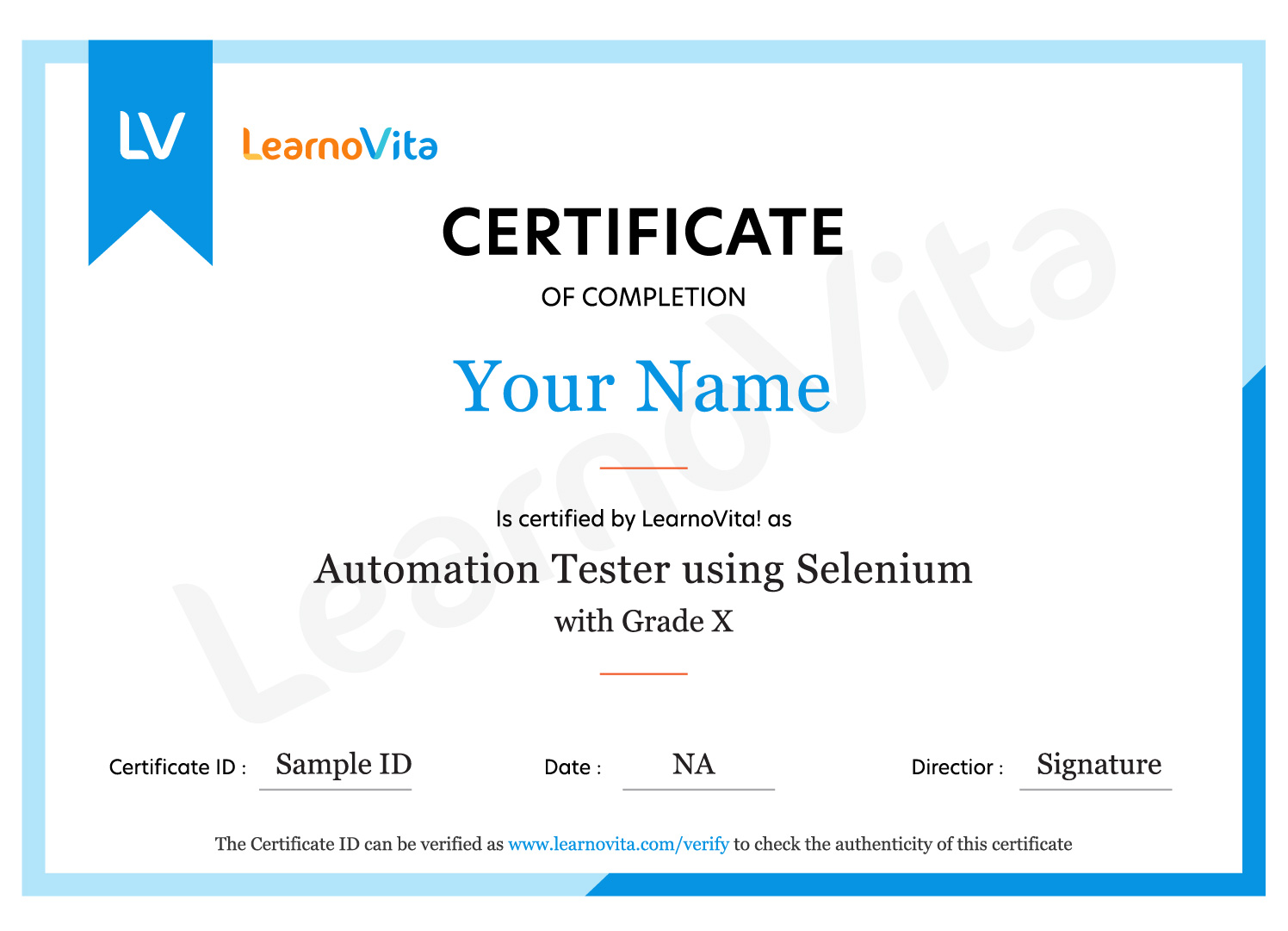
After Your Course Completion You will Receive
  • LearnoVita Certification is Accredited by all major Global Companies around the World.
  • LearnoVita is the unique Authorized Oracle Partner, Authorized Microsoft Partner, Authorized Pearson Vue Exam Center, Authorized PSI Exam Center, Authorized Partner Of AWS.
  • Also, LearnoVita Technical Experts Help's People Who Want to Clear the National Authorized Certificate in Specialized IT Domain.
  • LearnoVita is offering you the most updated, relevant, and high-value real-world projects as part of the training program.
  • All training comes with multiple projects that thoroughly test your skills, learning, and practical knowledge, making you completely industry-ready.
  • You will work on highly exciting projects in the domains of high technology, ecommerce, marketing, sales, networking, banking, insurance, etc.
  • After completing the projects successfully, your skills will be equal to 6 months of rigorous industry experience.
At LearnoVita you can enroll in either the instructor-led Online Training, Self-Paced Training, Class Room, One to One Training, Fast Track, Customized Training & Online Training Mode. Apart from this, LearnoVita also offers Corporate Training for organizations to UPSKILL their workforce.
LearnoVita Assures You will Never lose any Topics and Modules. You can choose either of the Three options:
  • We will reschedule the classes as per your convenience within the stipulated course duration with all such possibilities.
  • View the class presentation and recordings that are available for online viewing.
  • You can attend the missed session, in any other live batch.
Just give us a CALL at +91 9383399991 OR email at contact@learnovita.com
Yes We Provide Lifetime Access for Student’s Portal Study Materials, Videos & Top MNC Interview Question After Once You Have Enrolled.
We at LearnoVita believe in giving individual attention to students so that they will be in a position to clarify all the doubts that arise in complex and difficult topics and Can Access more information and Richer Understanding through teacher and other students' body language and voice. Therefore, we restrict the size of each Tableau batch to 5 or 6 members
Learning Tableau can help open up many opportunities for your career. It is a GREAT SKILL-SET to have as many developer roles in the job market requires proficiency in Tableau. Mastering Tableau can help you get started with your career in IT. Companies like Oracle, IBM, Wipro, HP, HCL, DELL, Bosch, Capgemini, Accenture, Mphasis, Paypal, and MindLabs.
The Average Tableau Developer salary in India is ₹4,43,568 per annum.
You can contact our support number at +91 93800 99996 / Directly can do by LearnoVita E-commerce payment system Login or directly walk-in to one of the LearnoVita branches in India.
view More view Less
Career Assistance
  • Build a Powerful Resume for Career Success
  • Get Trainer Tips to Clear Interviews
  • Practice with Experts: Mock Interviews for Success
  • Crack Interviews & Land Your Dream Job

Find Tableau Training in Other Cities

Acte Technologies WhatsApp