Home » Mircosoft » Android Training in Chennai

Android Training in Chennai

(4.7) 19658 Ratings
  • Enroll in Android Course in Chennai to Master Mobile App Development.
  • Choose from Convenient Learning Modes: Weekday, Weekend, or Accelerated Batches.
  • Android Development Program with Industry-Relevant Placement Support.
  • Curriculum Includes Java, Kotlin, Android Studio, UI/UX Design, Firebase, and SQLite.
  • Hands-On Experience with Live Projects and Interactive Sessions Led by Skilled Android Developers.
  • Boost Your Career with Resume Assistance, Interview Practice, and Job Readiness for Android Roles.

Course Duration

50+ Hrs

Live Project

3 Project

Certification Pass

Guaranteed

Training Format

Live Online (Expert Trainers)
WatchLive Classes
Course fee at
₹14500

₹18000

12257+

Professionals Trained

11+

Batches every month

3321+

Placed Students

316+

Corporate Served

What You'll Learn

Master Android app development with hands-on experience and real-world projects.

Learn to design responsive user interfaces and implement advanced UI/UX concepts in Android Course in Chennai.

Understand Android components like Activities, Services, and Broadcast Receivers.

Gain expertise in Java and Kotlin programming languages for Android app creation.

Learn to integrate APIs, handle databases, and optimize app performance effectively.

Build and deploy apps with industry-standard practices in our Android Training in Chennai.

An Complete Overview of Android Course

Our Android Training in Chennai offers comprehensive Android Training designed to equip you with essential skills in Android app development. This Android Course in Chennai covers everything from app architecture to advanced topics like UI/UX design, Java/Kotlin programming, and database integration. With expert instructors and hands-on projects, you'll be prepared for real-world challenges. Upon completion, you will receive an Android Certification and benefit from our Android Course with Placement support to kickstart your career. Gain experience by working on live Android projects to build a strong portfolio. Stay updated with the latest industry trends and best practices in mobile development. Flexible class schedules and weekend batches available to suit your convenience. Join a community of learners and get continuous mentorship even after course completion. Enroll now for Android Certification Course in Chennai and gain your career.

Additional Info

Exploring The Future Trends in Android Training

  • Kotlin as the Primary Language: Kotlin is quickly becoming the primary language for Android app development, replacing Java due to its concise syntax, safety features, and full compatibility with existing Java code. The language's ability to reduce boilerplate code and enhance productivity makes it a preferred choice. Android development training will focus more on Kotlin, equipping developers with essential skills for modern Android applications.
  • Cross-Platform Development: As demand grows for applications that can run across multiple platforms, tools like Flutter and React Native are gaining popularity in Android development. Cross-platform frameworks allow developers to write single codebase for both Android and iOS saving time and cost. Future Android training will emphasize these frameworks alongside native Android development, offering versatility in app creation.
  • AI and Machine Learning Integration: Artificial Intelligence (AI) and Machine Learning (ML) becoming integral to mobile app development. Android developers are learning to integrate AI-driven features like recommendation systems, facial recognition, and natural language processing into apps. Training will focus on using Android libraries such as TensorFlow Lite and ML Kit, which allow developers to bring intelligent features to their mobile apps.
  • Augmented Reality (AR) and Virtual Reality (VR): AR and VR technologie are becoming mainstream in mobile app development, with apps using them for gaming, retail, and education. Android training will include practical applications of ARCore, Google’s AR platform, helping developers create immersive experiences. This trend is expanding the possibilities of Android app development into new, innovative area.
  • Cloud-Based Android Apps: With the rise of cloud computing, Android app development is shifting towards cloud-based solutions. Cloud storage, cloud functions, and serverless architectures are becoming essential components in modern Android apps. Future Android training programs will focus on integrating cloud services like Firebase and AWS, ensuring developers can build scalable and reliable apps.
  • 5G Network Integration: The rollout of 5G networks will enable faster data transfer, leading to the development of more data-heavy apps. Android developers need to learn how to design apps that can leverage these high-speed networks, particularly in areas such as real-time streaming and IoT. Training will involve optimizing apps for 5G capabilities and ensuring maximum performance.
  • Jetpack Libraries: Jetpack, a set of Android libraries, is transforming how developers build Android apps by offering easy-to-use components for app architecture. These libraries simplify app development by automating common tasks and enhancing app performance. Training in Android will increasingly cover Jetpack components like Navigation, LiveData and Room to streamline app development and improve the user experience.
  • Internet of Things (IoT) Integration: As the IoT ecosystem grows, Android app are playing a key role in connecting and controlling smart devices. Future Android training will incorporate IoT integration, teaching developers how to build apps that communicate with devices like wearable smart home systems, and industrial sensors. This trend will open new opportunities for Android developers in the rapidly expanding IoT market.
  • App Security Features: With the growing concern around data breaches and app vulnerabilities, Android app security is becoming a top priority. Training will emphasize securing apps using encryption, secure APIs, and Google Play Protect. Developers will learn to implement best practices in authentication, data privacy, and app integrity, ensuring that users' personal information remains safe.
  • Instant Apps: Android Instant Apps are lightweight versions of native Android apps that don't require installation. These apps allow users to try out features instantly and seamlessly transition to full apps. As part of Android training, developers will learn to build Instant Apps, enabling a smoother user experience and improving app discoverability on the Google Play Store.

Essential Tools and Technologies in Android Training:

  • Android Studio: Android Studio is official Integrated Development Environment (IDE) for Android app development It provides a complete set of tool including a code editor, debugger and emulator, to streamline the development process. With its robust features like IntelliJ IDEA integration, code completion, and easy access to Android SDKs, Android Studio is essential for building and testing high-quality Android apps. It supports both Java and Kotlin making flexible for modern app development.
  • Kotlin: Kotlin is statically typed programming language that run on Java Virtual Machine (JVM), designed to fully integrate with Android. It's the preferred language for Android development due to its conciseness safety, and interoperability with Java. Kotlin reduces boilerplate code, increases productivity, and enhances the readability of Android applications. As part of Android training Kotlin is becoming a core focus for developers looking to modernize their app development process.
  • Firebase: Firebase is a suite cloud-based tools and service that enhance Android app functionality. It offers services like real-time databases, authentication, analytics push notifications, and hosting. Firebase is essential for managing user data, implementing scalable backends, and integrating cloud-based features without complex server management. It significantly reduces development time and provides robust infrastructure for building high-performance apps.
  • Gradle: Gradle is a powerful build automation tool used in Android development. It simplifies project builds, dependency management, and packaging of Android applications. Gradle supports incremental builds, which speeds up the development process, and allows developers to configure complex workflows with ease. By automating the build process, Gradle ensures that developer can focus more on coding and less on configuration management.
  • Jetpack: Jetpack is collection of Android libraries that make it easier to design modern, maintainable apps. It a wide range of tools and components for architecture, UI design, and performance optimization Key Jetpack libraries like Navigation, LiveData, and Room allow developers to create apps with cleaner code and better architecture Training on Jetpack is crucial for developers looking to follow Android’s best practices and build robust apps with minimal effort.
  • Retrofit: Retrofit is a type-safe HTTP client for Android and Java, designed to simplify API interaction. It allows developers to seamlessly make network requests and convert API responses into Java object. Retrofit is widely used for handling RESTful APIs and integrates easily with Gson or Moshi for JSON parsing. Understanding Retrofit is a key part of Android training, as it streamlines networking in mobile applications, making it essential for apps that rely on external data sources.
  • Appium: Appium is an open-source tool automating mobile application. across platforms, including Android. It support both native and hybrid app and can be used for UI testing. Appium allows developers to write tests using multiple programming languages Java, JavaScript, and Python. By using Appium, Android developers can ensure their apps are properly tested, helping improve functionality and user experience across devices and platforms.
  • Room Database: Room is a persistence library for Android that provide an abstraction layer over SQLite. It simplifies database access and management by providing an easy-to-use API. Room is designed to integrate with Android’s architecture components, offering seamless interaction with databases while ensuring high performance. Learning Room is a fundamental skill in Android training, as it helps developers store and retrieve data efficiently without writing complex SQL queries.
  • Espresso: Espresso is a UI testing framework for Android, used to simulate user interactions in real-time. It is designed for testing the user interface and ensuring that the app’s behavior matches expectations. Espresso is tightly integrated with Android Studio and allows for automated, repeatable tests that improve app reliability. By mastering Espresso, Android developers can enhance their app’s quality by catching UI issues early in the development process.
  • Android Emulator: The Android Emulator developers to test their applications on a variety of virtual devices, simulating real-world conditions without needing physical hardware. It supports different Android versions, screen sizes, and device configurations, making it ideal for testing apps in diverse environments. Learning how to effectively use the Android Emulator is an essential part of Android training, ensuring that developers can perform thorough testing before deployment.

Roles and Responsibilities in Android Training

  • Android Developer: An Android Developer responsible for designing, coding and testing Android applications. They need to create efficient, scalable, and user-friendly apps that align with client requirements. Their tasks include integrating APIs, managing databases, and ensuring apps are responsive across different Android devices. They must also work collaboratively with UI/UX designer and backend developers to ensure seamless functionality. Regular update and bug fixes also part of their ongoing responsibilities.
  • UI/UX Designer: A UI/UX Designer is tasked with crafting visually appealing and user-friendly interfaces for Android apps. They collaborate with developers to create smooth, intuitive designs that enhance the user experience. This includes designing layout structures, navigation patterns, and custom animations. Their role is also to ensure that the application’s design aligns with the brand’s visual identity and meets accessibility standards. Continuous feedback and improvements based on user testing are vital to their role.
  • Android Test Engineer: An Android Test Engineer is responsible for testing Android application to ensure they meet quality standard. They develop and execute test cases, report bugs, and track issues in the development cycle. The engineer works closely with developers to identify performance bottlenecks, security vulnerabilities, and usability issues. They use tools like Espresso and Appium for automated testing to improve efficiency. Their main goal is to ensure that the app functions flawlessly on all supported Android devices.
  • Backend Developer: Backend Developers focus on and maintaining the server-side components of Android applications. They ensure data management, user authentication, and API development work seamlessly with the Android front-end. Their responsibilities include handling database integration, building scalable server infrastructures, and optimizing the app's backend performance. They collaborate with Android developers to ensure smooth communication between the client-side and server-side components. Ensuring data security and system reliability in their role.
  • Android Team Lead: An Android Team Lead oversees the development of Android applications, guiding a team of developers, designers, and testers. They ensure project timelines are met, resources are allocated efficiently, and the final product meets the required specifications. They act as the liaison between stakeholders and the development team, providing regular updates and addressing any roadblocks. Team leads also mentor junior developers and provide technical direction for solving complex problems. Their focus is on maintaining code quality and fostering team collaboration.
  • Mobile App Architect: A Mobile App Architect is responsible for designing the overall structure of an Android app, ensuring it is scalable, maintainable, and efficient. They define the app's core architecture, decide on the technology stack, and design a system that can handle future updates. They work closely with both developers and stakeholders to translate requirements into a clear, logical design. The architect also ensures that the app adheres to industry best practices, including security standards and performance optimizations.
  • Security Specialist: A Security Specialist in Android development ensures the application is secure from vulnerabilities and data breaches. They focus on implementing encryption, secure APIs, and proper authentication measures to safeguard user data. The role involves conducting penetration testing, identifying weaknesses, and recommending solutions to mitigate security risks. Security specialists are also responsible for keeping up to date with Android security updates and ensuring that apps comply with relevant data protection regulations.
  • Android Performance Engineer: An Android Performance Engineer focuses on optimizing Android apps for speed, responsiveness, and low resource consumption. They analyze app performance using profiling tools and make recommendations for improvement in areas such as memory usage, battery consumption, and network efficiency. Their role involves fine-tuning code and identifying performance bottlenecks that could affect user experience. Regular performance testing across multiple devices is key to ensuring smooth app functionality under various conditions.
  • Android DevOps Engineer: An Android DevOps Engineer is responsible for streamlining the development and deployment process of Android apps. They work on automating builds, continuous integration/continuous deployment (CI/CD), and ensuring that code is easily deployable. DevOps engineers focus on optimizing workflows, reducing errors during deployment, and ensuring consistency across different environments. They also monitor app performance post-launch and work with the team to resolve any operational issues quickly.
  • Android Product Manager: An Android Product Manager oversees the development and lifecycle of Android applications, ensuring that the final product meets customer needs and business goals. They work closely with development teams to define features, prioritize tasks, and set timelines. Product Managers are responsible for gathering user feedback, analyzing market trends, and making strategic decisions about app features and improvements. Their role is to bridge the gap between stakeholders, developers, and users, ensuring the app delivers value.

Top Companies Seeking Android Professionals

  • Google: As the creator of Android, Google is always seeking skilled Android professionals to develop and enhance its mobile platform. The company’s Android teams work on a variety of cutting-edge projects, ranging from app development to improving core Android features. Professionals are expected to work with advanced tools and technologies to build innovative features for millions of users globally. Google encourages continuous learning and offers a dynamic work environment for Android developers. They value creativity, efficiency, and the ability to scale applications effectively.
  • Samsung: Samsung, a leading mobile manufacturer, requires Android developers for its vast range of smartphones and tablets. They focus on creating custom Android features that enhance user experience and performance. Working at Samsung provides opportunities to build innovative Android apps, especially for unique devices like foldables and wearables. Android professionals at Samsung work on system-level optimizations, and UI/UX customizations, and contribute to industry-leading mobile technologies. Their collaborative environment fosters the development of groundbreaking mobile solutions.
  • Facebook (Meta): Facebook, now Meta, frequently hires Android professionals to enhance its suite of apps, including Facebook, Instagram, WhatsApp, and Messenger. The company seeks developers to improve app performance, security, and functionality for millions of daily users. Android professionals at Meta work with advanced technologies like machine learning and AI to integrate new features and improve engagement. Meta encourages an open, creative work culture, enabling developer explore new ideas and contribute to high-impact products. It’s a great place for professionals passionate about social connectivity.
  • Amazon: Amazon employs Android professionals to work on its e-commerce app and other Android-based services like Amazon Alexa and Amazon Prime Video. The company offers Android developers the chance to work on large-scale projects with millions of active users. Amazon encourages mobile innovation, requiring professionals to focus on app performance, scalability, and user experience across a range of Android devices. The company values developers who thrive in high-performance environments and can deliver fast, reliable solutions. It’s a great opportunity for Android experts interested in mobile commerce and streaming.
  • Microsoft: Microsoft hires Android professionals to expand its ecosystem beyond Windows, especially on Android devices. The company’s mobile app development focuses on building cross-platform solutions and ensuring seamless integration between Android and Microsoft services. Android developers at Microsoft work on apps like Outlook, Teams, and OneDrive, adapting them for Android devices. They prioritize creating high-quality, secure, and innovative user experiences. Microsoft provides Android professionals with a collaborative work environment, encouraging them to contribute to global-scale mobile projects.
  • Uber: Uber, a global leader in ride-hailing services, employs Android professionals to improve its mobile applications for drivers and riders. The company focuses on performance optimization, real-time GPS integration, and scalable infrastructure. Android developers at Uber work on advanced features like ride prediction algorithms, payment systems, and geolocation services. The company encourages Android professionals to work on high-impact features that reach millions of users worldwide. Uber’s fast-paced, tech-driven culture offers a unique environment for Android developers to grow their careers.
  • Xiaomi: Xiaomi, one of the largest smartphone manufacturers globally, hires Android professionals to work on its custom MIUI operating system and apps. Their Android team focuses on building a fast, efficient, and customizable user experience for Xiaomi’s wide range of Android devices. Developers at Xiaomi are expected to optimize apps and UI elements for performance, including battery life and responsiveness. The company values innovation, encouraging Android developers to experiment with new features and technologies. Xiaomi offers a collaborative environment where developers can contribute to mobile technology advancements.
  • Snap Inc.: Snap Inc., the parent company of Snapchat, hires Android professionals to enhance the app's user interface, security, and performance across a global user base. Android developers at Snap work on exciting features like augmented reality (AR), photo/video filters, and messaging capabilities. They are also tasked with improving app speed and optimizing the app for various Android devices. Snap fosters a creative work environment, encouraging Android developers to push the limits of mobile technology. Professionals working here play a key role in shaping the future of social media.
  • LinkedIn: LinkedIn, the world’s largest professional networking platform, hires Android developers to build and optimize its mobile apps. Android professionals at LinkedIn work on improving user experience, performance, and new features like job recommendations, messaging, and notifications. The company provides an innovative and collaborative environment where Android experts can contribute to one of the largest social platforms globally. Developers are expected to work on scalable solutions and ensure that the app smoothly on various Android devices. LinkedIn values diversity and promotes a work culture that supports career growth and innovation.
  • Spotify: Spotify, a leading music streaming service, frequently hires Android professionals to work on its Android app. Developers at Spotify focus on optimizing the app for smooth playback, personalized recommendations, and offline functionality. They also work on integrating new features such as podcasts, social sharing, and music discovery tools. Spotify encourages Android developers to experiment with new technologies and push the boundaries of mobile music apps. The company provides an innovative atmosphere where professionals can make a tangible impact on of users worldwide.
View more

Android Course Objectives

The recommended prerequisites for our Android course include basic programming knowledge in Java or Kotlin, understanding of object-oriented programming concepts, and familiarity with general software development principles. Additionally, familiarity with version control tools like Git will be beneficial. Basic knowledge of XML for designing user interfaces will also help students to understand the course material more effectively and efficiently.
Enrolling in our Android course provides numerous benefits, such as gaining hands-on experience in building Android applications, learning the latest Android development tools and practices, and acquiring proficiency in Java/Kotlin. You will also gain insights into UI/UX design, databases, cloud services, and performance optimization. The course ensures you are well-equipped to work on real-world Android app development projects, improving your job prospects in the mobile app development industry.
Android plays a vital role in today's job market due to widespread adoption of mobile device globally. As one of the leading operating systems for smartphones, tablets and IoT devices, it provides numerous job opportunities for developers. The demand for skilled Android developers is high across industries such as e-commerce, gaming, healthcare, and entertainment. Android expertise is essential for companies looking to stay competitive in a mobile-first world.
  • Increasing demand for mobile apps in all sectors.
  • Growth of IoT devices and smart technologies powered by Android.
  • Rising opportunities in app monetization and mobile advertising.
  • Emergence of foldable and flexible screens.
  • Expansion in mobile gaming, AR/VR applications.
Yes, our Android course is designed with hands-on learning in mind. Students will work on real-world project that simulate the development process of actual Android applications. These project will help students apply their knowledge to build functional apps, solve real-world challenges, and develop a portfolio that demonstrates their skills. By working on these projects gain practical experience, which is essential for securing employment in Android development.
  • Introduction to Android Development
  • Android Studio and Development Environment
  • Java and Kotlin Programming for Android
  • User Interface Design with XML
  • Data Management in Android (SQLite, Firebase)
While our Android course provides comprehensive training and practical experience, a job guarantee cannot be assured. However, the course significantly enhances your chances of landing a job in Android development by equipping you with the skills required in the industry. We also provide career support, including job placements and interview preparation, to help your career in Android development.
  • Mobile App Development Companies
  • E-commerce Platforms
  • Gaming Industry
  • Healthcare and Fitness Tech
  • Banking and Finance
Participants in our Android course will gain proficiency in several essential tools, including Android Studio (IDE), Gradle (build automation), Firebase (cloud services), Retrofit (networking), Room Database (local storage), and the Android Emulator. Students will also learn about version control systems like Git, testing tools like Espresso, and integration tools such as Jenkins for continuous deployment. These tools will help them become proficient in all aspects of Android app development.
  • Understanding of Android app architecture, frameworks, and libraries.
  • Proficiency in building scalable and high-performance apps.
  • Enhanced problem-solving skills and ability to debug complex issues.
  • Higher earning potential and job opportunitie in variou industrie.
  • Ability to develop apps from scratch, publish on Google Play Store, and manage app updates.
view More view Less

Android Course Benefits

Our Android Certification Course in Chennai offers numerous benefits, including hands-on training in Java/Kotlin, UI/UX design, and app development. You’ll gain expertise in building scalable, high-performance apps and get familiar with the latest tools like Android Studio, Firebase, and Git. The course prepares you for real-world projects, enhances your job prospects, and equips you with valuable skills for Android development careers. It also includes opportunities such as an android internship in chennai, giving you practical industry exposure and experience.

  • Designation
  • Annual Salary
    Hiring Companies
  • 2.74L
    Min
  • 5.8L
    Average
  • 13.5L
    Max
  • 4.50L
    Min
  • 8.5L
    Average
  • 16.5L
    Max
  • 4.0L
    Min
  • 7.1L
    Average
  • 12.9L
    Max
  • 3.24L
    Min
  • 6.5L
    Average
  • 12.5L
    Max

About Your Android Certification Training

Our Android institute in Chennai offers an affordable and comprehensive path to mastering Android development, including Java/Kotlin programming, UI design, and app optimization. With over 500+ hiring partners, we provide excellent career opportunities and 100% placement support. Gain hands-on experience by working on android projects in Chennai, ensuring you develop the practical skills needed to excel in the mobile app development industry.

Top Skills You Will Gain
  • Java Programming
  • Kotlin Development
  • UI Design
  • Database Integration
  • API Integration
  • Debugging Techniques
  • Performance Optimization
  • Version Control

12+ Android Tools

Online Classroom Batches Preferred

Weekdays (Mon - Fri)
01 - Dec - 2025
08:00 AM (IST)
Weekdays (Mon - Fri)
03 - Dec - 2025
08:00 AM (IST)
Weekend (Sat)
06 - Dec - 2025
11:00 AM (IST)
Weekend (Sun)
07 - Dec - 2025
11:00 AM (IST)
Can't find a batch you were looking for?
₹18000 ₹14500 10% OFF Expires in

No Interest Financing start at ₹ 5000 / month

Corporate Training

  • Customized Learning
  • Enterprise Grade Learning Management System (LMS)
  • 24x7 Support
  • Enterprise Grade Reporting

Why Android Course From Learnovita ? 100% Money Back Guarantee

Android Course Curriculum

Trainers Profile

Our Android Training in Chennai trainers are committed to delivering the latest curriculum with advanced insights into Android development. With expertise from globally recognized, certified instructors, they ensure that students gain up-to-date knowledge and skill essential for success the rapidly evolving tech landscape. By leveraging their extensive experience, our instructors prepare students for career opportunities, including Android internships, to equip them for the job market's demands.

Syllabus for Android Course Download syllabus

  • Android Architecture
  • Setting Up Android Studio
  • Android SDK Installation
  • Creating First App
  • Debugging Basics
  • Variables & Data Types
  • Object-Oriented Concepts
  • Control Flow
  • Functions and Methods
  • Exception Handling
  • Views and Layouts
  • UI Components
  • Constraint Layout
  • XML Basics
  • UI Widgets
  • Activities
  • Services
  • Broadcast Receivers
  • Content Providers
  • Intents & Intent Filters
  • Shared Preferences
  • SQLite Database
  • Room Database
  • File Storage
  • Data Persistence
  • Introduction to APIs
  • RESTful Web Services
  • HTTP Requests
  • JSON Parsing
  • Retrofit Library
  • Firebase Overview
  • Firebase Authentication
  • Firebase Firestore
  • Realtime Database
  • Firebase Storage
  • Unit Testing
  • UI Testing
  • Espresso Framework
  • Mocking & Stubbing
  • Test-Driven Development
  • Memory Management
  • Battery Optimization
  • App Speed
  • Multithreading
  • Background Services
  • App Permissions
  • Secure Storage
  • Data Encryption
  • OAuth Authentication
  • Web Security
(15) view More view Less
Need customized curriculum?

Industry Projects

Project 1
Personal Finance Tracker

This project involves building an Android app that help users track their daily expenses budgets. Students will implement features like data entry, categorization, and graphical reporting. The project will also include integrating local storage and using Firebase for cloud synchronization, providing a comprehensive hands-on experience in data management and UI design.

Project 2
Weather Forecast App

In this project, students will create a weather forecasting app that pulls data from a public API. The app will display real-time weather information, such as temperature, humidity, and forecasts, with dynamic user interfaces. It will help participants learn about API integration, JSON parsing, and optimizing apps for mobile performance.

Project 3
To-Do List App

This project focuses on building a task app where users can add, update and delete tasks. Students will utilize Android's database like SQLite or Room for persistent storage and learn about UI components such as lists and notifications. The project enhances skills in CRUD operations and integrating local databases with the Android application.

Career Support

Our Hiring Partner

Exam & Android Certification

  • Basic programming knowledge (preferably Java or Kotlin).
  • Understanding of object-oriented programming (OOP).
  • Familiarity with Android development concepts and tools.
  • Experience with Android Studio and XML layout.
  • Basic knowledge of mobile app testing and debugging.
An Android certification validates your skills and knowledge in Android development, providing you with a competitive edge in the job market. It assures potential employers of your expertise and commitment to mastering Android development. Certification demonstrates that you have gained a thorough understanding of the tools, technologies, and best practices required for building high-quality Android apps. It can also help you earn higher advance your career within the mobile development field.
While Android certification enhances your employability and makes you stand out to potential employers. However, it significantly boosts your chances by showcasing your skills and commitment to learning. To maximize your opportunities, it's important to complement the certification with hands-on experience, a strong portfolio, and excellent interview skills.
The Android certification demonstrates your expertise in mobile app development, increasing your credibility and marketability as a developer. It helps you stand out in a market and opens doors to better job opportunities with higher salaries. As businesses continue to focus on mobile-first strategies, Android development expertise is in high demand, making this certification valuable for career advancement and professional growth.
  • Android Developer
  • Mobile App Developer
  • Mobile UI/UX Designer
  • Android Software Engineer
  • Android App Tester

Our Student Successful Story

checkimage Regular 1:1 Mentorship From Industry Experts checkimage Live Classes checkimage Career Support

How are the Android Course with LearnoVita Different?

Feature

LearnoVita

Other Institutes

Affordable Fees

Competitive Pricing With Flexible Payment Options.

Higher Android Fees With Limited Payment Options.

Live Class From ( Industry Expert)

Well Experienced Trainer From a Relevant Field With Practical Android Training

Theoretical Class With Limited Practical

Updated Syllabus

Updated and Industry-relevant Android Course Curriculum With Hands-on Learning.

Outdated Curriculum With Limited Practical Training.

Hands-on projects

Real-world Android Projects With Live Case Studies and Collaboration With Companies.

Basic Projects With Limited Real-world Application.

Certification

Industry-recognized Android Certifications With Global Validity.

Basic Android Certifications With Limited Recognition.

Placement Support

Strong Placement Support With Tie-ups With Top Companies and Mock Interviews.

Basic Placement Support

Industry Partnerships

Strong Ties With Top Tech Companies for Internships and Placements

No Partnerships, Limited Opportunities

Batch Size

Small Batch Sizes for Personalized Attention.

Large Batch Sizes With Limited Individual Focus.

Additional Features

Lifetime Access to Android Course Materials, Alumni Network, and Hackathons.

No Additional Features or Perks.

Training Support

Dedicated Mentors, 24/7 Doubt Resolution, and Personalized Guidance.

Limited Mentor Support and No After-hours Assistance.

Android Course FAQ's

Certainly, you are welcome to join the demo session. However, due to our commitment to maintaining high-quality standards, we limit the number of participants in live sessions. Therefore, participation in a live class without enrollment is not feasible. If you're unable to attend, you can review our pre-recorded session featuring the same trainer. This will provide you with a comprehensive understanding of our class structure, instructor quality, and level of interaction.
All of our instructors are employed professionals in the industry who work for prestigious companies and have a minimum of 9 to 12 years of significant IT field experience. A great learning experience is provided by all of these knowledgeable people at LearnoVita.
  • LearnoVita is dedicated to assisting job seekers in seeking, connecting, and achieving success, while also ensuring employers are delighted with the ideal candidates.
  • Upon successful completion of a career course with LearnoVita, you may qualify for job placement assistance. We offer 100% placement assistance and maintain strong relationships with over 650 top MNCs.
  • Our Placement Cell aids students in securing interviews with major companies such as Oracle, HP, Wipro, Accenture, Google, IBM, Tech Mahindra, Amazon, CTS, TCS, Sports One , Infosys, MindTree, and MPhasis, among others.
  • LearnoVita has a legendary reputation for placing students, as evidenced by our Placed Students' List on our website. Last year alone, over 5400 students were placed in India and globally.
  • We conduct development sessions, including mock interviews and presentation skills training, to prepare students for challenging interview situations with confidence. With an 85% placement record, our Placement Cell continues to support you until you secure a position with a better MNC.
  • Please visit your student's portal for free access to job openings, study materials, videos, recorded sections, and top MNC interview questions.
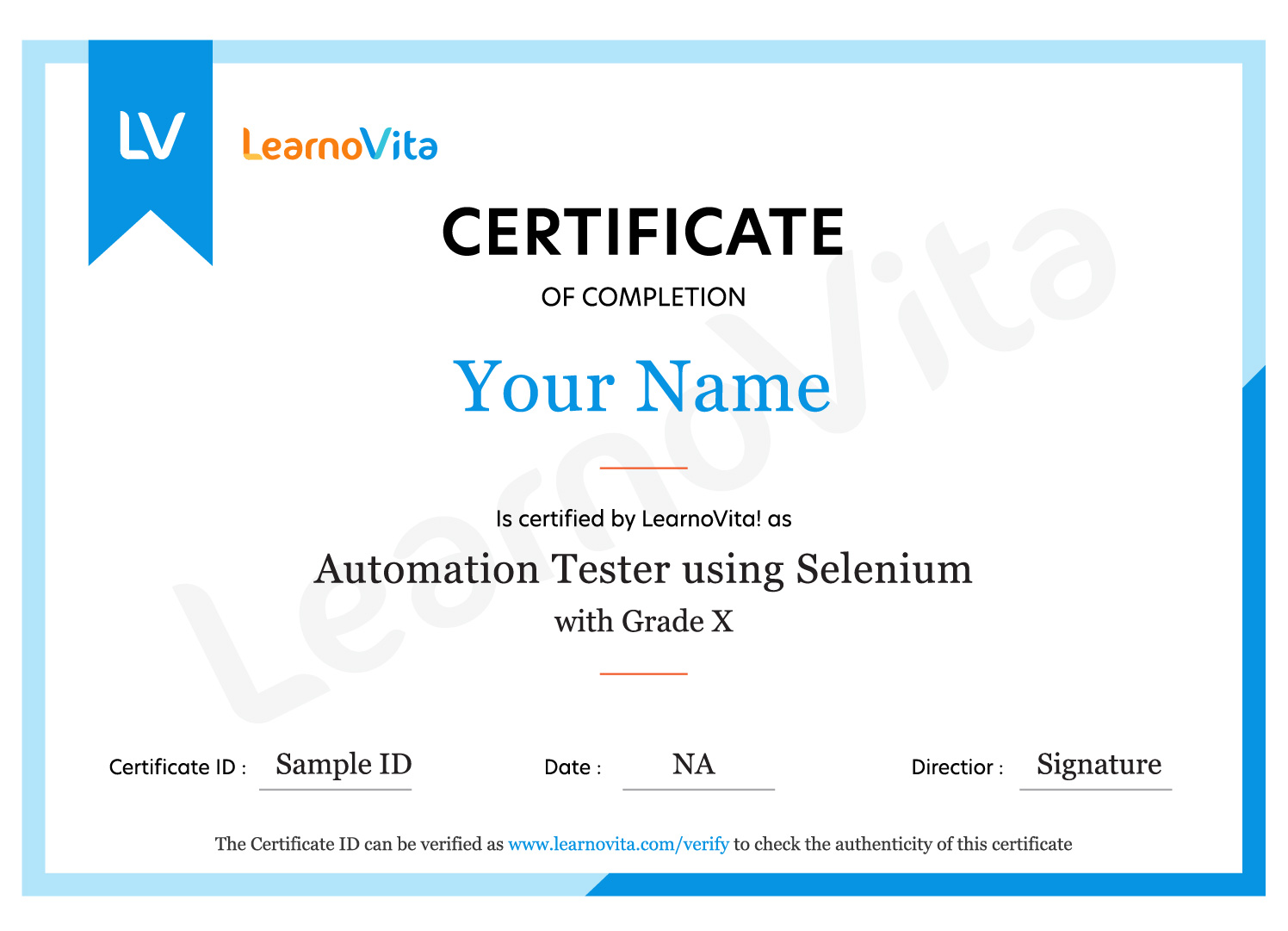
LearnoVita Certification is awarded upon course completion and is recognized by all of the world's leading global corporations. LearnoVita are the exclusive authorized Oracle, Microsoft, Pearson Vue, and Android I exam centers, as well as an authorized partner of Android . Additionally, those who want to pass the National Authorized Certificate in a specialized IT domain can get assistance from LearnoVita's technical experts.
As part of the training program, LearnoVita provides you with the most recent, pertinent, and valuable real-world projects. Every program includes several projects that rigorously assess your knowledge, abilities, and real-world experience to ensure you are fully prepared for the workforce. Your abilities will be equivalent to six months of demanding industry experience once the tasks are completed.
At LearnoVita, participants can choose from instructor-led online training, self-paced training, classroom sessions, one-to-one training, fast-track programs, customized training, and online training options. Each mode is designed to provide flexibility and convenience to learners, allowing them to select the format that best suits their needs. With a range of training options available, participants can select the mode that aligns with their learning style, schedule, and career goals to excel in Android .
LearnoVita guarantees that you won't miss any topics or modules. You have three options to catch up: we'll reschedule classes to suit your schedule within the course duration, provide access to online class presentations and recordings, or allow you to attend the missed session in another live batch.
Please don't hesitate to reach out to us at contact@learnovita.com if you have any questions or need further clarification.
To enroll in the Android at LearnoVita, you can conveniently register through our website or visit any of our branches in India for direct assistance.
Yes, after you've enrolled, you will have lifetime access to the student portal's study materials, videos, and top MNC interview questions.
At LearnoVita, we prioritize individual attention for students, ensuring they can clarify doubts on complex topics and gain a richer understanding through interactions with instructors and peers. To facilitate this, we limit the size of each Android Service batch to 5 or 6 members.
The average annual salary for Android Professionals in India is 5 LPA to 8 LPA.
view More view Less
Career Assistance
  • Build a Powerful Resume for Career Success
  • Get Trainer Tips to Clear Interviews
  • Practice with Experts: Mock Interviews for Success
  • Crack Interviews & Land Your Dream Job

Find Android Training in Other Cities

Get Our App Now!