Data Science with Python Training Overview
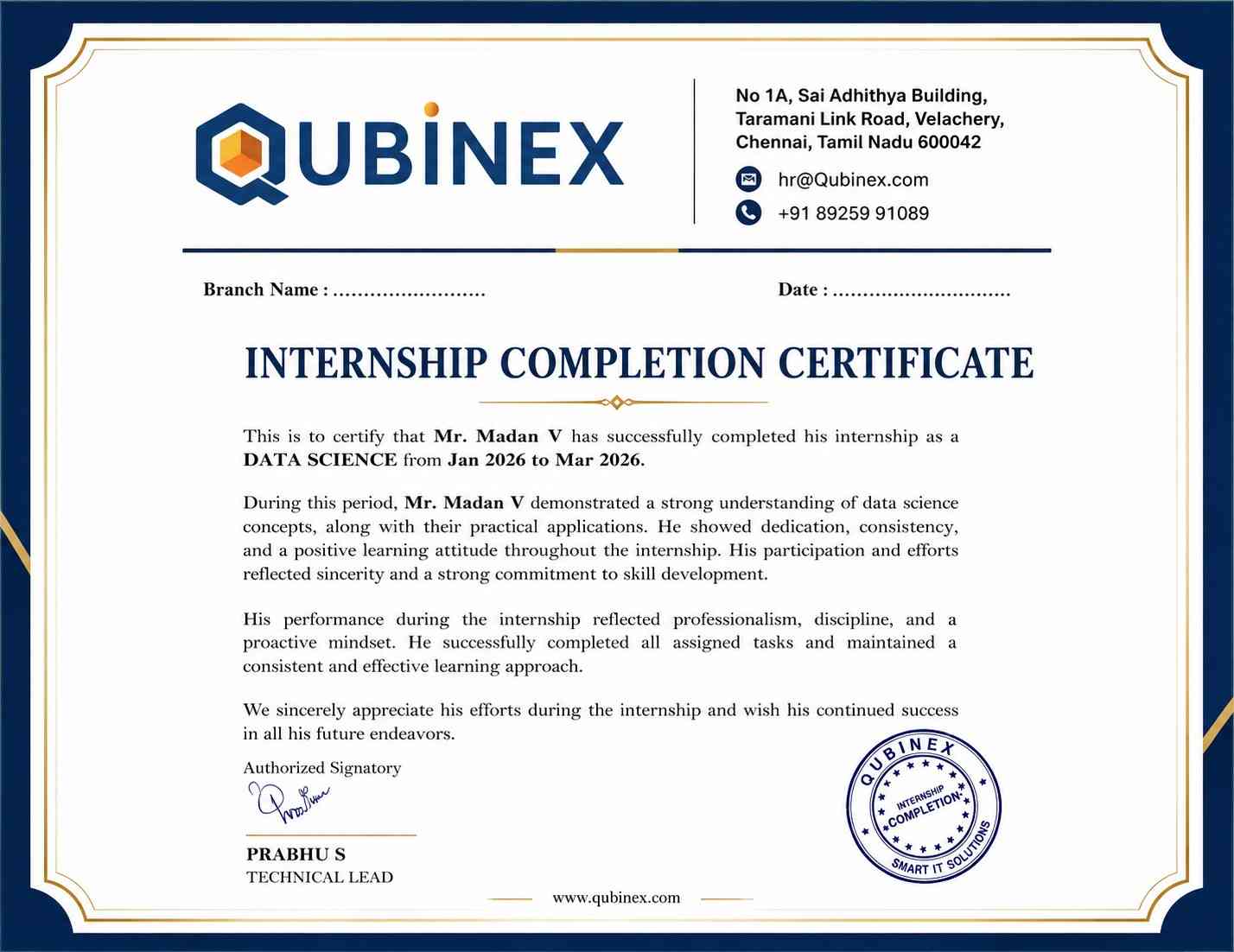
The Data Science with Python Course in Visakhapatnam is designed to provide deep knowledge of Python programming, data analysis, and machine learning. Participants gain hands-on experience via real-time projects, exercises, and guidance from industry experts. Through this Data Science with Python Online Course in Visakhapatnam, learners can choose flexible learning modes, including self-paced and instructor-led sessions. The Data Science with Python Certification Training in Visakhapatnam equips students to tackle enterprise-level data problems and opens opportunities in analytics, AI, and business intelligence roles. The course also includes live projects, Data Science Internship opportunities, and placement guidance, ensuring learners are industry-ready and confident in solving real-world challenges.
Additional Info
Future Trends in Data Science with Python
- AI-Driven Predictive Analytics:
The future of Data Science with Python is increasingly dominated by AI-powered predictive analytics. Organizations are leveraging machine learning models and deep learning techniques to forecast market trends, consumer behavior, and operational performance. Python libraries such as TensorFlow, PyTorch, and Scikit-learn enable data scientists to build robust predictive models. These models are becoming more accurate due to the integration of real-time streaming data and automated feature engineering. Professionals will need to combine domain expertise with technical skills to translate predictions into actionable business strategies. This trend positions Python data scientists at the core of decision-making in competitive industries.
- Automated Machine Learning (AutoML):
Automated Machine Learning is reshaping how data scientists approach model building. Python’s AutoML frameworks like H2O.ai, Auto-sklearn, and TPOT allow users to automatically select the best algorithms, tune hyperparameters, and preprocess data. This reduces manual effort and accelerates deployment while maintaining high model accuracy. Professionals will increasingly rely on AutoML to handle large-scale datasets efficiently. The trend emphasizes understanding the logic behind model automation rather than just coding. Data scientists with AutoML expertise can deliver faster, more accurate insights, improving organizational efficiency and operational decision-making.
- Natural Language Processing and Text Analytics:
Python has become the standard for NLP applications, and the trend is growing rapidly. Tools like NLTK, spaCy, and Transformers enable data scientists to analyze text data, perform sentiment analysis, and develop chatbots. Businesses are increasingly leveraging Python for automated content generation, customer support analytics, and social media monitoring. Future trends include real-time language processing and multi-lingual support for global audiences. Data scientists must also focus on ethical NLP practices, addressing bias in AI models. Python’s flexibility allows seamless integration of NLP pipelines into business applications, making text analysis a critical competency.
- Big Data Analytics Integration:
The combination of Python and big data technologies is shaping the future of analytics. Python’s Pandas, Dask, and PySpark libraries allow professionals to handle massive datasets with high performance. Data scientists are now expected to work with distributed computing frameworks to extract meaningful insights from unstructured data sources. Integration of Python with cloud platforms like AWS, Azure, and Google Cloud enables scalable analytics solutions. This trend requires proficiency in both Python programming and distributed system concepts. Organizations are increasingly seeking experts who can transform big data into actionable business intelligence efficiently.
- Data Ethics and Responsible AI:
Ethical considerations are becoming critical in data science applications. Python data scientists must ensure their models are transparent, unbiased, and comply with legal regulations. Trends in responsible AI include fairness evaluation, explainable machine learning models, and privacy-preserving computation. Organizations demand professionals who can mitigate risks associated with automated decision-making. Python libraries now offer tools for bias detection, model interpretability, and data anonymization. Data scientists must combine technical expertise with ethical judgment to build trustworthy AI solutions. This approach enhances public trust and ensures sustainable deployment of data-driven technologies.
- Cloud-Based Data Science Platforms:
Cloud computing is rapidly influencing the way Python data scientists work. Platforms like Google Colab, AWS SageMaker, and Azure Machine Learning offer scalable environments for data processing, model training, and deployment. The trend is moving toward fully managed cloud pipelines, reducing hardware dependency and enabling remote collaboration. Data scientists are expected to manage end-to-end workflows, from data ingestion to production deployment, using cloud-based Python tools. This enables faster experimentation, reproducibility, and operational efficiency. Cloud integration ensures Python remains the language of choice for modern, scalable data science projects.
- Edge Analytics and IoT Data Processing:
Edge computing is reshaping how data is collected and analyzed. Python is increasingly being used to process IoT-generated data at the edge, allowing for real-time insights without the latency of cloud transfer. Professionals must develop skills in streaming analytics, sensor data processing, and lightweight Python models that operate on edge devices. This trend is critical for applications like autonomous vehicles, smart manufacturing, and healthcare monitoring. Data scientists with Python expertise will be tasked with designing efficient algorithms that balance performance, resource constraints, and predictive accuracy, making edge analytics a growing field.
- Real-Time Data Science Applications:
The demand for real-time analytics is increasing across industries, from financial trading to e-commerce personalization. Python frameworks like Kafka-Python, PySpark Streaming, and Streamlit enable data scientists to analyze data streams on the fly. Professionals are expected to design robust pipelines that support continuous model updates, anomaly detection, and live decision-making. Real-time data science also involves monitoring model drift and adjusting predictions dynamically. This trend ensures businesses can respond immediately to operational and market changes. Python remains a versatile tool for implementing these live analytics solutions efficiently.
- Quantum Computing in Data Science:
Quantum computing promises to accelerate data processing for complex analytical problems. Python-based quantum frameworks such as Qiskit and Cirq allow data scientists to explore quantum algorithms for optimization, machine learning, and simulation. While still emerging, future data scientists will need to integrate classical and quantum workflows to tackle computationally intensive tasks. This trend requires a strong understanding of both mathematics and Python programming. Professionals who master quantum-enabled data science will drive innovation in finance, healthcare, and logistics by leveraging next-generation computing power for advanced analytics.
- Augmented Analytics and AI-Assisted Decision Making:
Augmented analytics is transforming the role of Python data scientists by embedding AI into analytics platforms. Tools that leverage Python for natural language queries, automated data preparation, and model recommendations are becoming mainstream. Professionals will use these tools to accelerate insight generation and empower non-technical stakeholders with self-service analytics. Python skills are essential to customize, optimize, and scale these AI-assisted analytics pipelines. This trend enables data-driven decision-making at unprecedented speed and precision, positioning Python-trained professionals as critical contributors to strategic business growth.
Tools & Technologies
- Python Libraries for Data Analysis:
Python offers an extensive ecosystem for data analysis, including Pandas, NumPy, and SciPy. These libraries allow data scientists to clean, manipulate, and analyze structured and unstructured data efficiently. Pandas provides DataFrame operations, NumPy enables numerical computation, and SciPy offers advanced scientific functions. Professionals use these libraries for statistical analysis, trend identification, and hypothesis testing. Mastery of these tools ensures accuracy and performance in data-driven decision-making. Organizations rely on Python-trained analysts to extract actionable insights from complex datasets, making library proficiency a cornerstone of modern data science.
- Data Visualization Tools:
Data visualization is critical for interpreting complex information. Python provides libraries like Matplotlib, Seaborn, and Plotly to generate interactive and static visualizations. Professionals create dashboards, trend graphs, and performance charts that communicate insights clearly. Effective visualization enables decision-makers to grasp patterns and anomalies quickly. Python’s flexibility allows integration with web frameworks for interactive reporting. Mastery of visualization tools ensures data scientists can transform raw numbers into compelling narratives. This capability is essential for stakeholders to make informed, timely decisions.
- Machine Learning Frameworks:
Python dominates machine learning with frameworks like Scikit-learn, TensorFlow, Keras, and PyTorch. Data scientists leverage these tools to implement classification, regression, clustering, and deep learning models. Frameworks provide pre-built algorithms, optimization routines, and GPU support for large-scale computations. Professionals design pipelines for data preprocessing, training, evaluation, and deployment. Python’s intuitive syntax accelerates experimentation and model iteration. Knowledge of these frameworks ensures data scientists can handle real-world machine learning projects efficiently, transforming predictive insights into actionable strategies.
- Big Data and Distributed Computing:
Python integrates seamlessly with big data frameworks like PySpark and Dask. These technologies allow data scientists to handle distributed datasets efficiently and perform computations in parallel. Professionals analyze large volumes of structured and unstructured data for pattern recognition and predictive modeling. Cloud integration enhances scalability and accessibility, enabling collaboration across teams. Expertise in distributed computing ensures Python professionals can handle enterprise-level datasets without performance bottlenecks. Organizations benefit from accelerated analytics and informed strategic decision-making.
- Data Cleaning and Preprocessing Tools:
Data quality is fundamental for accurate analysis. Python libraries like Pandas, OpenRefine, and NumPy help data scientists clean, normalize, and transform raw datasets. Techniques include handling missing values, encoding categorical variables, and feature scaling. Professionals must ensure preprocessing pipelines are robust, reproducible, and efficient. This stage influences the accuracy of machine learning models and analytical outcomes. Python-trained experts ensure that organizations base decisions on high-quality data. Clean, structured datasets lead to actionable insights and improved business performance.
- Database Connectivity:
Python provides connectors and ORMs for interacting with SQL and NoSQL databases. Tools like SQLAlchemy, PyMongo, and psycopg2 allow data scientists to query, retrieve, and update data efficiently. Professionals design pipelines to extract information, transform it, and integrate it into analysis workflows. Understanding database architecture and query optimization is crucial for high-performance data operations. Python’s flexibility allows seamless integration with data science pipelines. Proficiency in database connectivity ensures scalable and reliable data access for analytics and reporting.
- Statistical Analysis Tools:
Python libraries such as Statsmodels and SciPy support robust statistical modeling and hypothesis testing. Data scientists perform correlation analysis, regression modeling, and ANOVA to uncover relationships in data. Statistical rigor ensures that insights are reliable and actionable. Professionals design experiments, validate assumptions, and interpret results accurately. Python’s statistical capabilities enable automated testing and reproducible research. Expertise in these tools allows data scientists to deliver validated insights that influence critical business and operational decisions.
- Natural Language Processing (NLP) Tools:
NLP is essential for processing unstructured text data. Python libraries like NLTK, spaCy, and Transformers allow data scientists to analyze sentiment, extract keywords, and perform entity recognition. Professionals design pipelines for social media monitoring, customer feedback analysis, and automated reporting. Advanced NLP models integrate machine learning for context-aware predictions. Understanding tokenization, embeddings, and attention mechanisms is critical. Python’s NLP ecosystem empowers organizations to leverage text data strategically, enhancing customer experience and decision-making.
- Data Automation Tools:
Automation is key to scalable data workflows. Python’s ecosystem supports automated ETL processes, data validation, and report generation. Tools such as Airflow, Luigi, and Prefect enable scheduling, pipeline orchestration, and error handling. Data scientists ensure consistent, repeatable analytics pipelines. Automation reduces manual effort, improves accuracy, and accelerates decision-making. Python-trained professionals are essential for maintaining high-performance, automated data environments. This trend supports operational efficiency and timely delivery of business intelligence.
- Cloud-Based Data Science Platforms:
Python integrates seamlessly with cloud platforms like AWS SageMaker, Google Colab, and Azure Machine Learning. These platforms allow scalable computation, collaborative model development, and seamless deployment. Professionals can leverage GPUs and distributed computing for large datasets and deep learning models. Cloud-based Python solutions accelerate experimentation and production deployment. Data scientists gain flexibility to test algorithms, collaborate with global teams, and scale applications efficiently. Cloud expertise ensures Python professionals remain competitive in enterprise-level data science projects.
Roles & Responsibilities
- Data Scientist:
A Data Scientist is responsible for collecting, processing, and analyzing vast amounts of data to generate actionable insights for strategic decision-making. They design predictive models using Python libraries, perform feature engineering, and validate model accuracy. Beyond technical skills, they translate complex data into understandable reports for stakeholders. They also ensure the integrity and security of sensitive datasets, applying ethical and regulatory standards. Python proficiency enables them to automate workflows, visualize insights, and deploy machine learning solutions efficiently, making them pivotal in shaping data-driven strategies across organizations.
- Machine Learning Engineer:
Machine Learning Engineers focus on deploying and optimizing machine learning models in production environments. Using Python, they implement scalable algorithms, perform hyperparameter tuning, and ensure models perform efficiently under real-world data loads. Their responsibilities include continuous monitoring of model drift, retraining models with new data, and collaborating with software developers to integrate AI solutions into applications. These professionals must balance computational efficiency with predictive accuracy, ensuring that Python-powered models drive tangible business outcomes. Strong problem-solving skills and deep understanding of Python frameworks make them indispensable in AI-driven projects.
- Data Analyst:
Data Analysts gather and interpret data to support operational, marketing, and financial decisions. They use Python libraries like Pandas and NumPy to clean datasets, analyze trends, and visualize key performance indicators. Analysts also generate dashboards and automated reports to communicate findings effectively to management teams. Beyond numerical analysis, they evaluate data quality, identify anomalies, and recommend actionable strategies. Their Python skills allow them to handle large datasets efficiently and perform reproducible analysis, making them central to evidence-based decision-making in data-driven organizations. Analysts bridge the gap between raw data and strategic planning.
- Business Intelligence (BI) Developer:
BI Developers leverage Python to transform data into meaningful insights that support business strategy. They design data models, build dashboards, and automate reporting pipelines to provide real-time intelligence to executives. Their role requires proficiency in Python-based analytics and visualization tools to handle complex datasets and ensure scalability. BI Developers also validate data integrity and collaborate with data engineers to integrate multiple data sources. By translating raw data into actionable metrics, they empower organizations to make informed decisions, identify market trends, and optimize processes efficiently. They act as the bridge between analytics and business outcomes.
- Data Engineer:
Data Engineers focus on building robust data pipelines and maintaining the architecture necessary for large-scale analytics. Using Python, they design ETL workflows, automate data ingestion, and ensure data consistency across platforms. Their responsibilities include working with databases, cloud platforms, and distributed computing systems to manage structured and unstructured data efficiently. Data Engineers also implement data quality checks, optimize pipelines for performance, and collaborate closely with data scientists and analysts to deliver reliable datasets. Their work ensures that the organization’s data infrastructure is scalable, secure, and capable of supporting advanced Python-driven analytics and AI initiatives.
- Python Developer for Data Science:
Python Developers in Data Science specialize in writing efficient, modular, and reusable code for analytics and machine learning applications. They design algorithms, automate tasks, and integrate Python scripts into production systems. Responsibilities include testing code, debugging, and optimizing performance for large datasets. They also collaborate with data engineers and scientists to ensure smooth deployment of predictive models. These professionals must stay up-to-date with Python libraries, frameworks, and best practices. By combining software engineering skills with data expertise, they ensure that Python-powered analytics solutions are robust, scalable, and maintainable for long-term use.
- Machine Learning Researcher:
Machine Learning Researchers focus on developing innovative algorithms and exploring novel approaches in AI using Python. They conduct experiments, analyze model behavior, and publish findings for academic or industrial application. Responsibilities include designing neural networks, testing optimization strategies, and validating theoretical results through Python simulations. Researchers often work with unstructured data, high-dimensional datasets, and complex models, requiring advanced Python proficiency. Their insights contribute to the development of next-generation machine learning systems and help organizations maintain a competitive edge in AI innovation. They blend theoretical knowledge with practical application for impactful solutions.
- Data Visualization Specialist:
Data Visualization Specialists turn complex datasets into intuitive visual representations that drive business insights. Using Python libraries like Matplotlib, Seaborn, and Plotly, they create interactive dashboards, charts, and infographics. Responsibilities include designing visualizations that highlight trends, anomalies, and key performance metrics. They ensure visual clarity, consistency, and alignment with business objectives. By collaborating with data scientists and analysts, they translate raw data into actionable visual narratives. Their expertise helps decision-makers quickly grasp insights, identify opportunities, and make informed strategic choices. Python proficiency ensures scalable and reproducible visual analytics workflows.
- AI Solutions Architect:
AI Solutions Architects design and oversee the implementation of end-to-end AI systems using Python and cloud platforms. They define architecture, select appropriate machine learning frameworks, and ensure seamless integration with existing enterprise systems. Responsibilities include evaluating trade-offs between accuracy, performance, and scalability while mentoring development teams. They also monitor compliance, security, and data governance aspects of AI projects. By bridging technical expertise with strategic vision, these professionals ensure AI initiatives deliver measurable business value. Python serves as a foundational tool to prototype, deploy, and optimize intelligent solutions that meet organizational needs.
- Data Science Consultant:
Data Science Consultants provide expert guidance to organizations on leveraging data for strategic advantage. They assess current systems, recommend Python-based analytics solutions, and design implementation roadmaps. Responsibilities include performing advanced data analysis, building predictive models, and presenting actionable insights to stakeholders. Consultants also train teams on best practices for Python programming, machine learning, and data governance. They act as a bridge between technical teams and business leadership, ensuring solutions are aligned with organizational goals. Their role is critical in helping companies adopt data-driven strategies while optimizing resources and maximizing ROI.
Companies Hiring Data Science with Python Professionals
- Tata Consultancy Services (TCS):
TCS actively recruits data science professionals with Python expertise to support analytics and AI-driven business solutions across industries. Candidates work on large-scale predictive modeling, machine learning pipelines, and enterprise data integration projects. TCS encourages continuous skill development and offers opportunities to work on innovative, cross-industry data projects. Data scientists at TCS are exposed to real-world challenges, including cloud analytics, big data management, and business intelligence solutions. The organization values Python proficiency for designing scalable and efficient analytics workflows, making TCS a top destination for career growth in data science.
- Infosys:
Infosys hires Python-trained data scientists to drive analytics, automation, and AI-based transformation initiatives. Professionals engage in machine learning, predictive modeling, and NLP projects that influence business strategy for global clients. The company promotes continuous learning and certification programs to stay updated on emerging Python tools and technologies. Data scientists at Infosys work in collaborative teams to deliver innovative solutions in finance, healthcare, and retail. The focus is on leveraging Python for data wrangling, visualization, and scalable machine learning implementations, providing both technical depth and exposure to high-impact enterprise projects.
- Wipro:
Wipro seeks skilled Python data scientists for roles in predictive analytics, AI research, and automation-driven business optimization. Employees are involved in full-cycle projects, from data ingestion and preprocessing to model deployment and visualization. Python is used extensively for machine learning, data analytics, and big data applications. Wipro emphasizes hands-on experience with cloud platforms, real-time data processing, and advanced Python frameworks. Professionals receive mentorship and growth opportunities in diverse domains. The company’s focus on innovation and AI-driven solutions ensures data scientists gain exposure to cutting-edge technologies while contributing to impactful projects.
- HCL Technologies:
HCL Technologies recruits Python data scientists to develop machine learning models, perform predictive analytics, and automate data workflows. Professionals work on diverse projects in sectors such as IT services, finance, and healthcare. Python is utilized for data cleaning, visualization, statistical analysis, and model development. HCL promotes upskilling and offers opportunities to work on emerging technologies including AI, cloud computing, and IoT. Employees gain practical experience with large-scale datasets, end-to-end analytics pipelines, and collaborative project management, making HCL a great platform for building a career in Python-driven data science.
- IBM:
IBM hires Python data science professionals to support AI, analytics, and cloud-based solutions. Professionals engage in designing and implementing machine learning algorithms, analyzing business data, and delivering predictive insights. IBM encourages innovation through research and application of Python libraries for NLP, deep learning, and automation. Employees work in diverse industries and gain exposure to IBM’s analytics platforms and cloud infrastructure. Python proficiency is critical for developing scalable solutions, ensuring data integrity, and contributing to AI-driven strategic initiatives. IBM provides a stimulating environment for professional growth in cutting-edge data science projects.
- Accenture:
Accenture recruits Python data scientists to assist clients in implementing AI, data analytics, and automation strategies. Professionals design and deploy machine learning models, perform real-time analytics, and provide actionable business insights. Accenture encourages hands-on work with Python frameworks for big data, NLP, and deep learning projects. Employees collaborate with cross-functional teams to deliver end-to-end solutions that optimize business performance. The company offers career growth, training programs, and exposure to diverse industry domains. Python expertise enables data scientists to contribute effectively to high-impact projects and innovative solutions.
- Capgemini:
Capgemini actively hires Python data scientists for data analytics, AI modeling, and business intelligence projects. Professionals work on predictive modeling, visualization dashboards, and automation solutions using Python libraries. Capgemini emphasizes professional development, cloud integration, and collaborative problem-solving. Employees gain hands-on experience with data preprocessing, model evaluation, and deployment of Python-based solutions in enterprise environments. Data scientists play a key role in delivering insights that support strategic decision-making across sectors like banking, retail, and technology. Python skills are essential for developing scalable, accurate, and efficient analytics workflows.
- Tech Mahindra:
Tech Mahindra recruits Python-trained data science professionals to work on AI, analytics, and automation-driven projects. Responsibilities include data preprocessing, feature engineering, model building, and visualization using Python. Professionals engage with emerging technologies like deep learning, NLP, and big data analytics. Tech Mahindra promotes continuous learning and professional development to help employees stay updated with Python libraries, frameworks, and industry trends. Data scientists contribute to strategic initiatives by transforming complex datasets into actionable insights. Python expertise is crucial for delivering effective, scalable analytics solutions in a fast-paced corporate environment.
- Mindtree:
Mindtree hires Python data scientists to develop predictive models, perform data analytics, and create intelligent automation solutions. Professionals work with machine learning algorithms, cloud integration, and data visualization to solve real-world business problems. Mindtree encourages innovation and practical application of Python frameworks in diverse domains like healthcare, finance, and retail. Employees gain experience in end-to-end data pipelines, from data ingestion to model deployment. Python-trained data scientists play a pivotal role in enabling organizations to leverage data for operational efficiency, informed decision-making, and competitive advantage.
- Google:
Google recruits Python data scientists for AI research, data analytics, and machine learning projects. Professionals work on large-scale datasets, develop predictive models, and create automation pipelines using Python. Google emphasizes innovation, cloud-based analytics, and real-time data processing. Employees collaborate with cross-functional teams to deploy AI-driven solutions that impact millions of users worldwide. Python is critical for scripting, data manipulation, model training, and deployment. Google provides a stimulating environment for professional growth, research opportunities, and exposure to cutting-edge technologies in machine learning, AI, and data science.

 9564
9564 


 Fees Starts From























 Regular 1:1 Mentorship From Industry Experts