

- Understanding Agile Methodologies and Principles | A Complete Tutorial
- What is a Work Breakdown Structure (WBS)? | Learn Overview, Steps, Benefits
- Traditional Project Management Tutorial | A Comprehensive Guide
- Total Quality Management (TQM): Complete Guide [STEP-IN]
- Total Productive Maintenance Tutorial | Get an Overview
- Virtual Team Tutorial – Learn Origin, Definition and its Scope
- The Rule of Seven in Project Management – Tutorial
- Make or Buy Decision – A Derivative Tutorial for Beginners
- What is Halo Effect? | Learn More through Tutorial
- Balanced Score Card Tutorial | Learn with Definition & Examples
- What is Supply Chain Management? | Tutorial with Examples
- Succession Planning Tutorial | A Complete Guide with Definitions
- What is Structured Brainstorming? | Quickstart & Learn the Tutorial
- Stress Management Tutorial | A Comprehensive Guide for Beginners
- What is a Statement of Work? | Learn with Definition & Examples
- What is Stakeholder Management? – The Ultimate Guide for Beginners
- How to Create a Staffing Management Plan? | Learn from Tutorial
- What is Resource Leveling? | A Comprehensive Tutorial
- Requirements Collection Tutorial: Gather Project Needs
- What Is a RACI Chart? | Learn with Example & Definitions
- Quality Assurance vs Quality Control: Tutorial with Definitions & Differences
- Project Workforce Management Tutorial | A Definitive Guide
- Project Time Management Tutorial: Strategies, Tips & Tools
- Project Management Success Criteria Tutorial | Understand and Know More
- Identify Risk Categories in Project Management | A Comprehensive Tutorial
- Project Records Management Tutorial | Quickstart -MUST READ
- Project Quality Plan (PQP) Tutorial | Ultimate Guide to Learn [BEST & NEW]
- Project Portfolio Management | A Defined Tutorial for Beginners
- Goals of a Project Manager Tutorial | The Ultimate Guide
- Project Management Triangle Tutorial: What It Is and How to Use
- Project Management Tools Tutorial | Learn Tools & Techniques
- What is PMO (project management office)? | A Complete Tutorial from Scratch
- Project Management Lessons | Learn in 1 Day [ STEP-IN ]
- What is a Project Kickoff Meeting? | Learn Now – A Definitve Tutorial
- Project Cost Management Tutorial | Steps, Basics, and Benefits
- Types of Contracts in Project Management | Learn with Examples
- Project Activity Diagram | Ultimate Guide to Learn [BEST & NEW]
- What is Project Procurement Management? | Tutorial Explained
- Procurement Documents Tutorial | The Ultimate Guide
- Process-Based Project Management Tutorial: A Beginner’s Guide
- What Is PRINCE2 Project Management? | A Definitive Tutorial for Beginners
- Effective Presentation Skills – Learn More through Tutorial
- Powerful Leadership Skills Tutorial | The Ultimate Guide
- PERT Estimation Technique Tutorial | Explained with Examples
- Pareto Chart Tool Tutorial | Learn Analysis, Diagram
- Organizational Structure Tutorial: Definition and Types
- Negotiation Skills for Project Management | Learn from the Basics
- Monte Carlo Analysis in Project Management Tutorial | A Perfect Guide to Refer
- Effective Management Styles Tutorial | The Ultimate Guide
- Management by Objectives (MBO) Tutorial | Overview, Steps, Benefits
- Leads, Lags & Float – Understand the Difference through Tutorial
- What is Knowledge Management? – Tutorial Explained
- What is Just-in-Time Manufacturing (JIT)? | Know More through Tutorial
- Gantt Chart Tool Tutorial: The Ultimate Guide
- Extreme Project Management Tutorial – Methodology & Examples
- Introduction for Event Chain Methodology Tutorial | Guide For Beginners
- Enterprise Resource Planning (ERP) | A Complete Tutorial for Beginners
- What Is Design of Experiments (DOE)? | Learn Now – A Definitve Tutorial
- Decision Making Tutorial – Know about Meaning, Nature, Characteristics
- Critical Path Method Tutorial | How to use CPM for project management
- What is Critical Chain Project Management? | A Complete Tutorial
- What is Conflict Management? | Learn the Definition, styles, strategies through Tutorial
- Effective Communication Skills Tutorial – Definitions and Examples
- Communication Models Tutorial – Project Management
- Methods of Communication Tutorial | A Complete Learning Path
- Communication Management Tutorial | Know more about Plans & Process
- What are Communication Channels? | Learn Now Tutorial
- Communication Blocker Tutorial | Explained with Examples
- Cause and Effect Diagrams Tutorial | The Ultimate Guide
- What is Benchmarking? | Technical & Competitive Tutorial
- Seven Processes of Prince2 Tutorial | Everything you Need to Know
- Design Thinking Tutorial – Quick Guide For Beginners
- What is Performance Testing | A Complete Testing Guide With Real-Time Examples Tutorial
- What is Confluence? : Tutorial For Beginners | A Complete Guide
- Lean Six Sigma Tutorial
- Agile Scrum Tutorial
- PMI-RMP Plan Risk Management Tutorial
- Designing the Blueprint Delivery Tutorial
- What is Confluence? : Tutorial For Beginners | A Complete Guide
- Program Benefits Management Tutorial
- Continuous Improvement – Agile Value Stream Mapping
- Program Organization Tutorial
- Risk and Issue Management Tutorial
- Project Integration Management Tutorial
- Planning and Control Tutorial
- Program Management Principles Tutorial
- program strategy Alignment Tutorial
- PMP Tutorial
- Program Governance Tutorial
- Program Life Cycle Management Tutorial
- PMP Exam Preparation Tutorial
- PMI-PgMP Tutorial
- Agile Methodologies and Frameworks- Kanban and Lean Management Tutorial
- JIRA Tutorial
- Primavera P6 Tutorial
- Understanding Agile Methodologies and Principles | A Complete Tutorial
- What is a Work Breakdown Structure (WBS)? | Learn Overview, Steps, Benefits
- Traditional Project Management Tutorial | A Comprehensive Guide
- Total Quality Management (TQM): Complete Guide [STEP-IN]
- Total Productive Maintenance Tutorial | Get an Overview
- Virtual Team Tutorial – Learn Origin, Definition and its Scope
- The Rule of Seven in Project Management – Tutorial
- Make or Buy Decision – A Derivative Tutorial for Beginners
- What is Halo Effect? | Learn More through Tutorial
- Balanced Score Card Tutorial | Learn with Definition & Examples
- What is Supply Chain Management? | Tutorial with Examples
- Succession Planning Tutorial | A Complete Guide with Definitions
- What is Structured Brainstorming? | Quickstart & Learn the Tutorial
- Stress Management Tutorial | A Comprehensive Guide for Beginners
- What is a Statement of Work? | Learn with Definition & Examples
- What is Stakeholder Management? – The Ultimate Guide for Beginners
- How to Create a Staffing Management Plan? | Learn from Tutorial
- What is Resource Leveling? | A Comprehensive Tutorial
- Requirements Collection Tutorial: Gather Project Needs
- What Is a RACI Chart? | Learn with Example & Definitions
- Quality Assurance vs Quality Control: Tutorial with Definitions & Differences
- Project Workforce Management Tutorial | A Definitive Guide
- Project Time Management Tutorial: Strategies, Tips & Tools
- Project Management Success Criteria Tutorial | Understand and Know More
- Identify Risk Categories in Project Management | A Comprehensive Tutorial
- Project Records Management Tutorial | Quickstart -MUST READ
- Project Quality Plan (PQP) Tutorial | Ultimate Guide to Learn [BEST & NEW]
- Project Portfolio Management | A Defined Tutorial for Beginners
- Goals of a Project Manager Tutorial | The Ultimate Guide
- Project Management Triangle Tutorial: What It Is and How to Use
- Project Management Tools Tutorial | Learn Tools & Techniques
- What is PMO (project management office)? | A Complete Tutorial from Scratch
- Project Management Lessons | Learn in 1 Day [ STEP-IN ]
- What is a Project Kickoff Meeting? | Learn Now – A Definitve Tutorial
- Project Cost Management Tutorial | Steps, Basics, and Benefits
- Types of Contracts in Project Management | Learn with Examples
- Project Activity Diagram | Ultimate Guide to Learn [BEST & NEW]
- What is Project Procurement Management? | Tutorial Explained
- Procurement Documents Tutorial | The Ultimate Guide
- Process-Based Project Management Tutorial: A Beginner’s Guide
- What Is PRINCE2 Project Management? | A Definitive Tutorial for Beginners
- Effective Presentation Skills – Learn More through Tutorial
- Powerful Leadership Skills Tutorial | The Ultimate Guide
- PERT Estimation Technique Tutorial | Explained with Examples
- Pareto Chart Tool Tutorial | Learn Analysis, Diagram
- Organizational Structure Tutorial: Definition and Types
- Negotiation Skills for Project Management | Learn from the Basics
- Monte Carlo Analysis in Project Management Tutorial | A Perfect Guide to Refer
- Effective Management Styles Tutorial | The Ultimate Guide
- Management by Objectives (MBO) Tutorial | Overview, Steps, Benefits
- Leads, Lags & Float – Understand the Difference through Tutorial
- What is Knowledge Management? – Tutorial Explained
- What is Just-in-Time Manufacturing (JIT)? | Know More through Tutorial
- Gantt Chart Tool Tutorial: The Ultimate Guide
- Extreme Project Management Tutorial – Methodology & Examples
- Introduction for Event Chain Methodology Tutorial | Guide For Beginners
- Enterprise Resource Planning (ERP) | A Complete Tutorial for Beginners
- What Is Design of Experiments (DOE)? | Learn Now – A Definitve Tutorial
- Decision Making Tutorial – Know about Meaning, Nature, Characteristics
- Critical Path Method Tutorial | How to use CPM for project management
- What is Critical Chain Project Management? | A Complete Tutorial
- What is Conflict Management? | Learn the Definition, styles, strategies through Tutorial
- Effective Communication Skills Tutorial – Definitions and Examples
- Communication Models Tutorial – Project Management
- Methods of Communication Tutorial | A Complete Learning Path
- Communication Management Tutorial | Know more about Plans & Process
- What are Communication Channels? | Learn Now Tutorial
- Communication Blocker Tutorial | Explained with Examples
- Cause and Effect Diagrams Tutorial | The Ultimate Guide
- What is Benchmarking? | Technical & Competitive Tutorial
- Seven Processes of Prince2 Tutorial | Everything you Need to Know
- Design Thinking Tutorial – Quick Guide For Beginners
- What is Performance Testing | A Complete Testing Guide With Real-Time Examples Tutorial
- What is Confluence? : Tutorial For Beginners | A Complete Guide
- Lean Six Sigma Tutorial
- Agile Scrum Tutorial
- PMI-RMP Plan Risk Management Tutorial
- Designing the Blueprint Delivery Tutorial
- What is Confluence? : Tutorial For Beginners | A Complete Guide
- Program Benefits Management Tutorial
- Continuous Improvement – Agile Value Stream Mapping
- Program Organization Tutorial
- Risk and Issue Management Tutorial
- Project Integration Management Tutorial
- Planning and Control Tutorial
- Program Management Principles Tutorial
- program strategy Alignment Tutorial
- PMP Tutorial
- Program Governance Tutorial
- Program Life Cycle Management Tutorial
- PMP Exam Preparation Tutorial
- PMI-PgMP Tutorial
- Agile Methodologies and Frameworks- Kanban and Lean Management Tutorial
- JIRA Tutorial
- Primavera P6 Tutorial
Agile Scrum Tutorial
Last updated on 12th Oct 2020, Blog, Project Management, Tutorials
 (5.0) | 14562 Ratings 3136
 Agile
- Most of the time, both terms agile and scrum are used interchangeably but there is an important difference between the two.
- Agile is defined as the complete set of methods that are based on principles or values expressed in the Agile Manifesto as the cross-functionality of teams, collaboration, or self-organization etc.
Scrum
- Scrum is a framework for project management that emphasizes teamwork, accountability and iterative progress toward a well-defined goal.
- The framework begins with a simple premise: Start with what can be seen or known. After that, track the progress and tweak as necessary. The three pillars of Scrum are transparency, inspection and adaptation.
Scrum process
- A Scrum process is distinguished from other agile processes by specific concepts and practices, divided into the three categories of Roles, Artifacts, and Time Boxes. These and other terms used in Scrum are defined below.
- Scrum is most often used to manage complex software and product development, using iterative and incremental practices. Scrum significantly increases productivity and reduces time to benefits relative to classic “waterfall” processes. Scrum processes enable organizations to adjust smoothly to rapidly-changing requirements, and produce a product that meets evolving business goals.An agile Scrum process benefits the organization by helping it to
- 1. Increase the quality of the deliverables
- 2. Cope better with change (and expect the changes)
- 3. Provide better estimates while spending less time creating them
- 4. Be more in control of the project schedule and state
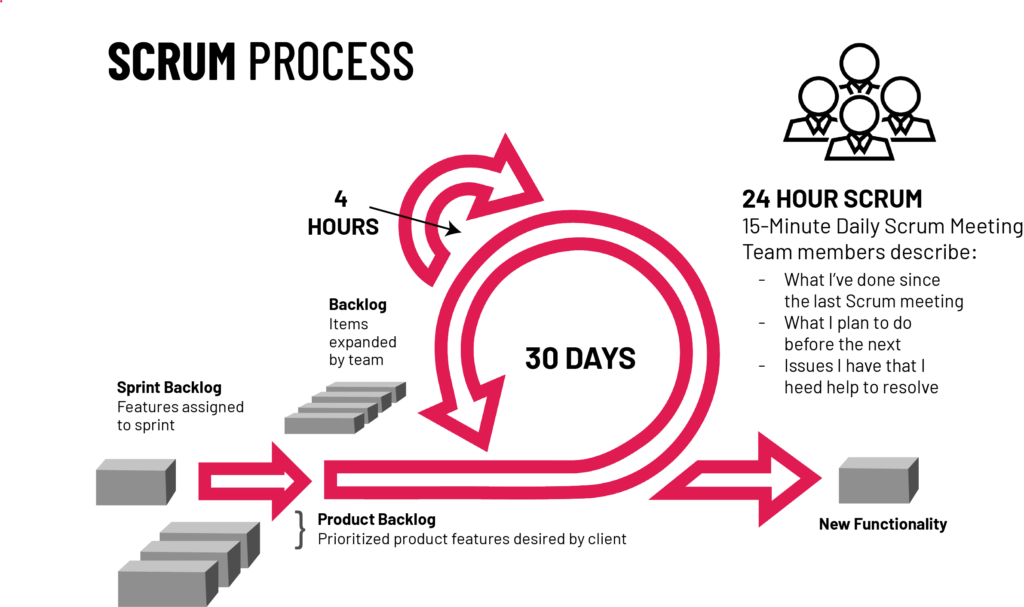
Scrum Process Work
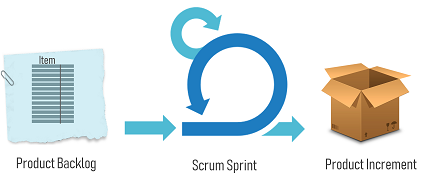
The image below roughly outlines how a sprint in scrum works.
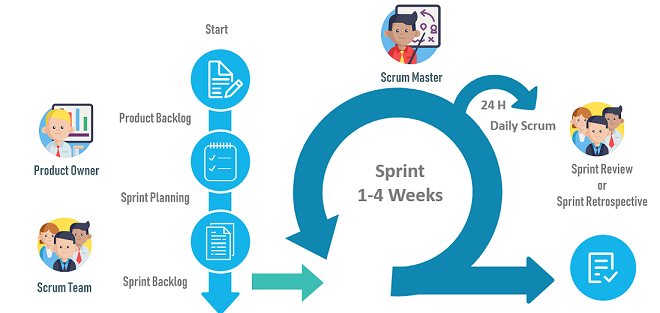
- Step1: Scrum process begins with a product owner. Product Owner creates a product backlog, a list of tasks and requirements the final product needs. The important part is that product backlog must be prioritized.
- Step2: The scrum team gets together for sprint planning, which is when the team decides together what to work on first from the product backlog. This subset of items from the product backlog becomes the sprint backlog.
- Step3: During the sprint, the team meets to communicate progress and issues, this meeting is called the daily scrum. It is overseen by the scrum master who ensures that all the team members follow scrum’s theories, rules, and practices.
- Step4: At the end of the sprint, the sprint review meeting is organized by the product owner. During the meeting, the development team demonstrates what they completed since the last sprint. Then the product owner gives information about what is remaining on the product backlog and estimated time to complete the project if needed.
- Step5: After the sprint review, the scrum team gathers-up in a sprint retrospective meeting, where the team discusses what went well, what did not and if they could have done better. Might be a tech limitation is holding them back or a team member is overloaded with tasks. The team decides how to fix these problems and creates a plan for improvements to be enacted during the next sprint.
- Step6: The cycle repeats for the remaining tasks in the product backlog. This goes on until either of the below-mentioned things happen:
- 1. The deadline has been reached
- 2. The budget is exhausted
- 3. The product owner is satisfied with the final product
- So, in a nutshell, that is how the Scrum Framework is used to produce a working piece of the product after every sprint. To conclude Scrum is a flexible way of working in a rapidly changing world. With Scrum, you’re not creating more work for yourself; you’re being more efficient with your time and work.
Subscribe For Free Demo
Error: Contact form not found.
Agile Process
- The important principle or best practice in Scrum is Transparency. The team leader should understand that everyone is working for the Company and equally responsible for the progress and achievements accomplished. That’s why keeping things more transparent is important for complex software projects.
- The major component of Framework for the transparency is the Scrum Board. This is the place where you could manage backlogs, or tasks effectively and check the progress of the current Sprint together. Scrum Boards are simple to understand like sticky notes where charts or other tracking features are added for each task.
- The main objective here is to check each task is visible completely to the users. The team members can see the work themselves and start on the same already. There is no reason that they should come to the project manager all the time for work. When tasks are outlined in detail properly before you assign them, work can be completed much faster than your expectations.
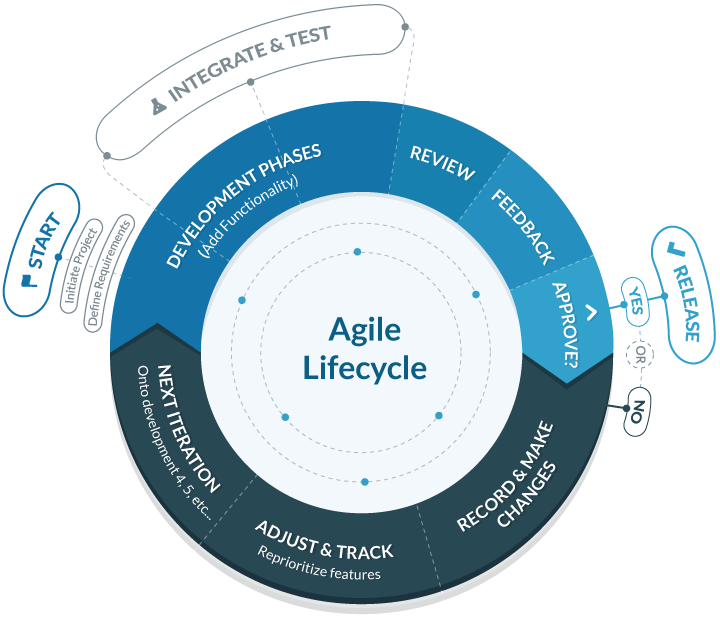
Important Parts or people of the Scrum Methodology
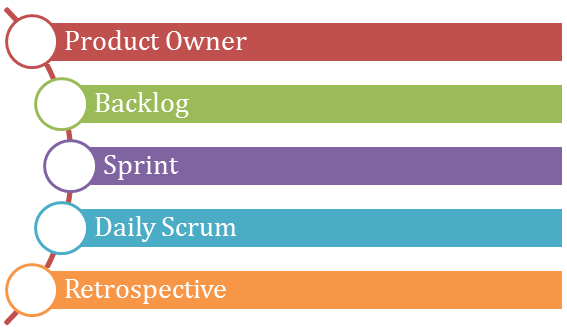
- To understand the Scrum topic in depth, you should know the people and part of the Framework well. The best part is that you don’t need any special experience or certification to start. There is a need for organizing your thoughts and your backlogs. Let us break down the parts that make Scrum happen:
- Scrum Framework starts with the Product Owner and he is the person who expresses the best interests of users and he has the authority to decide what should be added to the final product.
- The product owner takes care of the Backlog that involves tasks or requirements for the final product needs. This is an important part and BACKLOG should be prioritized wisely here. This is the job of a product owner only.
- Next important part is the Sprint that is described as the predetermined framework helping the team to complete a set of tasks from the Backlog. Each task is to set some deadlines based on the length or efforts.
- Teams work together almost daily to meet up the deadlines to add the progress status in the Daily Scrum. For a few people, it is named as the daily stand-ups too.
- For each Sprint, there is added one Retrospective or we can say Review in simple words where the work of the team is reviewed well and possible ways are discussed to make necessary improvements in the next Sprint.
Events in Scrum
In particular, there are four events that you will encounter during the scrum process. But before we proceed any further you should be aware of what sprint is.
- Sprint – A scrum sprint basically is a specified time period during which a Scrum Team produces a product. It forces prioritization, demonstrates progress, avoids unnecessary perfections, motivates closure, improves predictability and improves the return of investment.
The four events or ceremonies of Scrum Framework are:
Scrum Artifacts
- Artifacts are just physical records that provide project details when developing a product. Scrum Artifacts include:
Product Backlog
- It is a simple document that outlines the list of tasks and every requirement that the final product needs.
- It is constantly evolving and is never complete. The Product Owner manages the Product Backlog, including how it’s made available to the scrum team, its content, and how it’s ordered, everything.
- The Product Owner and the rest of the scrum team work together to review the Product Backlog and make adjustments as and when necessary. For each item in the product backlog, you should add some additional information like:
Description
Order based on priority
Estimate
Value to the business
Sprint Backlog
- It is the list of all items from the product backlog that need to be worked on during a sprint.
- Team members sign up for tasks based on their skills and priorities. It is a real-time picture of the work that the team currently plans to complete during the sprint. Here are some important points about sprint backlog:
- The sprint backlog is dynamic in nature because each scrum sprint has repeated changes to reach the goal
It is the outcome of sprint planning meeting sessions
The development team owns the sprint backlog and divides tasks according to their skills
It is a highly visible, real-time picture of the work that the Development Team plans to accomplish
Product Increment
- The most important artifact is the product improvement, or in other words, the sum of product work completed during a Sprint, combined with all work completed during previous sprints.
- Important point is that the increment must be in usable condition regardless of whether the Product Owner decides to release it.
Role
- The Scrum Team consists of three roles, namely a ScrumMaster, a Product Owner, and the Team.

Best JOB Oriented Agile and Scrum Training With Industry Experts
- Instructor-led Sessions
- Real-life Case Studies
- Assignments
ScrumMaster
- The Scrum Master (sometimes written as the Scrum Master, although the official term has no space after “Scrum”) is the keeper of the scrum process. He/she is responsible for-
- making the process run smoothly
- removing obstacles that impact productivity
- organizing and facilitating the critical meetings
Product Owner
- The Product Owner is responsible for maximizing the value of the product and the work of the Team. How this is done may vary widely across organizations, Scrum Teams, and individuals.
- The Product Owner is the sole person responsible for managing the Product Backlog. Product Backlog management includes-
- Expressing Product Backlog items clearly.
- Ordering the Product Backlog items to best achieve goals and missions.
- Optimizing the value of the work the Team performs.
- Ensuring that the Product Backlog is visible, transparent, and clear to all, and shows what the Team will work on further.
- Ensuring that the Team understands items in the Product Backlog to the level needed.
- The Product Owner may do the above work, or have the Team do it. However, the Product Owner remains accountable for these tasks.
- The Product Owner is one person, not a committee. The Product Owner may represent the desires of a committee in the Product Backlog, but those wanting to change a Product Backlog item’s priority must address the Product Owner.
- For the Product Owner to succeed, the entire organization must respect his or her decisions. The Product Owner’s decisions are visible in the content and ordering of the Product Backlog. No one is allowed to tell the Team to work from a different set of requirements, and the Team is not allowed to act on what anyone else says. This is ensured by ScrumMaster.
The Team
- 1. The Team is self-organizing and cross-functional. That means the team comprises analysts, designers, developers, testers, etc. as appropriate and as relevant to the project.
- 2. Some people in the industry refer to this team as a development team. However, such a reference is leading to controversy that the team can have only developers and no other roles. It is an obvious understanding that it is only a misconception. To develop a software product, we require all the roles and that is the essence of scrum – the team will function in collaboration.
- 3. Cross-functional teams have all competencies needed to accomplish the work without depending on others not part of the team, and thus time and effort can be saved. The team model in Scrum is designed to optimize flexibility, creativity, and productivity.
- 4. Optimal Team size is small enough to remain nimble and large enough to complete significant work within a Sprint. The Team size should be kept in the range from five to nine people, if possible. Fewer than five team members decrease interaction and results in smaller productivity gains. Having more than nine members requires too much coordination.
- 5. The scrum team works together closely, on a daily basis, to ensure the smooth flow of information and the quick resolution of issues. The scrum team delivers product iteratively and incrementally, maximizing opportunities for feedback. Incremental deliveries of a complete product ensure a potentially useful version of the working product is always available.
BENEFITS OF AGILE
Benefits to Customer
- Customers find that the vendor is more responsive to development requests. High-value features are developed and delivered more quickly with short cycles, than with the longer cycles favored by classic “waterfall” processes.
Benefits to Vendors
- Vendors reduce wastage by focusing development effort on high-value features, and reduce time-to-market relative to waterfall processes due to decreased overhead and increased efficiency. Improved customer satisfaction translates to better customer retention and more positive customer references.
Benefits to Development Teams
- Team members enjoy development work, and like to see their work used and valued. Scrum benefits Team members by reducing non-productive work (e.g.,
writing specifications or other artifacts that no one uses), and giving them more time to do the work they enjoy.
- Team members also know their work is valued, because requirements are chosen to maximize value to customers.
Benefits to Product Managers
- Product Managers, who typically fill the Product Owner role, are responsible for making customers happy by ensuring that development work is aligned with customer needs. Scrum makes this alignment easier by providing frequent opportunities to re-prioritize work, to ensure maximum delivery of value.
Benefits to Project Managers
- Project Managers (and others) who fill the ScrumMaster role find that planning and tracking are easier and more concrete, compared to waterfall processes. The focus on task-level tracking, the use of Burndown Charts to display daily progress, and the Daily Scrum meetings, all together give the Project Manager tremendous awareness about the state of the project at all times. This awareness is key to monitoring the project, and to catching and addressing issues quickly.
Benefits to PMOs and C-Level Executives
Scrum provides high visibility into the state of a development project, on a daily basis. External stakeholders, such as C-Level executives and personnel in the Project Management Office, can use this visibility to plan more effectively, and adjust their strategies based on more hard information and less speculation.
Conclusion
The objective behind the framework is not to do more work but to work smarter and achieve more. With Scrum Framework, you can always complete it twice in half the time.
With the Scrum, achievements are measured based on the work completed not on the basis of the number of hours. In this way, you can always spend more time with people and things you love. It would create a perfect life-balance approach too.

